
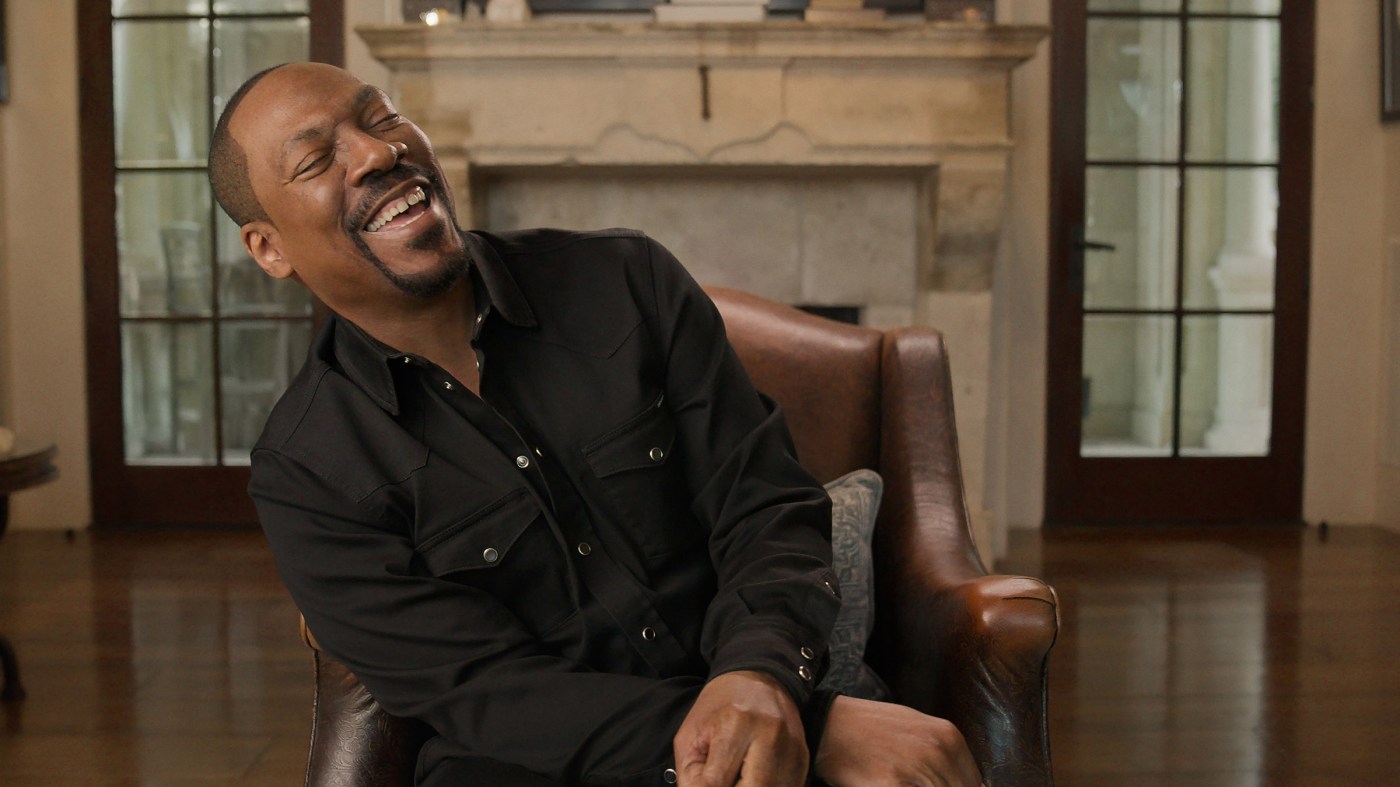
‘Being Eddie’ gets up close with comedy legend

LOS ANGELES — Eddie Murphy has solidly been established as Hollywood royalty after a decades-long career stretching from “Saturday Night Live” to “The Nutty Professor” to “Dreamgirls” and beyond.
A key hallmark of Murphy’s status is his voluminous gallery of offbeat characters — an impeccably attired prison convict, a clumsy professor, a wisecracking donkey, an elderly Jewish man and even an obese, abusive wife.
In Netflix’s “Being Eddie,” now streaming, Murphy lifts the veil on the persona he feels the closest to — Eddie Murphy.
Directed by Angus Wall (an executive producer of “The Greatest Night in Pop”), the documentary traces the meteoric rise and triumphs of Murphy, who seldom grants interviews and is fiercely private about his creative process and personal life.
With his trademark humor and probing insight, the entertainer offers candid perspective of his trajectory from a kid in New Jersey performing stand-up to joining “Saturday Night Live” right out of high school, his string of hit films (“48 Hrs.,” “Trading Places,” “Eddie Murphy Raw”) and his transition from foul-mouthed provocateur to family-friendly films.
He also addresses some of his misfires (“Vampire in Brooklyn”), and throws more than a little shade at “Saturday Night Live” and the Academy Awards (“I haven’t gotten an Oscar, and I’ve done everything”).
The film is largely set at Murphy’s castle-like estate, where he’s seen hanging out with his 10 children and second wife, Paige Butcher. (“My legacy is my children, not what I did at work,” he says. “My kids are the center of my life. It’s all about them… If you put your family first, you will never make a bad decision.”) Jerry Seinfeld, Dave Chappelle, Chris Rock, Kevin Hart and Pete Davidson are among the numerous entertainers who comment on Murphy’s influence on popular culture.
The following are some of the more fascinating takeaways from “Being Eddie.”
Though he was friends with hard-partying celebrities, Murphy has never touched drugs.
He recalled a night when he was 19 and going to a blues bar with fellow comedians John Belushi and Robin Williams, and “they put some blow on the table.” While hanging out with soul superstar Rick James during the 1980s, Murphy recalled making a quick exit “when certain people came into the room.”
“I was never curious about it,” he says. “I never tried cocaine or touched cocaine. I don’t drink, I don’t smoke cigarettes. I never smoked a joint until I was 30 years old.”
Others confirm Murphy’s low-key nature offscreen, including actor Jamie Foxx, who says, “Eddie is very introverted.” At a party, Eddie “will sit in the back of the room with a Coca-Cola.”
A joke by David Spade on ‘SNL’ upset him so much he stayed away from the show for decades.
On a 1995 “Saturday Night Live” segment of “Spade in America,” Spade showed a picture of Murphy and took a swipe at the box-office failure “Vampire in Brooklyn,” quipping: “Look, children, it’s a falling star. Make a wish.” The joke hurt Murphy: “It was like your alma mater taking a shot at you, at my career, not how funny I was.”
He noted that the joke had to go through several channels and producers before it aired. He distanced himself from the show as a result. Murphy took a break from show business in 2011 after a string of what he called “(expletive) movies.” But wanting to remind folks that he could still be funny, he decided to bury the hatchet with “Saturday Night Live,” returning to host in 2019: “‘SNL’ is part of my history. I need to reconnect with that show because that’s where I come from.”
He believes he had obsessive-compulsive disorder.
As a youngster, Murphy says he had a nightly ritual where he would repeatedly go into the kitchen and check the stove to see if the gas was on. He would also often hum a “goofy sound all the time.” He recognized those symptoms later while watching an expert on TV discuss OCD, and says he forced himself not to do it. However, he mentions repeating the behavior as an adult, though with less frequency.
His favorite TV shows are ‘Ridiculousness’ and ‘Seinfeld.’
“I think it’s the best show on television,” Murphy says of “Ridiculousness,” the MTV clip show that was recently canceled after 46 seasons. He compares the show to the work of Chilean-French avant-garde filmmaker Alejandro Jodorowsky. He added that he and his wife watch two episodes of “Seinfeld” each night before going to bed.
Murphy ditched his trademark laugh.
The infectious laugh that Murphy used in his films and stand-up is gone, replaced by a deeper, more guttural laugh. Murphy said he felt his previous laugh had become too much of a gimmick.
He has ventriloquist dummies of Bill Cosby and Richard Pryor, two major figures in his career.
At the end of the film, Murphy engages in humorous conversations with his dummies of Pryor and Cosby. Murphy idolized Pryor as a young comedian and wanted to be like him. As Murphy became more famous, Hollywood positioned them as rivals, especially after Pryor in interviews exhibited uneasiness with Murphy’s growing celebrity. Though Cosby was also an influence, he was offended by Murphy’s use of foul language in his comedy. Insulted by Cosby’s criticisms, Murphy got his revenge by doing a devastating impression of Cosby in “Eddie Murphy Raw.”
Tribune News Service
From left, Eddie Murphy with his brothers Vernon Lynch and Charlie Murphy. (Eddie Murphy/Netflix/TNS)


More Stories
Jackson Hole preview: US Fed’s Warsh to deliver keynote amid bond markets fears
In the wake of the recent Treasury intervention in the bond market and with another wave of inflation likely on...
Britain’s 240 crypto millionaires revealed in first HMRC cryptoasset tax data
Some 240 people declared more than £1 million each in capital gains from cryptoassets in the 2024 to 2025 tax...
UK business confidence rebounds but firms want policy certainty first
Confidence among British businesses has rebounded following the recent changes in Government, with 63 per cent now optimistic about the...
Young investors trust AI more than TV, radio or influencers, FCA finds
Young and less experienced investors now place more trust in artificial intelligence than in television, radio or social media influencers,...
EY urges junior staff back to the office as AI puts a premium on human skills
EY is urging its junior staff to get back into the office more often to sharpen the softer skills that...
Balcony solar panels reach UK shelves with promise of £110 a year off bills
Plug-in solar panels have gone on sale in the UK for the first time, with Argos this week becoming the...