
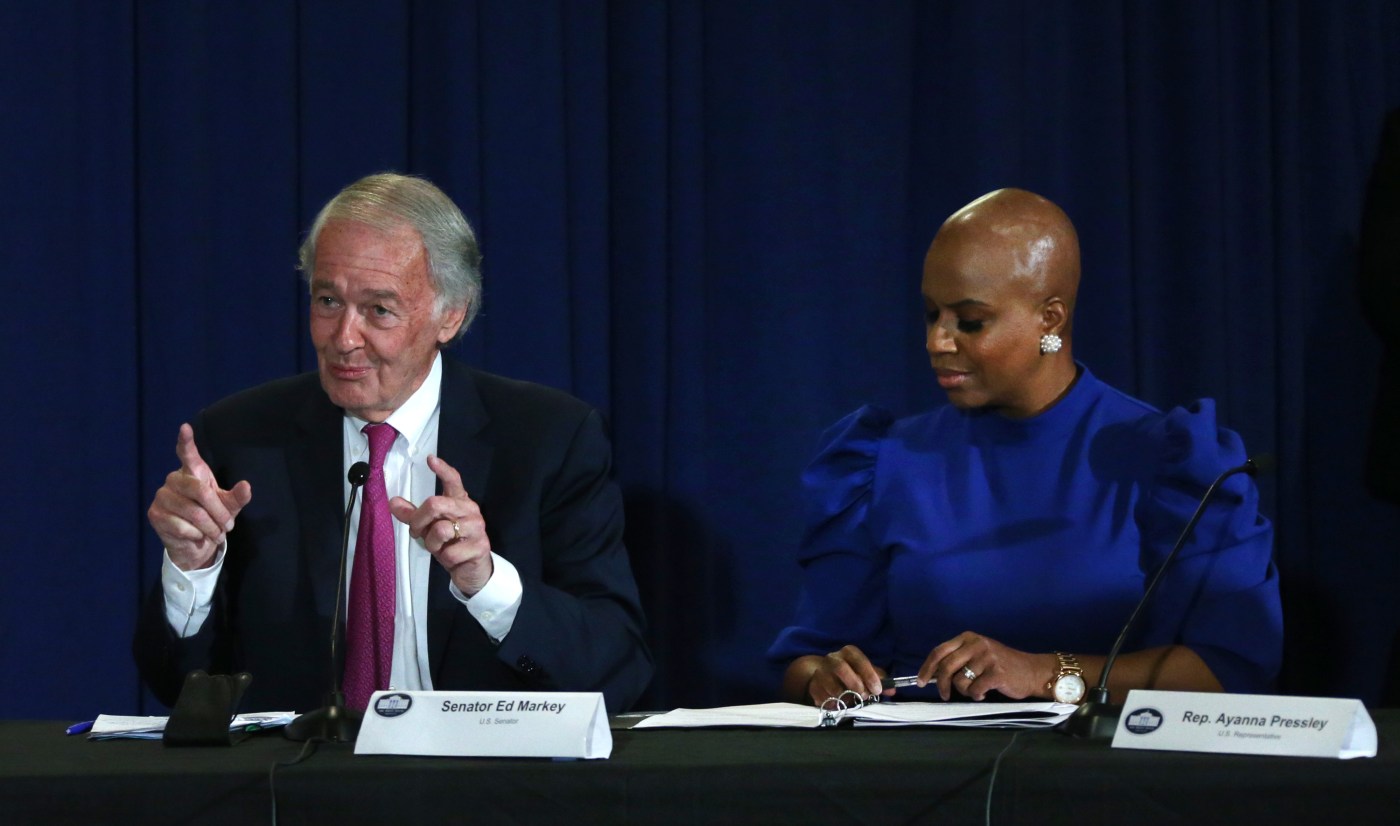
Ed Markey, Ayanna Pressley renew push for fare-free MBTA, public transit

U.S. Sen. Ed Markey and Rep. Ayanna Pressley refiled legislation that seeks to make public transportation fare-free for all users.
“Fare-free transit is an economic, racial, and climate justice issue, and it’s high time we invest in public transit as the public good that it is,” Pressley said in a Friday statement.
“Making our infrastructure fare-free will help folks access essential resources like jobs, school, child care, the grocery store, and the hospital while reducing greenhouse gas emissions and making our communities more connected.”
First introduced in 2020, the Freedom to Move Act would seek to make public transportation, including the MBTA, free by establishing a $5 billion competitive grant program to support state and local fare-free efforts, investing in infrastructure and safety improvements, particularly in low-income communities, and ensuring grant recipients use funds to address equity gaps in transit systems.
Markey and Pressley say the legislation builds on fare-free pilot programs in Boston and those through regional transit authorities across the state such as the Worcester Regional Transit Authority and Merrimack Valley Transit.
“All across Massachusetts and the country, more communities are joining the fare-free revolution,” Markey said in a statement. “By making public transit free, we can alleviate the high burden of transportation costs on working families while building a system that is more accessible and efficient.
“Free buses and trains also means less traffic congestion, cleaner air and a safer working environment for transit workers.”
Low-income families spend nearly 30% of their household income on transportation expenses. Traffic congestion has worsened greenhouse gas emissions and pollution, exacerbating climate change and contributing to health issues like asthma and lung cancer in “marginalized communities,” according a statement issued by Pressley’s office.
Boston Mayor Michelle Wu threw her support behind the proposed legislation, saying Friday that “free transit is an investment in the public good and in our economy and communities.”
Related Articles
MBTA board gets an earful over White Stadium transportation proposal
Data shows more than 100 MBTA employees made over $100k in overtime in 2024
GM Phil Eng pushes back on report about increased costs at the T
500 MBTA riders stuck on Blue Line train without A/C evacuated: ‘Really scary’
Study shows MBTA costs way up since spending control board disbanded
“Boston’s fare-free bus routes have had the highest ridership of the entire bus system, and we’ve seen improved service from buses being able to load faster at each stop,” Wu said in a statement. “Most of all, commuters no longer have to ration trips to connect all the pieces of their lives.”
Critics of fare-free public transportation have pointed to the MBTA’s financial struggles in recent years.
The MBTA Board approved a $3.24 billion fiscal 2026 budget that increases total expenses by $222 million, or 7%, last month, according to a State House News Service report. MBTA officials said the agency’s budget deficit is projected at $168 million in the FY26 budget.

More Stories
Russia sends three diesel tankers toward US
Deputy PM Alexander Novak has confirmed the first shipments under an agreement with Washington aimed at easing the global fuel...
How small businesses can outsource customer service without losing control of quality
An external team might answer the third message promptly. Unless that team can investigate the order or obtain a decision,...
Going Global Changes the Business: Are Your People Ready?
Attention turns to where to establish a presence, how to form alliances and what the financial rewards might be. But...
When Test Holes Pay Off: Choosing SUE Quality Levels by Risk
Subsurface utility engineering (SUE) exists to bridge that gap: it gives project owners a structured way to decide how much...
HMRC expects £12.9bn of tax debt to go uncollected, NAO says
HMRC expects £12.9bn of tax debt to go uncollected, three times the level recorded before the pandemic, according to a...
Retail sales fall 0.4 per cent as households cut back on food
Retail sales volumes in Great Britain fell by 0.4 per cent in September, according to figures published today by the...