
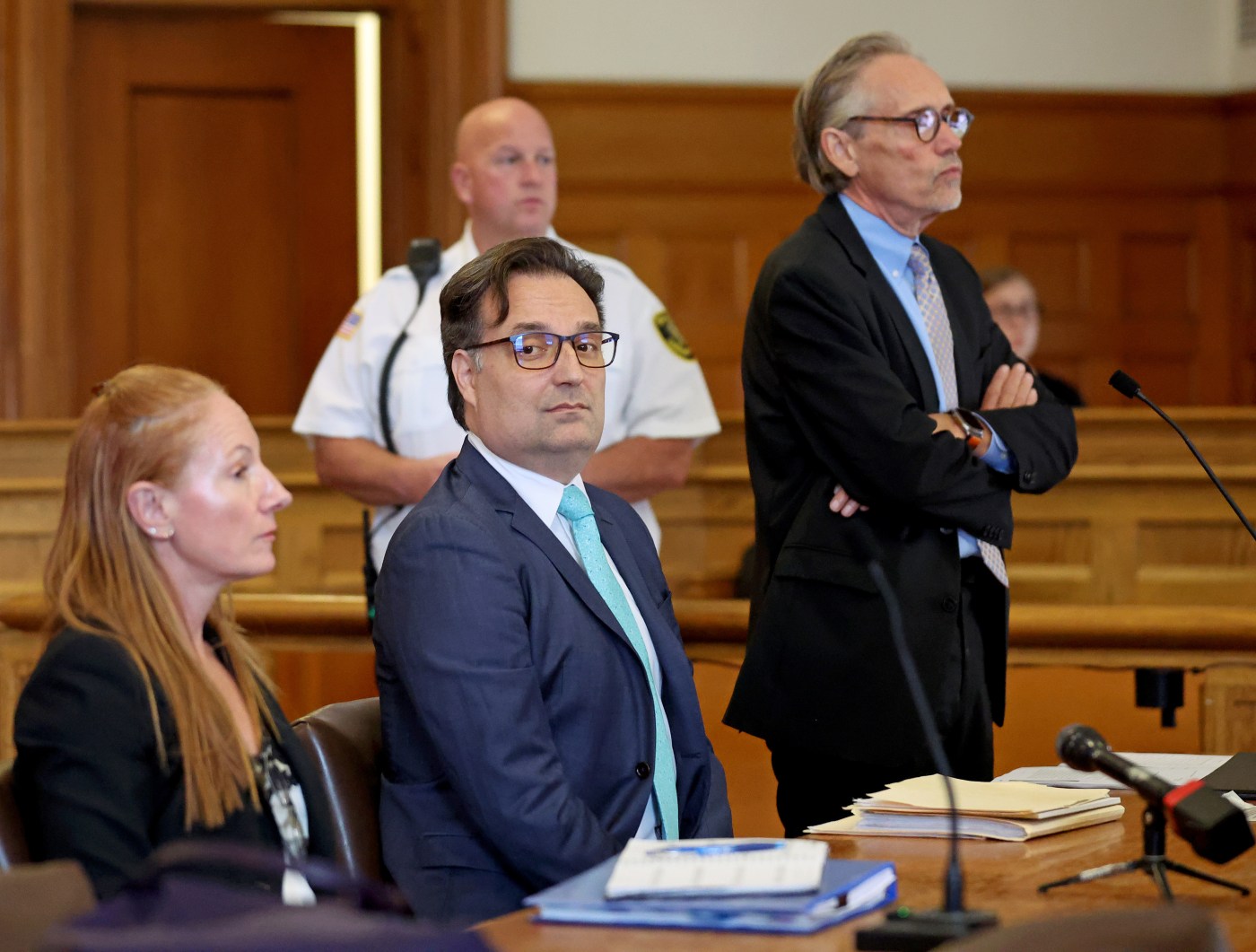
Brian Walshe’s attorney wants murder charge tossed, says evidence doesn’t show premeditation

Brian Walshe’s attorneys are asking to have his first-degree murder charge dismissed because they say his alleged gory Google searches came after his wife Ana Walshe’s death and do not indicate premeditation.
That was argued in a hearing Thursday that also gave some additional details on the shadowy federal court holdings of disgraced former State Police investigator Michael Proctor’s phone records.
Defense attorneys in several cases investigated by Proctor, including the Walshe case, want access to that information because it could contain evidence that would help or exonerate their clients.
Walshe dismissal argument
Walshe, of Cohasset, is charged with murdering his wife, Ana Walshe, on New Year’s Day 2023. Prosecutors say he dismembered her and made several trips to dumpsters around Greater Boston to dispose of her body and any physical evidence.
Not only does surveillance video show him picking up cleaning supplies at Home Depot and then making a large number of trips to dumpsters after his wife went missing, prosecutors say, but a set of grisly internet searches on how to dispose of a body informed the trip.
But Walshe defense attorney Larry Tipton says that those internet searches would have happened after the alleged murder took place, based on the prosecution’s own case as presented to the grand jury that indicted Brian Walshe for Ana Walshe’s murder. He said that the prosecution is unfairly relying on multiple, conflicting timelines of the case.
“So you can’t just throw … things against the wall and see what sticks then walk away and say the grand jury heard sufficient evidence,” Tipton said.
Tipton said prosecutors told grand jurors that Walshe’s son claimed to have last seen his mother at 6:30 a.m. — which is after some of the searches were made — but then go through an “enormous amount of effort to dispute” the child’s recollection, suggesting that Walshe coached his son on the timeline. But, Tipton says, to say that some of these searches were made before Ana Walshe was killed would have the prosecutors relying on a timeline they themselves disputed.
The reason this matters is because if some searches were made before Ana Walshe was killed, then it would be an example of premeditation, which is part of the definition for first-degree murder, for which Walshe is charged. First-degree murder, according to state law, would require it to be “committed with deliberately premeditated malice aforethought, or with extreme atrocity or cruelty.”
Prosecutors have also suggested that Brian Walshe was motivated to murder Ana Walshe because she was having an affair with a man in Washington D.C., where she worked. But Tipton says they have presented no hard evidence that Brian Walshe was aware of the affair before Ana Walshe died.
A prosecutor said that a search for “What’s the best state to divorce for a man?” — which did not cast Massachusetts favorably — ahead of Ana Walshe’s death shows a motivation built on a fractured relationship.
Finally, prosecutors say that Brian Walshe could have been motivated by the possibility of inheriting millions of dollars in life insurance benefits upon Ana Walshe’s death, and that alleged searches for luxury items just ahead of her death pointed toward dreaming of a windfall, especially since he was cash strapped due to his losing a federal art fraud case.
Judge Diance C. Freniere, who presided over the hearing, said she’ll take the arguments under advisement and did not rule immediately. The case is next due in court on Aug. 1 at 2 p.m. for a scheduled motion hearing.
The Proctor angle
Former Massachusetts State Police Trooper Michael Proctor’s downfall from the Karen Read murder case continues to ripple through Norfolk County criminal cases — including the Walshe case.
Last week, on July 17, defense attorneys received a notice from the Norfolk District Attorney’s office that it would be destroying the iCloud materials related to Proctor’s work and personal phones — materials that defense attorneys said they didn’t know about, let alone its impending destruction, so they raced into court to call for emergency preservation of the materials.
Proctor was fired from the MSP earlier this year due almost entirely to his behavior during the investigation into the death of Boston Police Officer John O’Keefe, which led to Read being charged with murder.
During Read’s first trial last year, Proctor admitted to “inappropriate” text messages regarding the defendant to his friends and colleagues. He was first placed on leave immediately after that trial ended and then fired ahead of Read’s second trial, after which she was acquitted of the murder.
Now defense attorneys say materials on that iCloud account might also free their clients, but the trouble is that access to the materials is governed by the federal court, so they don’t actually know what’s there.
Emergency hearings last week showed that only the DA’s office had access based on the original rules and that further allowances were governed by a protective order that was itself protected, so not even the judge could read it. Judge Peter Krupp said last week he was uncomfortable writing an order that would contradict a federal judge order he hadn’t even been able to read. Proctor didn’t show after being subpoenaed to testify in court on Monday.
The end of Thursday’s Walshe hearing indicated that there could be some movement on getting materials from that iCloud archive, but that things remain unclear.
The issue is set to be discussed again in court on Friday at 2:45 p.m.
Courtesy / Cohasset Police Department
Ana Walshe (Courtesy/Cohasset Police Department)



More Stories
Billionaire David Reuben leaves UK for Monaco
David Reuben, the property tycoon who shares second place on this year’s Sunday Times Rich List with his brother Simon,...
Deliveroo to roll out delivery robots in five UK locations
Deliveroo is to begin using pavement robots to deliver takeaways and groceries in the UK, with its first robot deliveries...
UAE threatens to pull billions from UK over Man City ruling
The United Arab Emirates has warned the government it could cancel billions of pounds of investment in the UK over...
Richard Megson on why people, not AI, will fix the home-moving process
Richard Megson is managing director of ASAP, the Pontefract-based business he co-founded with conveyancer Tony Hill to provide outsourced sales...
Dr Nilesh R. Parmar on the business of dentistry and delegating
Dr Nilesh R. Parmar is clinical director of Parmar Dental, the Essex dental group that the company says was founded...
Russian businessman accuses Biden of stealing his money
Moscow has opened a criminal case over the seizure of Konstantin Malofeev’s US assets and the transfer of some of...