
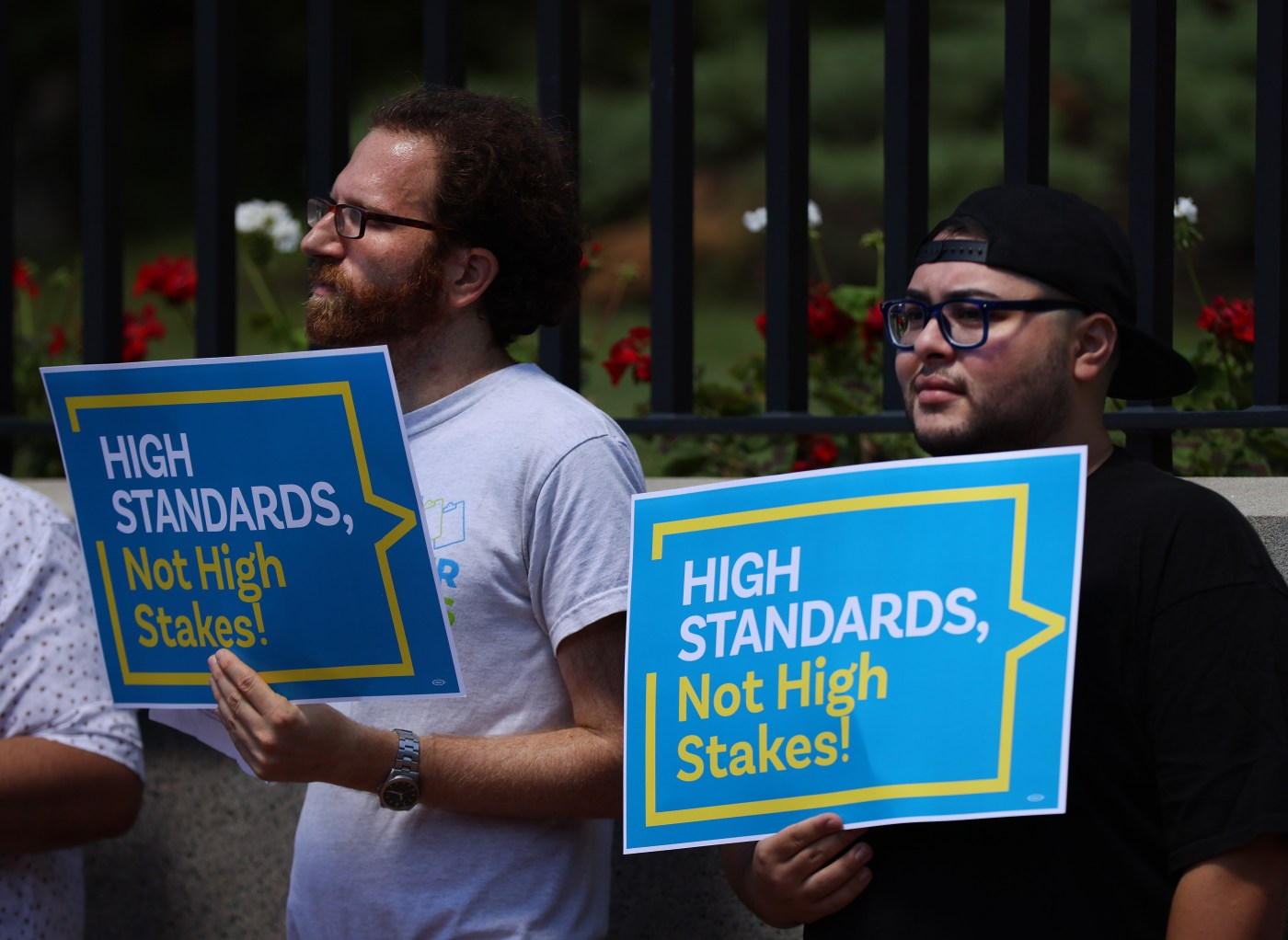
MCAS ballot question supporters pay $4K penalty to resolve late reporting accusations

The group that backed a successful ballot question to end the use of the MCAS as a high school graduation requirement paid a $4,000 penalty to resolve accusations that officials did not report $2.3 million in contributions in a timely manner ahead of the November 2024 election.
The fight between the Massachusetts Teachers Association and business groups over the fate of the MCAS was the most expensive ballot question battle in Massachusetts during the 2024 election cycle, with tens of millions flowing between the two sides, according to state records.
But campaign finance regulators said the Committee for High Standards, Not High Stakes — which was largely backed by the MTA — did not report $800,000 in monetary donations and more than $1.5 million in in-kind contributions in the days leading up to the election.
“Although the committee accurately disclosed all of these contributions in its November 5th report, the committee’s failure to file the required late contribution reports frustrated the public’s interest in accurate and timely disclosure of campaign finance activity during the relevant period,” Office of Campaign and Political Finance Director William Campbell wrote in a June 24 letter.
A spokesperson for the Massachusetts Teachers Association did not immediately provide a response to a Herald inquiry Tuesday.
Ballot question committees must file reports with state regulators if they receive a contribution of $500 or more during what’s known as the “late contribution reporting period” that began Oct. 19, 2024, and ended Nov. 1, 2024.
The reports are designed to document cash flowing in and out of ballot question committees in the days just before an election, when spending can reach staggering amounts as supporters and opponents try to sway voters with last-minute pitches.
State regulators said the committee backing the MCAS ballot question received “a number of contributions” during the later reporting period, and filed two reports documenting the spending on Oct. 25, 2024, and Oct. 26, 2024.
But the group did not disclose that it had received 11 contributions totalling $2.3 million during the late reporting period, according to regulators. The ballot question committee ultimately reported the fundraising in a report that was due on Election Day, OCPF officials said.
“The receipt and utilization of these eleven contributions should have been disclosed in late contribution reports, due within 72 hours of receipt or utilization,” Campbell said in his letter. “Since multiple late contributions can be reported on a single report, at a minimum, four additional reports should have been filed.”
The Committee for High Standards, Not High Stakes reported spending $950,000 across 2023, 2024, and 2025 to back the question and receiving more than $15.6 million in in-kind contributions for goods or services, state data shows.
Opponents to the question, largely business groups who formed the Protect Our Kids’ Future ballot question committee, spent $5.3 million in 2025 and 2024 and another $93,763 in in-kind contributions in 2023, according to state data.


More Stories
Shein overtakes Asos as UK sales rise 26 per cent to £2.58bn
Shein, the online fast-fashion retailer founded in China, increased its UK sales by 26 per cent to £2.58bn last year,...
David Phillips on how Pangolin grew from £3,000 into an award winner
David Phillips is co-founder and CEO of Pangolin, the creative PR and communications agency he set up in 2013 with...
Frasers to close Harvey Nichols Birmingham with at least 60 jobs lost
Harvey Nichols’ Birmingham store is to close in January with the loss of at least 60 jobs, as its owner...
Carlsberg Britvic plans to close Marston’s Brewery, risking 310 jobs
Carlsberg Britvic has proposed closing Marston’s Brewery in Burton upon Trent in summer 2027, putting about 310 jobs at risk...
Virgin shows first cross-Channel train and plans 20 daily services
Virgin Group has released the first image of the high-speed train it plans to run through the Channel Tunnel and...
E.ON Next completes Ovo Energy takeover to create ‘big three’
E.ON Next completed its takeover of Ovo Energy yesterday, giving the supplier 25 per cent of Great Britain’s household energy...