
Officials blast cancelation of climate grants in Chelsea, Everett

Officials in Chelsea and Everett blasted a Trump administration decision to cancel a flooding mitigation grant awarded under a program the president himself signed in his first administration, saying the zeroed out award will put the communities at risk.
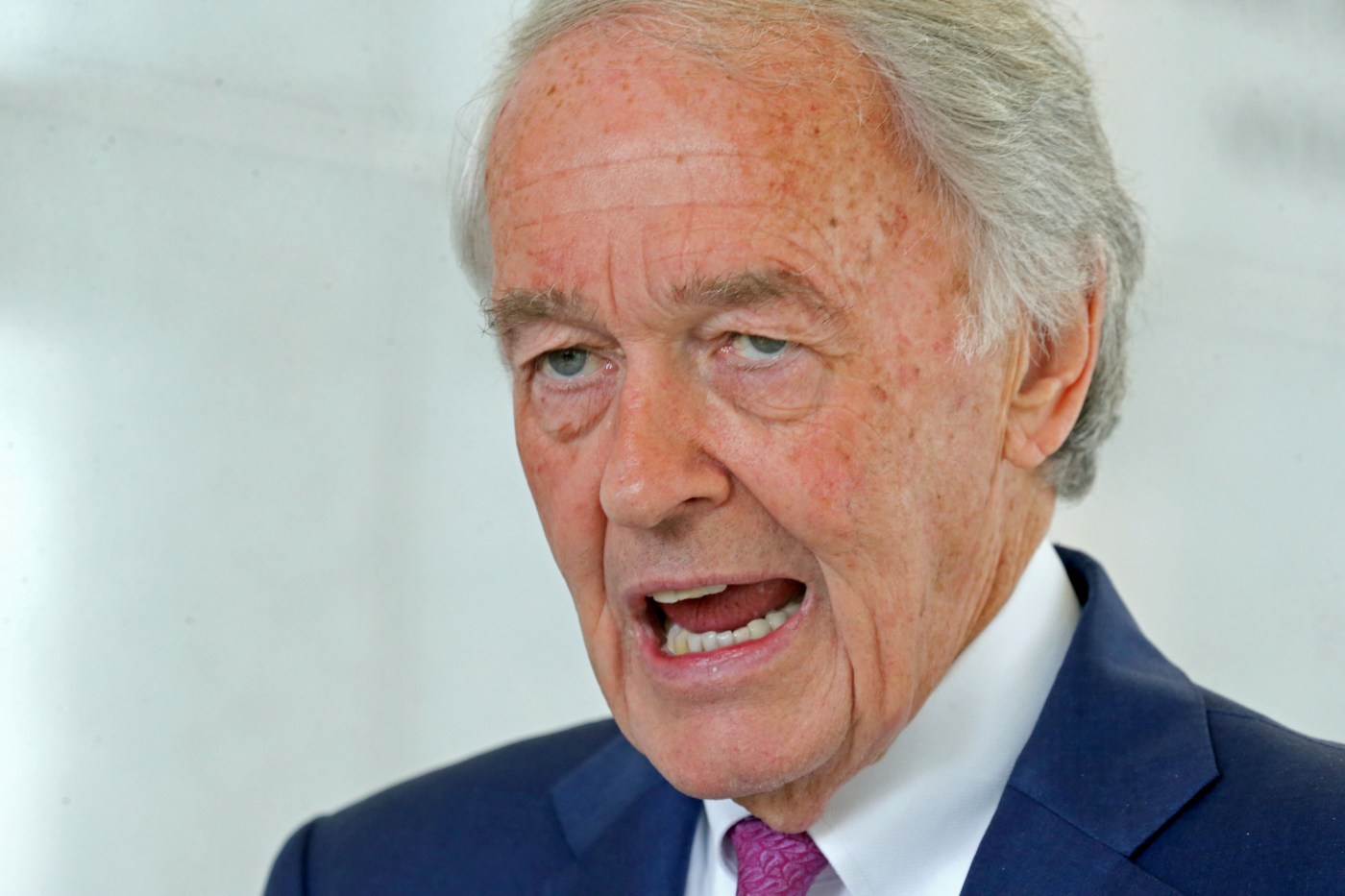
U.S. Sen. Ed Markey, along with Chelsea City Manager Fidel Maltez, State Sen. Sal DiDomenico, and State Rep. Judith Garcia, gathered in Chelsea Wednesday with community advocates to call out the Trump over the administration’s April decision to claw back funds designated for Building Resilient Infrastructure and Communities grants, or BRIC grants, which were first implemented by Trump and expanded in 2021 under former President Joe Biden’s Bipartisan Infrastructure Law.
According to Markey, the current administration’s April 4 decision to cancel all BRIC grants is akin to “ripping the rug from underneath communities who rely on this funding and putting projects across the Commonwealth — but right here in Chelsea and Everett — at risk.”
The pair of Bay State cities stand to lose on out $50 million in already-awarded federal funds slated for use on their Island End River Coastal Flood Resilience Project, which includes plans to construct a storm surge barrier and storm surge control facility to mitigate flooding. The Bay State as a whole is facing $90 million in BRIC grant cuts.
Economic analysis performed by the Metropolitan Area Planning Council found flooding at Island End River, which is home to more than 5,000 people, “could result in a loss of $2.3 billion in annual economic activity and 11,000 jobs.” Not carrying through with the project, which was due to break ground next year, will mean that the area could see flooding “almost weekly by the year 2030, and as much as twice per day by 2050,” Markey said.
“That nightmare is not an option — not for Chelsea, not for Everett, not for Massachusetts — we have to do something about it,” Markey said.
According to DiDomenico, they were doing something about it, and responding to the decades of industrial dumping in communities like Chelsea and Everett with a climate resiliency project represented the government’s “moment” to show up and demonstrate their commitment to their constituency.
The Legislature worked for years to cobble together the funding required to cover the state’s share of the $120 million project cost, he said. After “we got that money,” the state senator said, the Healey-Driscoll Administration “unlocked” those funds by pursuing matching federal grants and the Biden Administration met them in the middle.
“So we have the funds at the state level, and we did have the funds at the federal level, to make a difference and make this project move forward,” he said.
That was then.
Now Congress is trying to find ways to cover the cost of “tax breaks to billionaires” contained in the President’s “big beautiful bill,” DiDomenico said, and federal grant funding seems to be an easy victim of that search for potential cost cutting.
“Now we have to keep fighting,” he said, before advising people to “have no fear.”
“Chelsea and Everett are resilient communities — we don’t give up easily,” he said.
In announcing the grant cancellation, a spokesperson for the Federal Emergency Management Agency said that the spending was identified by the Trump Administration as “yet another example of a wasteful and ineffective FEMA program.”
The BRIC grant funding was first approved by a Republican controlled Congress and signed into law by Trump as the Disaster Recovery Reform Act of 2018. In implementing that law, FEMA set aside $500 million to “build a culture of preparedness” in response to an increasing number of climate change driven natural disasters.
Toward the end of Trump’s previous term in office, FEMA even hosted a “Summer Engagement Series” for local officials aimed at equipping “states, local governments, tribes and territories” with the tools required to apply for grants to cover the cost of disaster “mitigation activities.”
“FEMA is excited about BRIC’s potential to help communities proactively reduce their vulnerability to natural hazard events, and in turn, make the nation more resilient,” the Trump administration said in a release issued on Sep 25, 2020.
However, according to the current Trump administration, the grant program went off course somewhere along the way, eventually becoming “more concerned with political agendas than helping Americans affected by natural disasters.”
The 47th President’s Administration, they added to their grant-cancellation announcement, is nevertheless apparently “committed to ensuring that Americans in crisis can get the help and resources they need.”


More Stories
US threatens EU with ‘devastating’ retaliation over Starlink restrictions
The bloc has proposed reserving satellite spectrum for local firms, potentially limiting access for foreign players such as Elon Musk’s...
Hate the new Jaguar? Good. That’s rather the point
Most Sunday mornings in winter, I can be found in a cold garage doing what owners of classic cars do...
Beyond the Microphone: British Comedians Who Became Directors and Presenters
Stephen Merchant co-created The Office and went on to write and direct for the cinema. Simon Amstell writes and directs...
Top 10 Best Hair Transplant Doctors in Turkey: A 2026 Guide to Surgeons
This guide names the top 10 best hair transplant doctors in Istanbul for 2026 and explains, in plain terms, how...
How to Choose an HR System for a Growing UK Business
For a while, email and spreadsheets seem good enough. Then managers start asking where the latest file is, staff have...
Top 10 Best Hair Transplant in Turkey
Turkey has become one of the world’s most familiar destinations for hair restoration, with Istanbul attracting patients from Europe, the...