
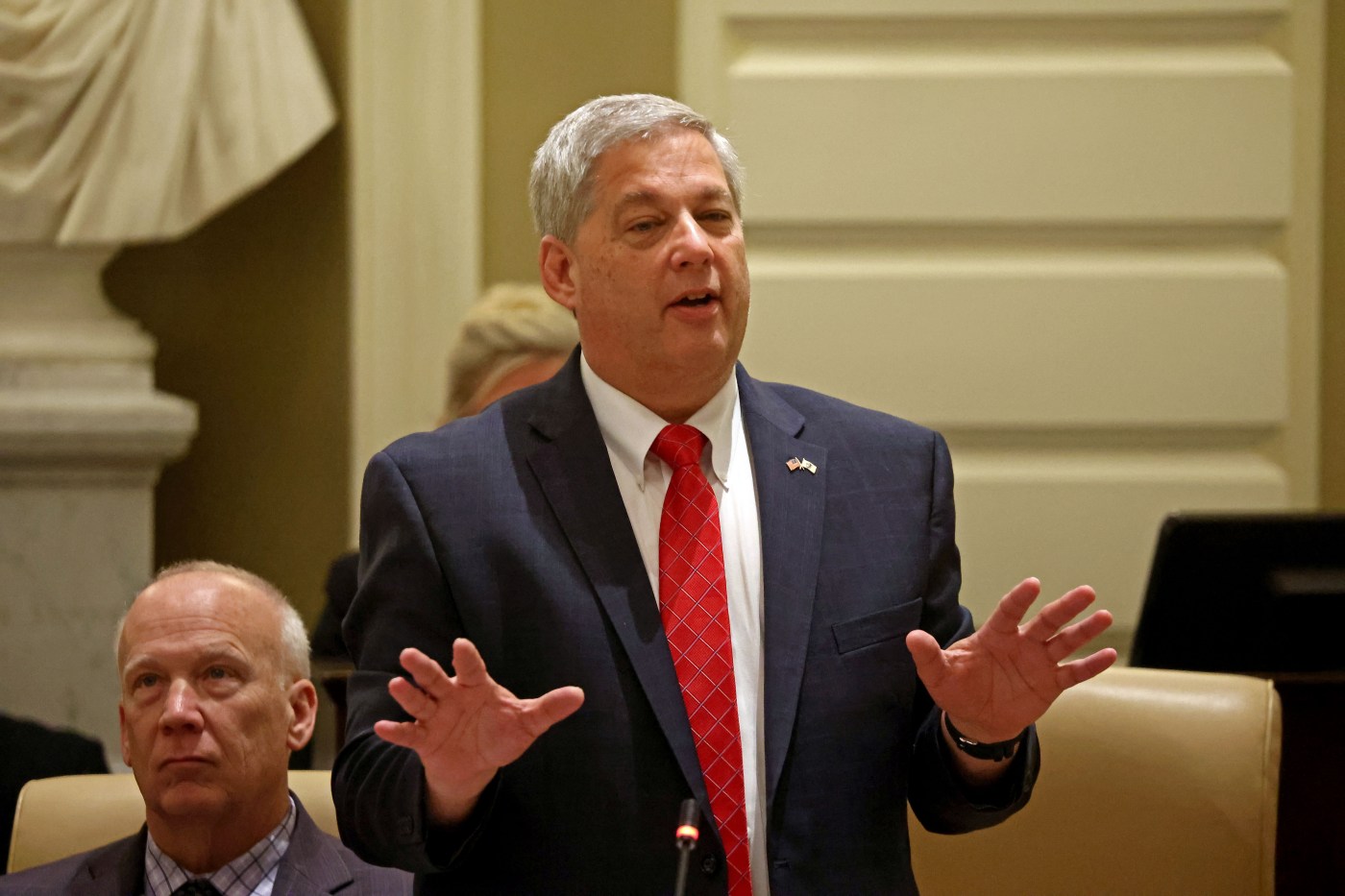
Maura Healey’s hiring freeze begs the question of who should follow suit: Bruce Tarr

The Bay State’s executive branch hiring freeze went into effect on Tuesday, and the idea has got one member of the State Senate wondering if the chill should spread to other parts of the state payroll.
According to Senate Minority Leader Bruce Tarr, Gov. Maura Healey’s May 14 announcement that she would take a “proactive step” to manage spending amidst uncertain economic headwinds by preventing new hires just goes to show how much costs can be cut by not splurging on new personnel.
“The governor has illustrated the impact of personal costs on the state budget by implementing a hiring freeze,” he told the Herald.
Healey’s freeze, according to the governor, came in response to uncertainty coming out of Washington, D.C., where President Donald Trump is waging a one-man trade war with most of the world while simultaneously putting the states on notice that they won’t be getting promised federal funding.
“The people of Massachusetts expect us to protect and maximize their tax dollars, and that’s exactly what we’re doing,” Healey said earlier this month. “Tariffs and funding cuts from Washington are causing so much economic damage and instability. We are taking this step to prepare for more uncertain economic times, protect taxpayer dollars, and move our state forward while ensuring funding will be available for the vital services people need.”
Her reaction, Tarr said, begs the question of whether a hiring freeze could make a difference elsewhere in state government.
“A serious question remains as to whether the quasi-public agencies will take similar action to control costs in the face of an uncertain future, and the costs that could be avoided by not filling open positions, many of which are highly compensated,” he said.
Massachusetts maintains dozens of so-called quasi-public agencies which are both part of the state government and simultaneously self-managing.
Among them are Massport, the Convention Center Authority, the Cannabis Control Commission, the state Ethics Commission, the Gaming Commission, the Massachusetts Water Resources Authority, the Comptroller’s and Inspector General’s offices, and the POST Commission.
This is not the first look at the agencies that Tarr has taken this year. When the State Senate passed their version of the fiscal 2026 spending plan last week, the budget bill included an amendment offered by the Gloucester lawmaker which would require those agencies to publicly disclose their salaries.
Some of the agencies already do so, but Tarr’s proposal would require such disclosure from all quasi-public agencies and would establish a dashboard where people could see where their tax dollars are going and view audits of the agencies.
“Quasi-public agencies perform public functions, and shouldn’t operate in the shadows. Their payroll information should be subject to public scrutiny, just as it is for every other public employee of the Commonwealth,” the Republican told the Herald.
Healey’s office did not immediately respond to comment.
More Stories
Henry Gabay Started Duet Group With $10 Million. Two Decades Later, It Managed More Than $5 Billion.
By the time Financial News reported on the firm’s 2013 results, that early bet had compounded into one of the...
Planning an Antarctica Cruise Tour
Poseidon Expeditions runs its Antarctica program aboard the 114-passenger M/V Sea Spirit, an ice-strengthened ship led by a team of...
Vincent “Vinny” Colardi on Running, Music and Making Room for Different Passions
Between his career, playing guitar, writing music, running, and exploring his interest in food, Colardi has built a life around...
Why the Rolex Air King Makes More Sense in an Era of Lookalike Luxury Watches
Dials in black, metal bracelets, highly readable markings, and sport-inspired cases are common throughout many current product ranges, while social...
Viriora Expands Online Trading Access Across Forex, Stocks and Crypto Markets
The platform is designed around a broad selection of markets, with published information about available instruments and trading conditions. More...
Markets too ready for conflict over Taiwan – US diplomat
Investors are overestimating the threat of a military confrontation over the island, Michael DeSombre has told CNBC Investors are exaggerating...