
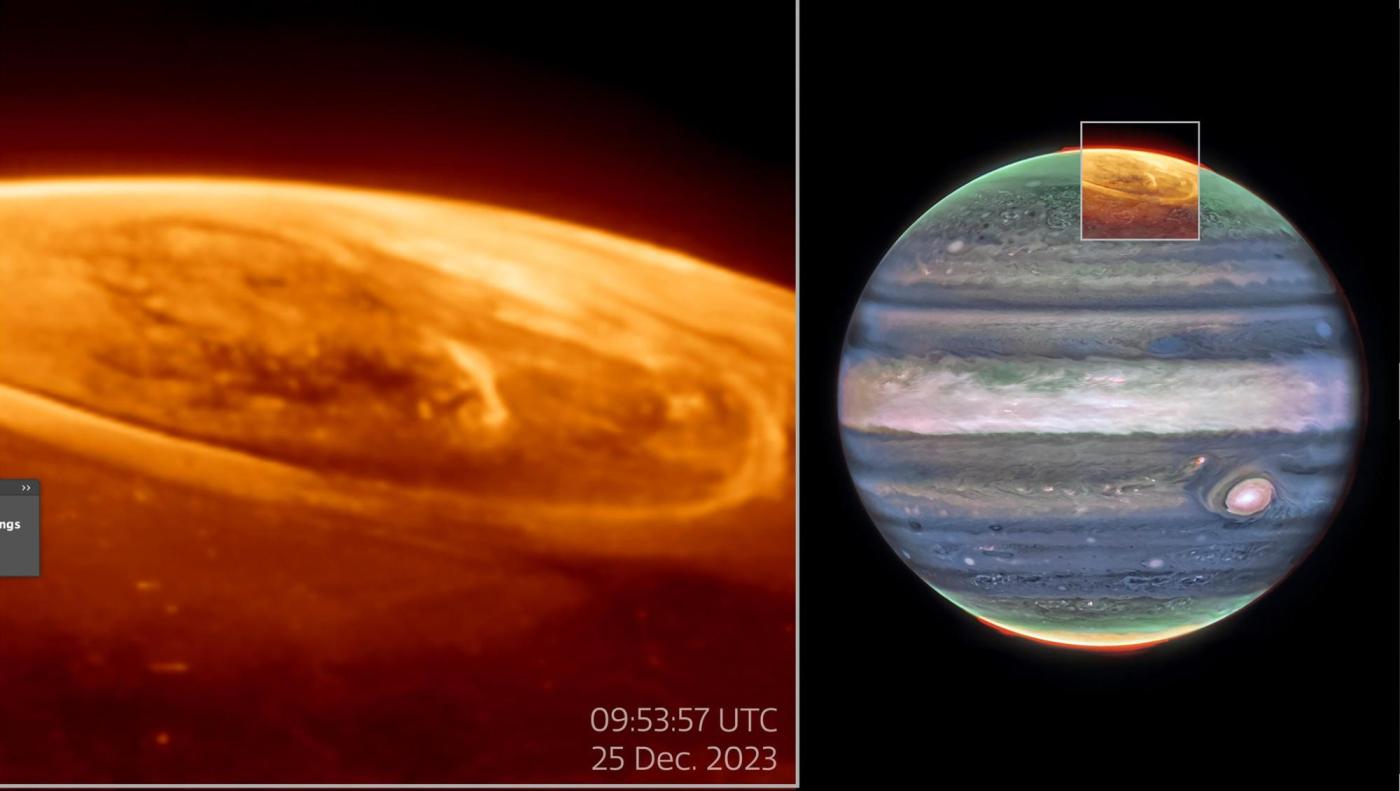
Bright auroras on Jupiter are captured by Webb Space Telescope

By CHRISTINA LARSON, AP Science Writer
WASHINGTON (AP) — Jupiter’s dazzling auroras are hundreds of times brighter than those seen on Earth, new images from the James Webb Space Telescope reveal.
The solar system’s largest planet displays striking dancing lights when high-energy particles from space collide with atoms of gas in the atmosphere near its magnetic poles, similar to how the northern lights are triggered on Earth.
This image provided by NASA shows new details of the auroras on Jupiter captured by the James Webb Space Telescope. (NASA via AP)
But Jupiter’s version has much greater intensity, according to an international team of scientists who analyzed the photos from Webb taken on Christmas in 2023.
Related Articles
Chimpanzees drum with regular rhythm when they beat on tree trunks, a form of ancient communication
US infant mortality dropped in 2024. Experts partly credit RSV shots
Dog data may help track dangerous disease for humans
Europe launches a drive to attract scientists and researchers after Trump freezes US funding
Scientific societies say they’ll do national climate assessment after Trump dismissed report authors
Webb previously captured Neptune’s glowing auroras in the best detail yet, many decades after they were first faintly detected during a flyby of the Voyager 2 spacecraft.
The Associated Press Health and Science Department receives support from the Howard Hughes Medical Institute’s Science and Educational Media Group and the Robert Wood Johnson Foundation. The AP is solely responsible for all content.


More Stories
London’s share of first-time equity deals falls to 44.6 per cent
The majority of companies raising equity for the first time are now based outside London, according to research from Beauhurst...
Legal & General to cut 1,000 jobs by mid-2027 to simplify operations
Legal & General is to cut about 1,000 jobs by the middle of next year, around 10 per cent of...
Kimel Law Group: focused counsel for Ontario’s estate disputes
Founded in 2021 by Katherine Kimel, the firm has grown from a single practitioner into a team of lawyers and...
German chemicals giant reveals details of downsizing
Evonik plans site closures and thousands of job cuts amid industry-wide structural crisis German chemicals giant Evonik is overhauling its...
Rising Presenteeism? Your Employees’ Lunch Could Be to Blame
Ask most SME owners what’s eating into their productivity and you’ll hear about hybrid working, recruitment costs, or the ever-present...
OECD raises UK growth forecast to 1.1 per cent for 2026
The UK economy will grow by 1.1 per cent this year, according to new forecasts from the Organisation for Economic...