
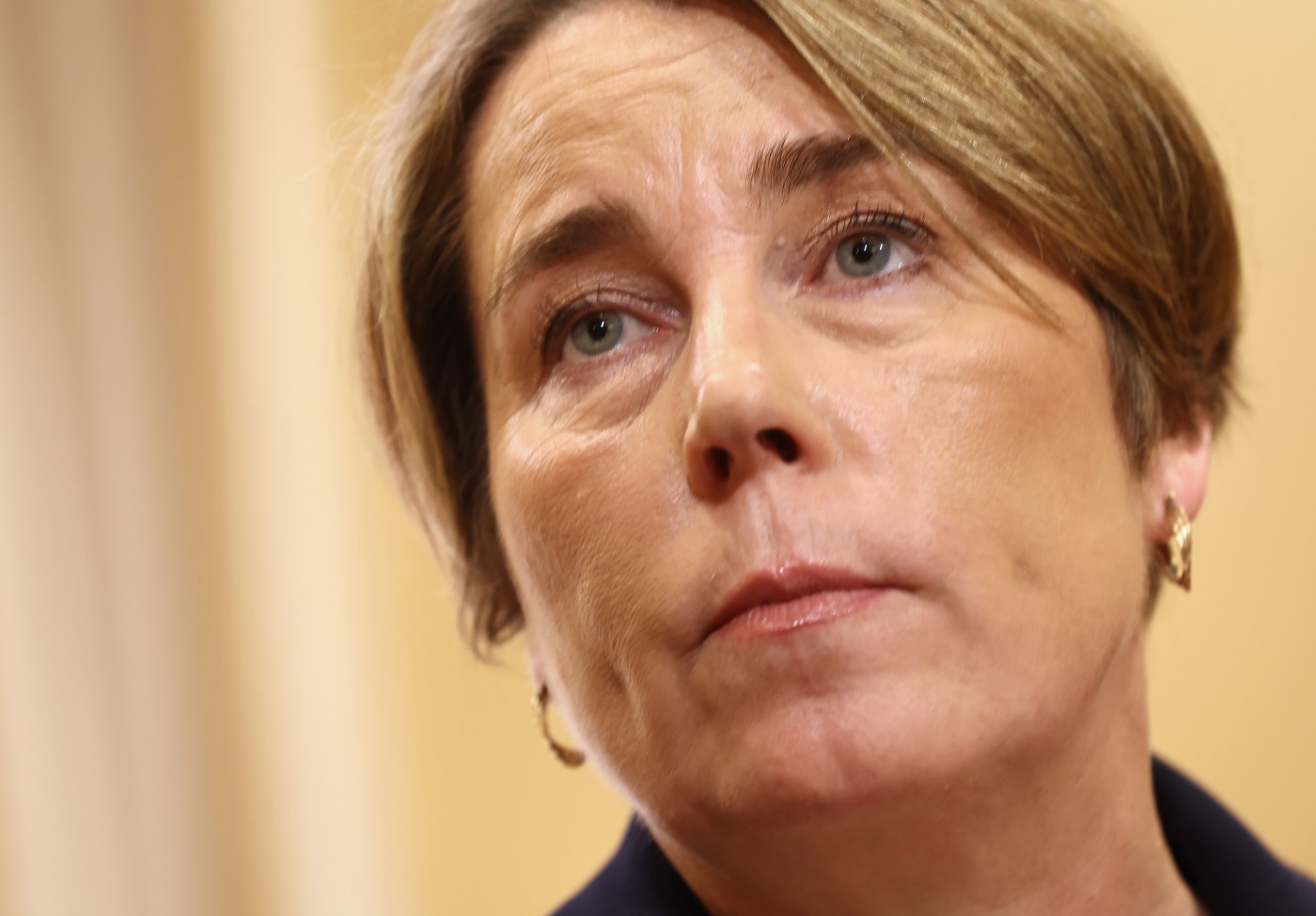
‘Raging moderate’: Is Gov. Maura Healey tacking toward the center ahead of the 2026 gubernatorial race?

Tax cuts. Cutting red tape. Deregulation. Making life easier for businesses. Cracking down on free benefits for newly-arrived migrants. A pledge to work with the Trump administration.
Those are key issues that Massachusetts conservatives have long championed. But they have also been touted over the past month as top priorities for Gov. Maura Healey, a first-term Democrat from Arlington who has not yet said whether she plans to run for reelection next year.
Leaning heavily on moderate stances that could play well to voters who helped drive President Donald Trump back to the White House and shift parts of New England to the right comes as Healey is staring down the 2026 gubernatorial race, when Republicans have pledged to put up a fight for the state’s executive office.
Rob Gray, a veteran political strategist who worked on campaigns for Baker and Mitt Romney, said Healey knows Baker was reelected overwhelmingly — he earned 66% of the vote in 2018 and 48% in 2014 — “by governing and speaking as a raging moderate.”
“Baker was just right of center, which is a comfortable spot for Massachusetts voters, and it seems like Healey is trying to be just left of center and mimic Baker, but from the Democratic side,” Gray told the Herald this week in an interview.
In her second State of the Commonwealth address earlier this month and in a speech to the business community this week, Healey repeatedly said she wants to make it easier for people to do business in Massachusetts.
Part of that push, she said, includes not assuming “that all our regulations and permitting process make sense.” Healey said she would direct her economic team to review all business and licensing regulations in the first three months of the year.
“Our goal is to find and eliminate needless red tape. And if you have barriers you’d like to propose removing, we are listening. When we see anything that doesn’t make sense, we’re going to work to fix it,” Healey told the Associated Industries of Massachusetts, the state’s largest business group.
Healey has also spent the better part of her time in office touting a $1 billion-a-year series of tax cuts that Baker had pushed for in his final moments in office and that progressives have argued largely serve people with higher incomes. The governor has defended them as “absolutely essential.”
Progressive Massachusetts Policy Director Jonathan Cohn said Healey “trying to stress a … more conservative rhetoric,” especially around taxes, is a “misread” of the political climate in Massachusetts.
“Where she is often most comparatively conservative to other Democrats is on economic issues,” Cohn said. “It’s also an area where she didn’t do a lot as an attorney general because that’s an area of policy that is less day-to-day. Even though you’ll have some anti-monopoly work it’s not as, let’s say, core to some of the top priorities in the job.”
Healey did roll out a fiscal year 2026 budget this week that increased spending by 7.4% over the current year’s budget and included a series of tax increases on candy, complimentary hotel rooms, and synthetic nicotine products.
The governor has also used major speeches and public appearances over the past month to pledge that she will work with the Trump administration but “not change who we are.”
It is a departure from her time as attorney general during Trump’s first term when she sued the president nearly 100 times.
Wendy Wakeman, a Republican strategist in Massachusetts, said she believes Healey has been pitching herself toward the right from where she stands now and “talking in some very conservative ways.”
“I do think it’s with 2026 in mind,” Wakeman said. “Massachusetts voters, again and again, have shown that they love the Democrat supermajority they have going on but they’re willing to put a Republican governor in there.”
Healey has shifted her priorities on state-run emergency shelters, a taxpayer-funded system set up under a 1980s law that sought to give immediate, temporary housing to pregnant women and families with children who were facing homelessness.
The shelter system has come to house thousands of migrant families and cost taxpayers $856 million in fiscal year 2024 and an expected $1 billion in the current fiscal year — massive tabs that have put pressure on budget writers and the Healey administration to curb expenses.
Nearly a year and a half ago, when the shelter system was first starting to buckle, Healey said state officials would meet migrant families with compassion and resourcefulness while also trying to “remain unwavering in our commitment to being a state and a people of compassion, safety, opportunity, and respect.”
But in the time since, the governor has put in place a series of restrictive policies to cut down the number of families in shelters.
And this month, she called on the Legislature to pass new rules that would keep out migrants, including by implementing a three-month residency requirement that Republicans had long supported. Some top Beacon Hill Democrats have questioned the policy.
Jerold Duquette, a professor of political science at Central Connecticut State University and co-author of the MassPoliticsProfs blog, said politics has made the shelter issue worse and Healey has had to adjust “both in terms of how to manage it and how to manage it politically.”
“If you’re a professional politician who has to solve problems, you have two levels of every problem. You have to solve actual problems, and you also have to keep them politically solvable,” Duquette said. “That’s something that the average person totally does not accept.”

More Stories
Bailey says firms are cutting costs and margins to absorb energy bills
British businesses are cutting costs, reducing headcount and absorbing higher energy bills in their profit margins rather than passing them...
Intuit to buy British AI start-up Sequence in reported $200m deal
Intuit, the American software company, has agreed to buy Sequence, a British financial technology business, in a deal estimated to...
More than 200 bosses urge Healey to overhaul business rates
More than 200 employers have written to the Chancellor, John Healey, calling for an overhaul of business rates at his...
Getting to know you: Ross Cafferkey, founder and CEO, Research Clever
Ross Cafferkey is the founder and CEO of Research Clever, a bootstrapped London market research agency that provides survey programming,...
Getting to know you: Alex Postlethwaite, founder, Pebblio
Alex Postlethwaite is the founder of Pebblio, a web app that helps friends and family put interest-free loans in writing,...
Getting to know you: Steve Rowbotham, founder, Navigator
Steve Rowbotham is the founder and CEO of Navigator, a London-based travel commerce media business that aggregates more than 2bn...