
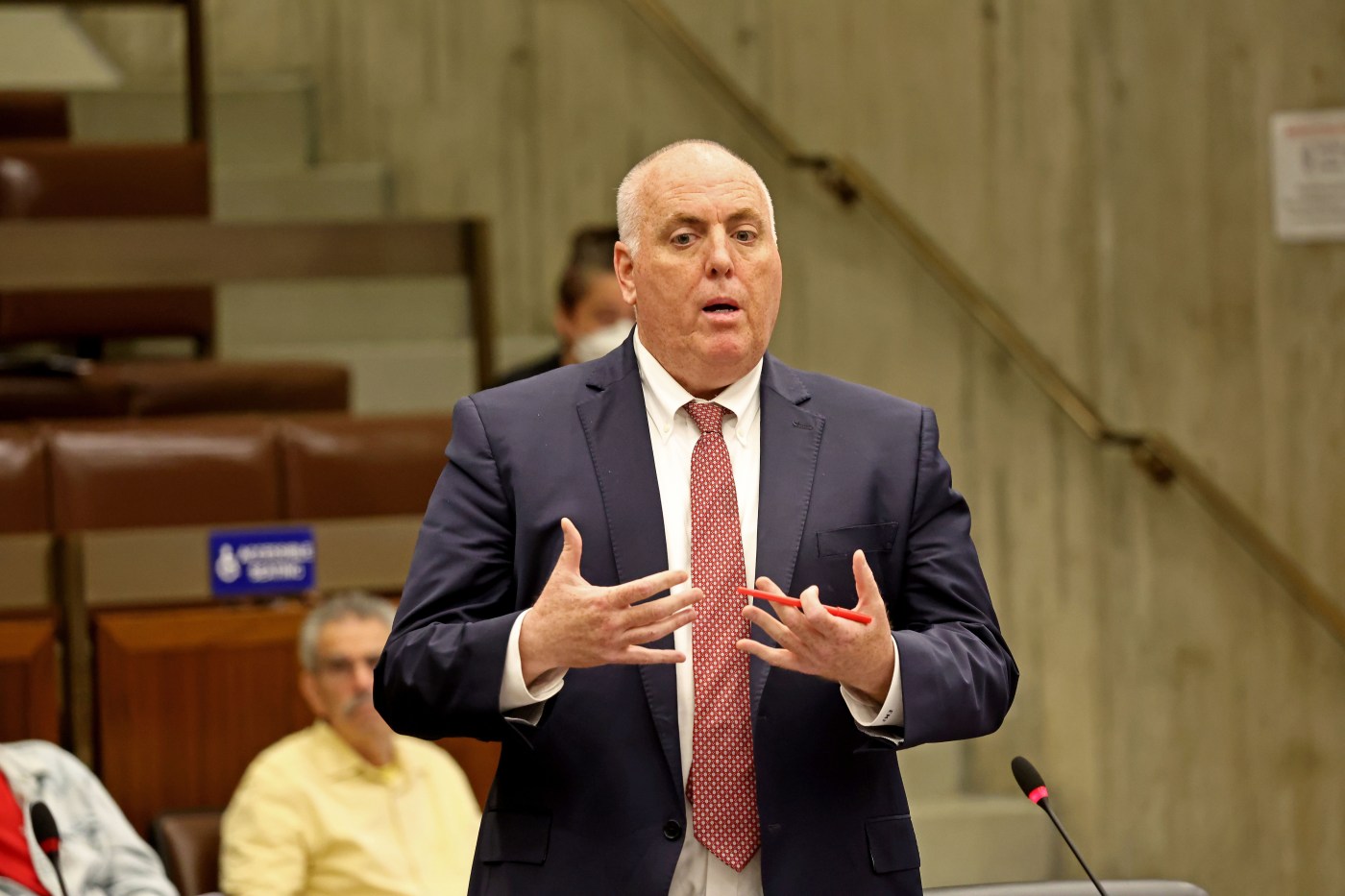
Boston city councilor pushes to review 50-year-old residency requirement to mixed reactions

A Boston city councilor is questioning whether the city’s decades-old residency requirement for municipal employees still makes sense at a time when salaries have not kept pace with rising housing costs.
Councilor Ed Flynn plans to introduce a hearing order at the Wednesday Council meeting, calling for a discussion on whether the “residency requirement has become a barrier to recruiting and retaining talent” in Boston, which he said “continues to rank as one of the most expensive cities to live in the United States.”
“The cost of living in Boston has significantly increased since the requirement was introduced almost 50 years ago,” Flynn wrote in the hearing order.
“With today’s housing crisis and the high cost of living, and many working families and employees struggling to remain in Boston, it is worthwhile that we discuss our city’s ability to continue to attract and retain talent to ensure both public safety and the quality of life for our residents,” he added in a statement to the Herald.
Flynn’s order cites a study conducted by SmartAsset that found a single adult has to make over $124,966 a year to live comfortably in the city, whereas a family of four has to make $319,738.
By comparison, the average salary of a City of Boston employee is $79,000, according to Flynn’s order. He goes on to cite a June report from the Greater Boston Association of Realtors that put the median sales price for a house at $961,250.
Flynn first publicly broached his intention to ask the Wu administration to revisit the residency requirement last month, telling the Herald at the time that his push was focused on easing up on the policy for public safety workers, particularly police officers, in order to address the staffing shortage at the police department.
His remarks were met by skepticism from Police Commissioner Michael Cox, who essentially said he didn’t see removing the policy as the answer to the department’s staffing crunch, saying that the data from other major cities doesn’t support such a correlation.
The city’s largest police union, the Boston Police Patrolmen’s Association, disagrees, and has been pushing for a repeal or reduction of the requirement, which stands at 10 years for police union membership.
The fire union, on the other hand, which is also subject to the 10-year requirement, has been more receptive to keeping the policy, as long as wages continue to rise.
“If we’re going to have legitimate conversations about residency requirements, we need to have real conversations about the importance of paying Boston employees wages reflective of the expenses in the city they proudly serve,” Sam Dillon, president of Boston Firefighters Local 718, said in a statement Tuesday.
While his request this week is all inclusive, Flynn’s prior comments on residency ruffled the feathers of several other unions representing city employees — who felt that limiting the Council debate to public safety personnel only was exclusionary.
“When we heard about the residency, I was on vacation, my phone started to blow up that they thought they were just doing it for one group, and that’s unacceptable,” Chris “Tiger” Stockbridge, president of AFSCME Council 93, which represents roughly 1,500 city employees, told the Herald.
“It has to be everyone, or no one at all,” Stockbridge said, adding that the union would “like to see the residency requirement removed.”
Thomas McKeever, president of SEIU Local 888, which represents roughly 2,000 city employees, also favors a repeal of residency. SEIU members “certainly can’t afford to live in the city,” he said, and are often juggling multiple jobs.
He noted a three-year residency waiver to help beef up staffing for 911 dispatchers in the police department, SEIU members, has been implemented to some success.
“We’re trying to solve that contractually and at the bargaining table,” McKeever said. “Let’s not keep the scope of lifting residency for public safety and public safety only. That conversation has got to be for all union members in the city of Boston.”
Similar feedback, Flynn said, prompted him to expand the scope of his request.
Larry DiCara, an attorney and former city councilor who sponsored and voted for the residency ordinance when it came before the Council in 1976, said the policy has always created similar pushback from city employees.
“It was a very different time; the city was bleeding people,” DiCara said. “We thought it would be a way of preventing the city from losing even more people. It was very unpopular among public employees, not surprisingly, but I think it served its purpose. Whether it does today or not, I don’t know.”
While Mayor Michelle Wu has softened the residency requirement in recent years, granting waivers to lifeguards, 911 call takers and dispatchers, cafeteria workers and EMTS, her administration appears to favor keeping the ordinance in place.
“Our administration believes that there is no substitute for the knowledge and experience that Boston residents bring to the crucial functions that municipal government carries out every day,” a Wu spokesperson said in a statement. “We are also aware of the challenges that public sector employers face for recruitment and retention in an increasingly expensive housing market.
“Because of this, we have strategically targeted positions that have been particularly hard to fill, through short-term or specific residency waivers that the ordinance provides. This creative, good governance has enabled us to fill many vacancies.”
Related Articles
‘Major update’ to Boston bus routes on the way as on-time woes continue
Ex-Boston Zoning Commission chair says Mayor Wu fired him for voting down her climate-friendly building initiative
Boston Mayor Wu says remaining COVID relief funds to be spent on affordable housing, small business initiatives
Boston City Council ‘chaos’, lack of support from Mayor Wu prompted Suffolk SJC clerk bid, Erin Murphy says
Boston Mayor Wu rescinds Summer Street bus lane that wasn’t working ‘as intended’ in bustling Seaport
Flynn’s push for a review is also drawing some pushback from city councilors.
“I am always a proponent of Boston jobs for Boston residents, and Boston jobs for Boston kids,” Council Vice President Brian Worrell said in a statement. “There are benefits to keeping as many of the city’s dollars in the city’s economy as possible, and it ensures every employee in the city is putting Boston first. I’m open to strategic exemptions where needed, but we should redouble our efforts on recruitment to fill the jobs.”
Councilor Erin Murphy, who has been a supporter of the residency requirement in the past, appears to have softened her stance, however, given the “hundreds” of vacancies that have remained unfilled in the city, “in some cases for years.”
“I have always been a strong supporter of city jobs for city kids, but we are in a crisis and I don’t believe it’s fair to allow some departments, and some administrative positions filled by the mayor, to lift the residency requirement if that requirement isn’t lifted for all departments,” Murphy said in a statement.

More Stories
Shein overtakes Asos as UK sales rise 26 per cent to £2.58bn
Shein, the online fast-fashion retailer founded in China, increased its UK sales by 26 per cent to £2.58bn last year,...
David Phillips on how Pangolin grew from £3,000 into an award winner
David Phillips is co-founder and CEO of Pangolin, the creative PR and communications agency he set up in 2013 with...
Frasers to close Harvey Nichols Birmingham with at least 60 jobs lost
Harvey Nichols’ Birmingham store is to close in January with the loss of at least 60 jobs, as its owner...
Carlsberg Britvic plans to close Marston’s Brewery, risking 310 jobs
Carlsberg Britvic has proposed closing Marston’s Brewery in Burton upon Trent in summer 2027, putting about 310 jobs at risk...
Virgin shows first cross-Channel train and plans 20 daily services
Virgin Group has released the first image of the high-speed train it plans to run through the Channel Tunnel and...
E.ON Next completes Ovo Energy takeover to create ‘big three’
E.ON Next completed its takeover of Ovo Energy yesterday, giving the supplier 25 per cent of Great Britain’s household energy...