
NASA Unveils Plan for First Nuclear-Powered Interplanetary Spacecraft

By T. J. Muscaro
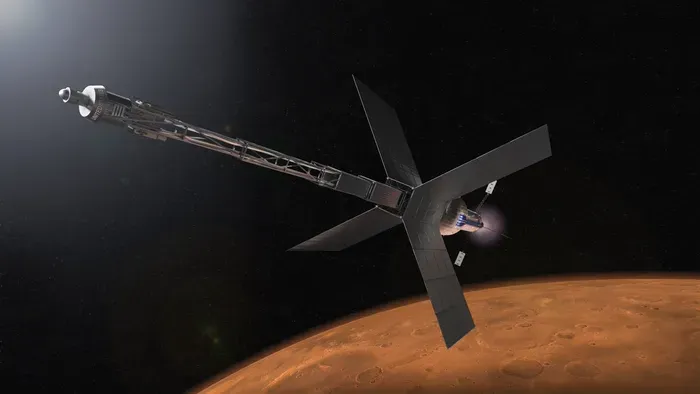
The first-ever nuclear-powered spacecraft built for interplanetary travel will set off on a mission to Mars in 2028.
The Space Reactor‑1 Freedom (SR-1 Freedom) project was unveiled in Washington on March 24. NASA leadership said it’s the first step toward nuclear power on the moon and for exploratory missions farther out in space, where solar panels and traditional chemical propulsion would be less and less effective.
The ship was introduced by Steve Sinacore, NASA’s Fission Surface Power program executive, who said it comes from utilizing more than 60 years of NASA’s research into fission nuclear propulsion and repurposing a power and propulsion unit already nearing completion.
It will be fueled with low-enriched uranium, producing more than 20 kilowatts of advanced electric propulsion primarily through the transfer of heat from the uranium. It will also be equipped with radiation shielding and high-rate direct-to-Earth communications with images and data.
SR-1 Freedom’s first mission will be a year-long journey to Mars for a mission called “Skyfall.” Its job will be to deliver a payload of three helicopter drones modeled after “Ingenuity,” the first helicopter to fly on Mars, to the surface. The aircraft will then take readings of and below the planet’s surface in anticipation of a crewed mission, such as searching for water as ice trapped beneath the surface, and scouting out a landing site.
NASA leaders didn’t announce where the launch would take place or disclose what kind of rocket would be used.
Sinacore called the project a “pathfinder” that will accelerate development and frequency of interplanetary traffic and the amount of cargo that can be moved.
“Overall, a fission-powered spacecraft carrying science to Mars is not just a tech demo,” he said. “It is the first freight run on the Transcontinental Railroad of the solar system. It proves the U.S. can build, launch, and operate a nuclear propulsion system.”
He said the vehicle’s development will help establish the foundation and standards for an entirely new workforce and class of space exploration by working with the Department of Energy and industry partners.
“We will establish flight heritage and set regulatory and launch precedent, and we will activate an industrial base to provide components and subject matter experts, ultimately enabling quicker follow-on missions,” he said.
Those future space nuclear missions include the deployment of the first nuclear power plant on the moon in 2030, which Sinacore said would use the spacecraft’s operational data and be adapted from the SR-1 Freedom’s technology for the lunar surface.
Sinacore also clarified that SR-1 Freedom’s individual interplanetary mission won’t end after it delivers its payload to Mars. In fact, as of March 24, mission planners still have not decided where SR-1 Freedom’s mission would ultimately end.
“We will explore what we can do to continue the science and ultimately, the long-duration operations of a nuclear electric propulsion spacecraft, because we do want to push the bounds with this demonstrator, find all the points on the operational box and explore them,” he said.

More Stories
No Evidence Medical Cannabis Alleviates Anxiety, Depression, or PTSD: Study
By Zachary Stieber There is no evidence medical cannabis works against anxiety, depression, or post-traumatic stress disorder, according to a...
National Medical School Accreditor Scrapping DEI Requirements
By Aaron Gifford The nation’s largest medical school accreditor is phasing out its guidance on diversity, equity, and inclusion (DEI),...
Burgum Says Trump Energy Policies Make US Less Vulnerable to Upheaval, the World Safer
By John Haughey HOUSTON—President Donald Trump’s policies boosting American energy production are proving prescient with ships and pipelines carrying oil,...
Senators Weigh Plan to End DHS Shutdown
By Jackson Richman and Nathan Worcester WASHINGTON—Senate Republicans are closing in on a plan to end the impasse over funding...
The Latest News From Major Tech Companies
By Louis Navellier The big investment news last week was Nvidia’s developer conference, which is already helping to boost storage...
US Natural Gas Market Shielded From Global Price Shocks During Iran War
By John Haughey Iran’s de facto closure of the Strait of Hormuz and partial destruction of Qatar’s liquified natural gas...