
China prioritizes Russian gas amid Middle East conflict – media

Beijing’s latest development strategy envisions accelerated work on a major gas pipeline project with Moscow
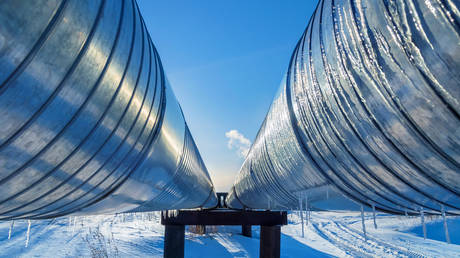
China has signaled a major push to secure more natural gas from Russia, referencing two new pipelines in the draft of its latest five-year plan. The move comes as conflict in the Middle East threatens LNG shipments transiting the Strait of Hormuz, a key energy chokepoint.
The draft version of China’s development blueprint for 2026–2030, submitted to the National People’s Congress last week, notes that Beijing would “advance preparatory work” on the “central route of the China-Russia natural gas pipeline,” the South China Morning Post (SCMP) reported on Monday.
The draft did not name the specific project, but market observers interpreted the comments as referring to the Power of Siberia 2 pipeline, and suggested that, given the developments in the Middle East, its construction could be accelerated.
Read more
Did you notice the EU just lost its gas lifeline? Here’s what you should know
In September, Russia and China signed a legally binding memorandum to construct the pipeline after nearly a decade of talks. The agreement was announced during President Vladimir Putin’s visit to Beijing. The pipeline is designed to deliver up to 50 billion cubic meters annually from western Siberia to northern China via Mongolia.
Russia already delivers natural gas to China via the Power of Siberia pipeline, which began operations in 2019 and reached full operational capacity in December 2024. Moscow has also become Beijing’s second-largest source of LNG, behind Qatar.
Middle Eastern supplies have been disrupted over the past week by the escalating conflict triggered by US-Israeli strikes on Iran. China sources around 18% of its LNG from Qatar and up to 5% from the UAE, with cargoes typically routed through the Strait of Hormuz, a waterway now largely paralyzed by the fighting.
The draft also mentions the “China-Russia Far East Natural Gas Pipeline,” according to Tencent News. Built by Russia’s Gazprom and China’s CNPC, the pipeline runs from the town of Dalnerechensk, some five kilometers from the Chinese border, and has an annual capacity of 12 billion cubic meters. It is fully constructed and is set to go operational in January 2027.
Read more
Will the war with Iran make Russia richer?
Russian President Vladimir Putin warned last week that Moscow could halt gas supplies to the EU ahead of a planned 2027 ban and redirect them to “reliable” partners. Deputy Prime Minister Aleksandr Novak later confirmed that Russia would reroute some LNG from Europe to Asia-Pacific markets, including China. The remarks prompted concern over European energy security and calls from politicians to roll back sanctions on Russian energy.
Despite sweeping Western restrictions, China has deepened energy trade with Russia. Beijing and Moscow declared a “no-limits” partnership in 2022. In a phone call with Xi Jinping last month, Putin highlighted bilateral trade exceeding $200 billion annually and Russia’s role as a leading energy supplier to China. Xi, for his part, pledged to deepen energy cooperation at the China-Russia Energy Business Forum in Beijing in November.


More Stories
Reform UK becomes first British political party to launch its own podcast
Reform UK is venturing into podcasting with a weekly show that will offer listeners behind-the-scenes access to Nigel Farage and...
Labour’s tax uncertainty is pushing Britain’s wealthiest towards the exit
The majority of Britain’s ultra-wealthy individuals are actively weighing up whether to leave the country, driven not so much by...
Barclays bets on the high street once more with new branches and the return of the bank manager
Barclays is charting a decisive U-turn on the high street, with plans to open new branches across the country and...
Amazon bets on Whole Foods to salvage its troubled UK grocery ambitions
Amazon is dusting itself off for another tilt at Britain’s fiercely competitive grocery sector, this time by converting its abandoned...
OpenAI’s flagship UK data centre hits the buffers in blow to Starmer’s AI ambitions
OpenAI’s much-trumpeted plans to build a major data centre in the north-east of England have ground to a halt, dealing...
Explosion Proof PTZ Cameras — Full 360° Intelligence in Explosive Zones
In a standard office building, a blind spot in your surveillance coverage is an inconvenience. In an oil refinery, a...