
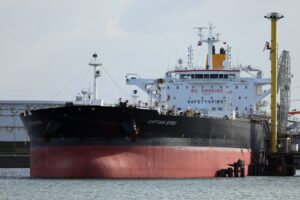
Strait of Hormuz crisis sends oil price close to $120 as Middle East conflict rattles markets

Oil prices surged to their highest levels in nearly three years as escalating conflict in the Middle East disrupted energy supplies and triggered fears of a major global shock to oil markets.
The global benchmark Brent crude oil briefly climbed to $119.50 a barrel in overnight trading, the first time prices have approached $120 since 2022, before easing back to around $107 after reports that the Group of Seven could release strategic oil reserves to stabilise markets.
The sharp spike came as shipping through the Strait of Hormuz, one of the world’s most important energy corridors, ground to a near halt following escalating military tensions involving Iran, the United States and Israel.
The Strait of Hormuz, a narrow waterway linking the Persian Gulf with the Gulf of Oman, normally carries around 20% of the world’s oil exports. The latest conflict has seen tanker traffic collapse as insurers, shipping companies and crews refuse to risk the route.
According to data from shipping tracker MarineTraffic, only nine commercial vessels passed through the strait last week, compared with a typical daily average of about 50 before hostilities intensified.
Iran’s Islamic Revolutionary Guard Corps has warned that any vessels attempting to pass through the waterway could be targeted, threatening to “set ablaze” ships using the route.
The disruption has forced energy traders and governments to confront the possibility of one of the largest supply shocks since the 1970s oil crises.
Brent crude has already risen more than 50% since the start of 2026, when prices were hovering around $61 a barrel.
The surge accelerated dramatically after several Gulf producers, including Qatar, United Arab Emirates, Kuwait and Iraq, cut production amid the growing conflict.
Analysts at Goldman Sachs warned that prices could climb even higher if tanker flows do not recover quickly.
The bank said Brent crude could surpass the $146 peak reached during the 2008 oil crisis if the strait remains closed for an extended period.
“Our analysis suggests that developments in the Persian Gulf represent one of the most severe disruptions to global energy supply in decades,” Goldman said in a note to investors.
The crisis has already severely impacted production in Iraq, one of the largest oil exporters in the region.
Output from Iraq’s main southern oilfields has reportedly dropped by 70% to about 1.3 million barrels per day, compared with roughly 4.3 million barrels per day before the conflict escalated.
Officials from the state-run Basra Oil Company said exports had effectively stalled because tankers were unable to reach the country’s main terminals.
Storage facilities in southern Iraq have reportedly reached full capacity as crude continues to be pumped but cannot be shipped.
“This is the most serious operational threat Iraq has faced in more than 20 years,” a senior official from the Iraqi oil ministry told Reuters.
Economists warn the energy shock could ripple across the global economy if prices remain elevated.
Analysts at JPMorgan Chase estimate that oil prices stabilising around $120 per barrel could add more than one percentage point to global inflation and reduce economic growth by up to 1.2 percentage points.
The surge has already pushed investors toward safe-haven assets, strengthening the US dollar and triggering volatility in equity markets.
Asian stock markets suffered steep declines earlier in the week as investors reacted to the possibility of prolonged disruption to energy flows.
Industry data suggests hundreds of oil tankers are effectively stranded around the Persian Gulf region as shipowners adopt a “wait-and-see” approach.
Goldman Sachs analysts said many shipping companies were unwilling to risk sending vessels through the Strait of Hormuz while the security situation remains uncertain.
“Most shippers are currently in a wait-and-see mode while physical risks in the strait remain elevated,” the bank said.
The disruption is already significantly larger than the shock caused by Russia’s invasion of Ukraine in 2022, according to early trade flow analysis.
G7 considers emergency oil release
To prevent the crisis spiralling further, finance ministers from the G7 are expected to meet to discuss releasing crude oil from emergency strategic reserves.
Such coordinated releases have previously been used to stabilise markets during supply shocks, including during the early months of the Ukraine war.
However, analysts warn that emergency stockpiles may only provide temporary relief if the shipping disruption continues.
The surge in energy prices has also complicated the outlook for global monetary policy.
Traders have sharply scaled back expectations of interest rate cuts from major central banks, fearing the energy shock could trigger a fresh wave of inflation.
Economists at Deutsche Bank warned that if oil prices remain elevated the Bank of England may cut interest rates only once in 2026.
Chief UK economist Sanjay Raja said inflation in Britain could rise as high as 3.8% if energy costs remain elevated.
In that scenario, he suggested the UK government could be forced to consider fuel duty reductions to offset rising household energy and transport costs.
Some economists believe the crisis could rival some of the most significant oil disruptions in modern history.
Nobel Prize-winning economist Paul Krugman said the situation could potentially exceed previous shocks linked to the 1973 Yom Kippur War and the 1979 Iranian revolution.
“The disruption of world oil supplies caused by the war in Iran looks extremely serious,” Krugman wrote.
“If the Strait of Hormuz remains closed for an extended period, this will be a worse disruption than either of those historic energy crises.”
For now, global markets remain focused on whether tanker traffic can resume through the strait, a development that could quickly bring oil prices down, or whether the conflict will deepen into a prolonged geopolitical and economic shock.
Read more:
Strait of Hormuz crisis sends oil price close to $120 as Middle East conflict rattles markets


More Stories
The Naughty AI President: A New Age of Governance
In the race to build better systems of governance, humanity has always chased an impossible ideal: the perfect ruler. Rational,...
Sends shares Q1 2026 business update and product progress
Sends reported Q1 2026 updates sharing news on digital cards, app redesign, ClearBank integration, and fintech industry recognition. Sends, a...
Government doubles down on gaming with £30m funding package as sector eyes global growth
The government has fired the starting gun on a £30 million funding offensive aimed at Britain’s video games sector, urging...
Rising energy costs from Middle East conflict set to leave UK households £480 worse off this year
Rising energy costs triggered by the escalating Middle East conflict are on course to strip nearly £500 from the finances...
UK firms risk being left behind as AI adoption gap widens, warns PwC
British businesses are in danger of being left stranded in the middle of the pack on artificial intelligence, with a...
Virgin StartUp opens second round of free accelerator for dyslexic entrepreneurs
Virgin StartUp has launched applications for the second round of Momentum, its free eight-week accelerator programme built specifically to help...