
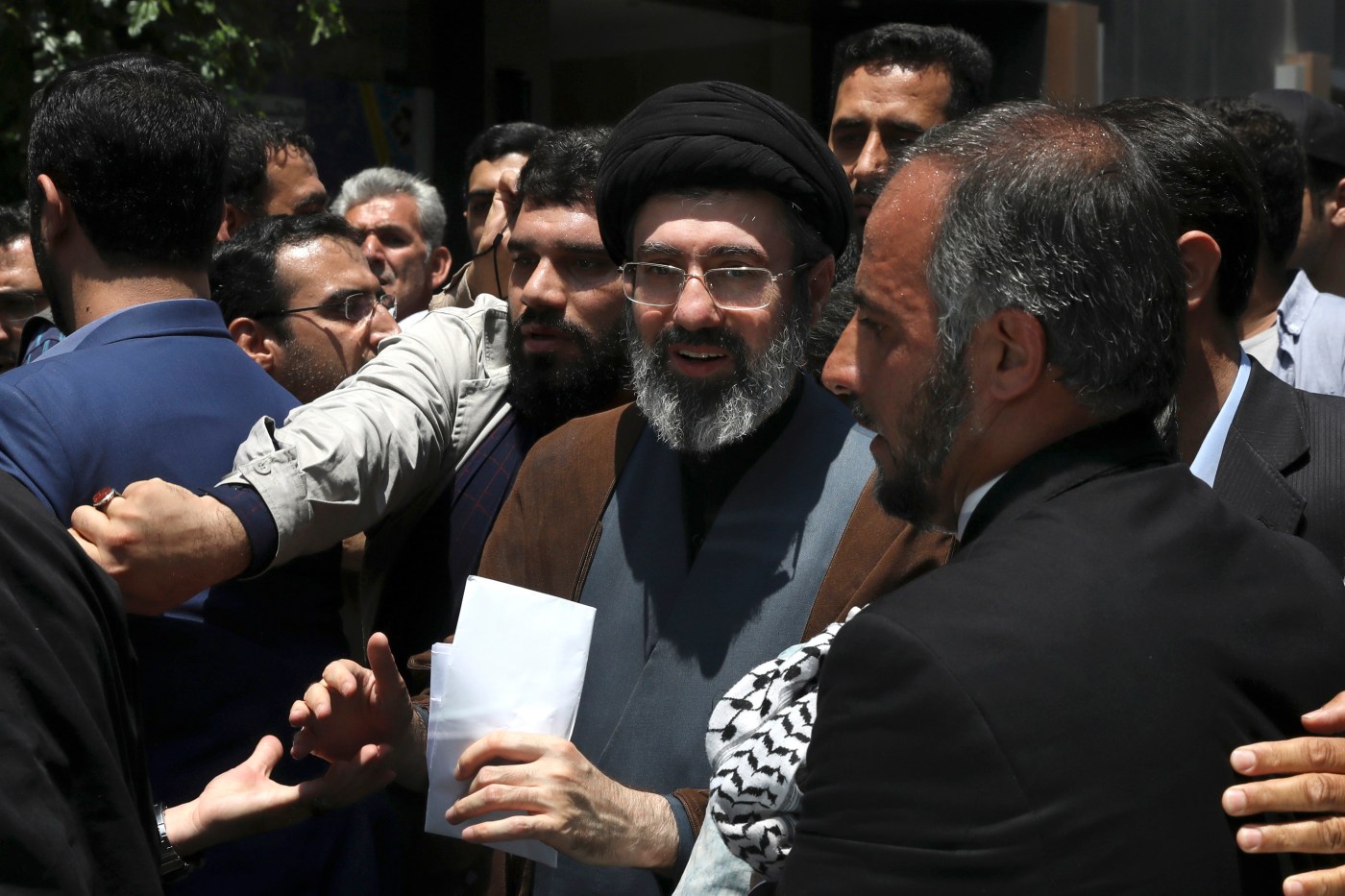
Iran names new leader

DUBAI, United Arab Emirates — Mojtaba Khamenei, a son of Iran’s late supreme leader, has been named his successor, Iranian state TV announced early Monday, as the war that began a little over a week ago with his father’s killing took a dramatic turn.
The younger Khamenei, who had not been seen or heard from publicly since the war started, had long been considered a contender for the post, even before an Israeli strike killed Ayatollah Ali Khamenei, and despite never being elected or appointed to a government position.
His appointment came after signs of a rift among Iranian officials as the country awaited a decision by the Assembly of Experts, a group of clerics that selects the supreme leader. State TV read a statement from the assembly saying he was selected based on “strong” votes and urging the nation to unite behind him. The station broadcast scenes of people celebrating in parts of Tehran.
There has been only one other transfer of power in the office of supreme leader since the Islamic Revolution almost a half-century ago.
A secretive figure, the 56-year-old Khamenei now stands at the heart of Iran’s theocracy and will have final say over all matters of state. He will serve as commander-in-chief of the military and powerful paramilitary Revolutionary Guard. He also has authority over a stockpile of highly enriched uranium that could be used to build a nuclear weapon, if he chooses to decree it.
The selection of Khamenei faces the likelihood of U.S. criticism. “Khamenei’s son is unacceptable to me,” U.S. President Donald Trump has said. “We want someone that will bring harmony and peace to Iran.”
The White House did not immediately respond to a request for comment. Trump told ABC News on Sunday he wants a say in who comes to power once the war is over; a new leader “is not going to last long” without his approval.
Also on Sunday, U.S. military said a service member died of injuries from an Iranian attack on troops in Saudi Arabia on March 1. Seven U.S. soldiers have now been killed.
Two US officials say the State Department will order nonessential personnel and families of all staff to leave Saudi Arabia as Iran escalates its attacks. The officials, who spoke on condition of anonymity pending a formal announcement, said the “ordered departure” status would be announced on Sunday.
Eight other U.S. diplomatic missions have ordered all but key staff to leave: Bahrain, Iraq, Jordan, Kuwait, Lebanon, Qatar, the United Arab Emirates and the consulate in Karachi, Pakistan.
Iran’s Revolutionary Guard issued a statement expressing support for the new leader, and the Iran-backed Lebanese militant group Hezbollah shared a portrait of the younger Khamenei on Telegram with the caption, “Leader of the blessed Islamic revolution.”
Top Iranian security official Ali Larijani, speaking to state TV, praised the Assembly of Experts for “courageously” convening even as airstrikes continued in Tehran. He added that the younger Khamenei had been trained by his father and “can handle this situation.”
Oil rises above $100 a barrel
The war’s toll on civilian targets grew as Bahrain accused Iran of striking a desalination plant vital to drinking water supplies, and oil depots in Tehran smoldered following overnight Israeli strikes.
As the war impedes the region’s oil production and shipping, crude prices have surpassed $100 per barrel for the first time in more than three and a half years. Some regional producers, including in Iraq, have curbed output amid dangers in the Strait of Hormuz.
In a sign of rising regional anger, the Arab League chief lashed out at Iran for its “reckless policy” of attacking neighbors, including ones that host U.S. forces. Gulf countries have been struck by hundreds of missiles and drones since the war started on Feb. 28.
Saudi Arabia said a military projectile fell onto a residential area and killed two people of Indian and Bangladeshi nationality. Foreign residents and workers have made up most of the war’s deaths in Gulf nations.
Later Sunday, the Kingdom’s Defense Ministry said it had intercepted a missile headed toward Prince Sultan Air Base, and two drones in northern Riyadh city
In an earlier post on X, it said it intercepted a drone over the Empty Quarter desert while heading toward the Shaybah oil field.
A separate post had the same details for the latter drone, but it was unclear if that was a different event.
The ministry also shared footage it said showed Saudi air defenses intercepting and destroying “a number of drones” launched at it in recent days
The war has killed at least 1,230 people in Iran, at least 397 in Lebanon and at least 11 in Israel, according to officials. Israel reported its first soldier deaths Sunday, saying two were killed in southern Lebanon, where its military is fighting Hezbollah.
Bahrain accused Iran of indiscriminately attacking civilian targets and damaging one of its desalination plants, though its electricity and water authority said supplies remained online.
Desalination plants supply water to millions of residents in the region and thousands of stranded travelers, raising new fears of catastrophic risks in parched desert nations.
The strike came after Iran said a U.S. airstrike damaged a desalination plant there. Foreign Minister Abbas Araghchi said the strike on Qeshm Island in the Strait of Hormuz had cut into the water supply to 30 villages.
He warned that in doing so “the U.S. set this precedent, not Iran.”
In response, CENTCOM spokesperson U.S. Navy Capt. Tim Hawkins said that “U.S. forces do not target civilians – period.”
A man rides a motorbike as smoke billows after overnight airstrikes on oil depots on Sunday in Tehran, Iran. (Photo by Majid Saeedi/Getty Images)

More Stories
UK business confidence crashes to Covid-era lows as Iran conflict forces firms into survival mode
Britain’s finance chiefs have retreated into full defensive mode as the fallout from the war in Iran sends confidence tumbling...
OpenAI doubles down on London with first permanent office despite Stargate U-turn
The decision by OpenAI to plant its flag in King’s Cross with a permanent London headquarters, just days after walking...
Founders push for ‘repeat entrepreneur relief’ to keep exit capital flowing back into UK start-ups
Some of Britain’s most prominent entrepreneurial voices are pressing the Treasury to introduce a targeted tax incentive designed to keep...
Middle East war triggering global energy ‘shock’ – IMF
Disruptions to oil and gas supplies will leave lasting “scars” on the world economy, managing director Kristalina Georgieva has said...
What is fueling unrest across the EU?
The bloc is facing an energy crisis due to the Strait of Hormuz disruption, with soaring diesel prices triggering protests...
OECD urges reeves to overhaul ‘inefficient’ UK tax system
Rachel Reeves has been told by one of the world’s most influential economic bodies that Britain’s tax system is holding...