
The Strategic DIYer: Using Factory Data to Master Modern Car Repairs

For the modern vehicle owner, the boundary between a simple weekend project and a costly mechanical disaster has never been thinner. With professional labor rates often exceeding $150 per hour, the appeal of “doing it yourself” is stronger than ever. However, as cars transition from purely mechanical machines into complex, software-driven systems, the tools needed for a successful repair have changed. It is no longer just about having the right wrench; it is about having the right information.
The High Cost of Information Gaps
Many enthusiasts begin their DIY journey by watching quick online videos. While helpful for visual orientation, these videos often skip over the microscopic details that define a vehicle’s health. A common mistake among weekend mechanics is assuming that a procedure for one model year applies perfectly to another. In reality, a slight change in a timing belt tensioner spec or a specific bolt’s torque value can lead to catastrophic engine failure.
Precision is the difference between a repair that lasts for years and a mistake that costs thousands. When dealing with critical components like timing systems or internal engine parts, “good enough” is a dangerous mindset. This is why professionals never rely on memory or generic guides; they rely on verified, factory-level data to ensure every adjustment meets the manufacturer’s exact standards.
Categorizing Your Repairs: A Tiered Approach
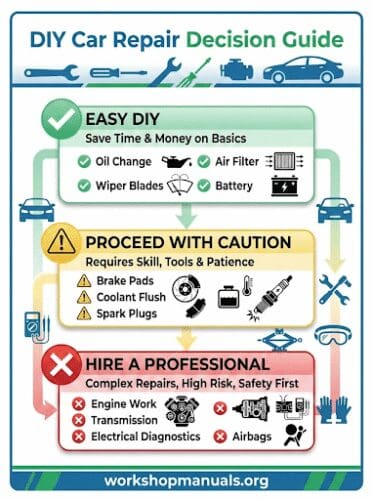
To manage a vehicle effectively, an owner must categorize repairs based on complexity and the risk involved. Understanding where a task falls helps in deciding whether to pick up a tool or call a flatbed.
The Routine Maintenance Zone
Basic tasks like changing oil, replacing air filters, or swapping out a battery are excellent starting points for any DIYer. These jobs require minimal specialized tools and can save an owner hundreds of dollars annually. Even in this “safe zone,” however, mistakes happen. Using the wrong oil viscosity or installing a battery with the incorrect cold-cranking amps can cause long-term electrical or mechanical strain. Having a reliable source for workshop manuals ensures that even these basic tasks are performed according to the vehicle’s specific requirements.
The Intermediate Challenge
Moving into brakes, coolant flushes, or spark plug replacements requires a higher level of mechanical aptitude. These are “Yellow Zone” repairs. For instance, modern braking systems often involve specific caliper compression methods or electronic parking brake retractions that aren’t obvious to the naked eye. Without model-specific procedures, a simple brake job can turn into a nightmare of dashboard warning lights and compromised safety.
The Professional Boundary
Certain systems should remain off-limits for most home mechanics unless they possess professional-grade diagnostic equipment. Internal transmission work, complex electrical troubleshooting, and airbag system repairs carry high risks. Modern cars house dozens of interconnected electronic modules; an incorrect probe into a wiring harness can fry an expensive control unit instantly.
The Anatomy of a Professional Repair
What separates a successful repair from a “hack job” is the documentation used during the process. There is a significant difference between a generic aftermarket manual and a factory service guide.
Factory-grade automotive repair guides provide VIN-specific accuracy. They don’t offer general ranges; they provide exact torque specifications, actual wire colors for electrical schematics, and step-by-step reassembly notes. For owners of European brands like BMW or Audi, or those driving modern hybrids, this level of detail is mandatory. These vehicles often require specific “service positions” or de-energizing procedures that generic guides simply do not cover.
Maximizing Longevity and Resale Value
Beyond the immediate savings, performing repairs correctly preserves the vehicle’s value. A car that has been maintained using factory specifications is far more reliable than one subjected to “guesswork” repairs. Documentation is also a powerful tool for troubleshooting. Instead of “parts-throwing”—the expensive habit of replacing sensors one by one hoping to fix a problem—factory diagnostic flowcharts allow you to test components systematically.
For example, a “System Too Lean” code could be caused by anything from a vacuum leak to a failing fuel pump. A professional-grade manual provides the voltage ranges and testing steps to identify the $15 hose before you spend $300 on a new mass airflow sensor.
The Future of DIY Maintenance
As we move further into the era of Advanced Driver Assistance Systems (ADAS) and electric drivetrains, the role of the DIYer is evolving. Even a simple windshield replacement or a suspension tweak can now necessitate a camera or radar calibration. Staying informed through official documentation is the only way to ensure these safety systems remain functional.
Conclusion
The goal of car ownership should be to make informed decisions. By utilizing professional-grade data, you empower yourself to tackle manageable repairs with confidence while recognizing when a job requires a specialist’s touch. It is an investment in your skills, your safety, and your financial well-being
The post The Strategic DIYer: Using Factory Data to Master Modern Car Repairs appeared first on My Car Heaven.


More Stories
Unlock Hidden Performance: Why Modern Drivers Are Turning to Smart Tuning Solutions
Unlock Hidden Performance: Why Modern Drivers Are Turning to Smart Tuning Solutions For decades, car enthusiasts have searched for ways...
What Food Is Miami Known For? Dishes You Should Not Miss
Miami’s colorful cuisine is a real reflection of its diverse culture and history. The unique dishes, a combination of a...
2027 Chevrolet Corvette Grand Sport X Could Be the Real Sweet Spot in the Lineup
Back on March 13, 2001, Paul Pierce lit up the Lakers at Staples Center with 42 points on 13-of-19 shooting....
2026 Chevrolet Silverado EV Trail Boss Review & Test Drive
The electric vehicle (EV) market has leveled out for many reasons as of late, but such an environment hasn’t stopped...
Netherlands March 2026: Tesla manages 1-2, Kia EV5 in Top 10
The Kia EV5 ranks #8 for its 5th month in market. The Dutch new car market stabilises after two horrendous...
Italy March 2026: Leapmotor T03 on podium
The Leapmotor T03 becomes the first Chinese model to enter the Italian podium. New car sales in Italy are up...