
Records break down Boston’s $135M White Stadium cost, and reveal City Hall waited to tell taxpayers

Newly released public records break down the taxpayer-funded spending for Boston’s White Stadium rebuild and show the mayor apparently hid the fact that the city’s final cost had nearly tripled to $135 million for at least a month from the public.
The city last Thursday provided the contract it has entered into with BOND Building Construction for its half of the professional soccer stadium rebuild, along with a city building permit issued on Jan. 8, in response to a Herald records request.
The permit was issued to the contractor and reflects final project costs that weren’t revealed to the public by Mayor Michelle Wu until nearly a month later, at a Feb. 6 press conference. It lists the “declared value” of the planned construction at $134.14 million and fees at more than $1.34 million.
Although the information was in hand at City Hall, Wu waited at least a few weeks to announce that taxpayer costs for the contentious public-private plan had nearly tripled, from an initial estimate two years ago of $50 million to $135 million today.
Records show that the contract was submitted by BOND on Jan. 21. A stamp on the document says revised on Feb. 4. There is no explanation of what the revision is.
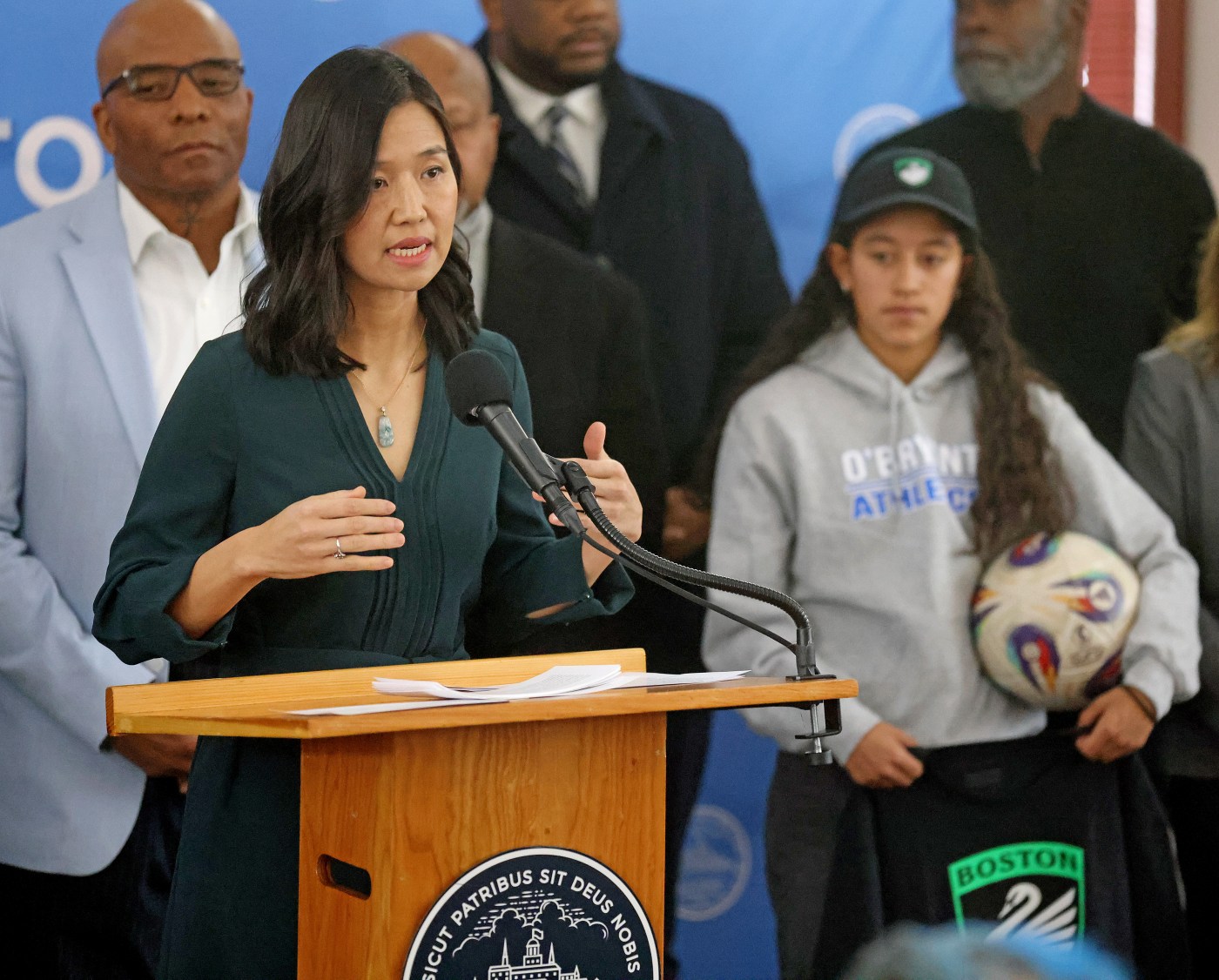
Two days later, the mayor convened a press conference to announce final costs for the city and its private partner, Boston Legacy FC, which is now kicking in more than $190 million for its portion of the project.
The total rehab plan is now set to cost more than $325 million, compared to the roughly $200 million cost the city had been projecting since late 2024, when the taxpayer tab was projected at $91 million.
The city’s contract with BOND shows final taxpayer costs are tens of thousands of dollars more than what Wu announced, at $135,035,515.
Reflected in that new publicly-funded price tag is the city’s commitment to rebuild the east side of Franklin Park’s White Stadium, which is set to begin this month.
Work will also begin this month on the stadium’s west side, which is the responsibility of Boston Legacy FC, a new National Women’s Soccer League team set to share use of the stadium with Boston Public Schools student-athletes, beginning next year.
The building permit states that taxpayer-funded work will include foundation and framing steel for new construction, including the assembly of a 5,000-seat east grandstand, canopy, support wings, and track and field site improvements for BPS athletics.
Contract costs are broken down into three major categories: building, site and related allowance and contingency add-ons like insurance and overtime, which are projected at $79.1 million, $24.3 million, and $31.58 million, respectively.
The contractor has budgeted its overtime allowance, for example, at $3.62 million, and part of the site work includes a $61,200 allowance for “export of hazmat soils beyond what was identified in the contract documents and estimate,” records show.
Wu said last month that the city’s new $135 million cost reflects the “final budget” for the project, which may not be a statement of optimism ruling out further cost overruns, but rather a contractual agreement with BOND Building Construction.
The mayor’s office issued a press release to go along with last month’s announcement that states “the city has established a total construction cost for the publicly-funded share of the project, protected by a guaranteed maximum price contract.”
A GMP contract implies that the project owner is only responsible for the agreed-upon cap, or maximum price of the contract, meaning that any cost overruns would be borne by the construction contractor, rather than the city.
“The GMP was developed through a full and now complete public bidding process under state law, and the updated cost includes the pricing of a finalized design and scope, tariffs on construction materials, and market escalation,” the press release from the mayor’s office states.
In a radio interview last month, Wu mentioned that steel prices have gone up “40% from when we started” and labor costs have increased “significantly.”
The $135 million contract budgets structural steel at $8.65 million.
Wu said the cost escalations for the project have largely been due to community feedback, with suggestions from the public baked into the project.
“We heard from over 100 public meetings and conversations, what people’s needs and dreams and hopes were, and we decided to expand the project, to do it right,” Wu said last month, adding that the enhanced project reflects her belief that “Our Boston kids deserve nothing but the best.”
Related Articles
Pols & Politics: Boston city councilor calls for cuts to $2M program that gives 11-year-olds budgetary power
City of Boston payroll tops $2.45B, with 30-plus police locking up $400,000+ [Scan entire database]
Ed Flynn’s open meeting law complaint against Boston City Council shut down by Mayor Wu’s law department
Battenfeld: Michelle Wu’s Orwellian strategy of making snow seem joyful
Ex-Boston Housing Authority employee busted by feds for $40K overtime fraud scheme
Wu has championed the public-private deal as being crucial to delivering the financial investment needed to rebuild the 77-year-old stadium, but it’s been a source of contention since it was announced.
Critics have raised concerns over the ballooning price tag for taxpayers, along with transportation and parking challenges expected to be exacerbated by the project. They have described the plan as a “giveaway” to wealthy investors.
The project is the subject of a two-year-old community lawsuit that’s already gone to trial. A Suffolk Superior Court judge sided with the city last spring, finding that the rehab project would not illegally privatize public parkland in Franklin Park.
The case has been appealed, however, and is set to be heard by the state’s highest court — the Massachusetts Supreme Judicial Court — later this year.
Opponents of the public-private deal have pitched a high-school-only stadium alternative that they say can be built at a fraction of the cost to taxpayers, $64.6 million.
White Stadium is covered in scaffolding Sunday during the ongoing construction there. (Libby O’Neill/Boston Herald)
An excavator works at the scene at White Stadium earlier this month. (Photo By Matt Stone/Boston Herald, File)


More Stories
From Scotland Yard Commander to Global Security Entrepreneur: Dr Ali Dizaei’s Leadership Story
There are career journeys that follow a straight line, predictable, uniform, and comfortable. And then there are journeys shaped by...
The Naughty AI President: A New Age of Governance
In the race to build better systems of governance, humanity has always chased an impossible ideal: the perfect ruler. Rational,...
Sends shares Q1 2026 business update and product progress
Sends reported Q1 2026 updates sharing news on digital cards, app redesign, ClearBank integration, and fintech industry recognition. Sends, a...
Government doubles down on gaming with £30m funding package as sector eyes global growth
The government has fired the starting gun on a £30 million funding offensive aimed at Britain’s video games sector, urging...
Rising energy costs from Middle East conflict set to leave UK households £480 worse off this year
Rising energy costs triggered by the escalating Middle East conflict are on course to strip nearly £500 from the finances...
UK firms risk being left behind as AI adoption gap widens, warns PwC
British businesses are in danger of being left stranded in the middle of the pack on artificial intelligence, with a...