
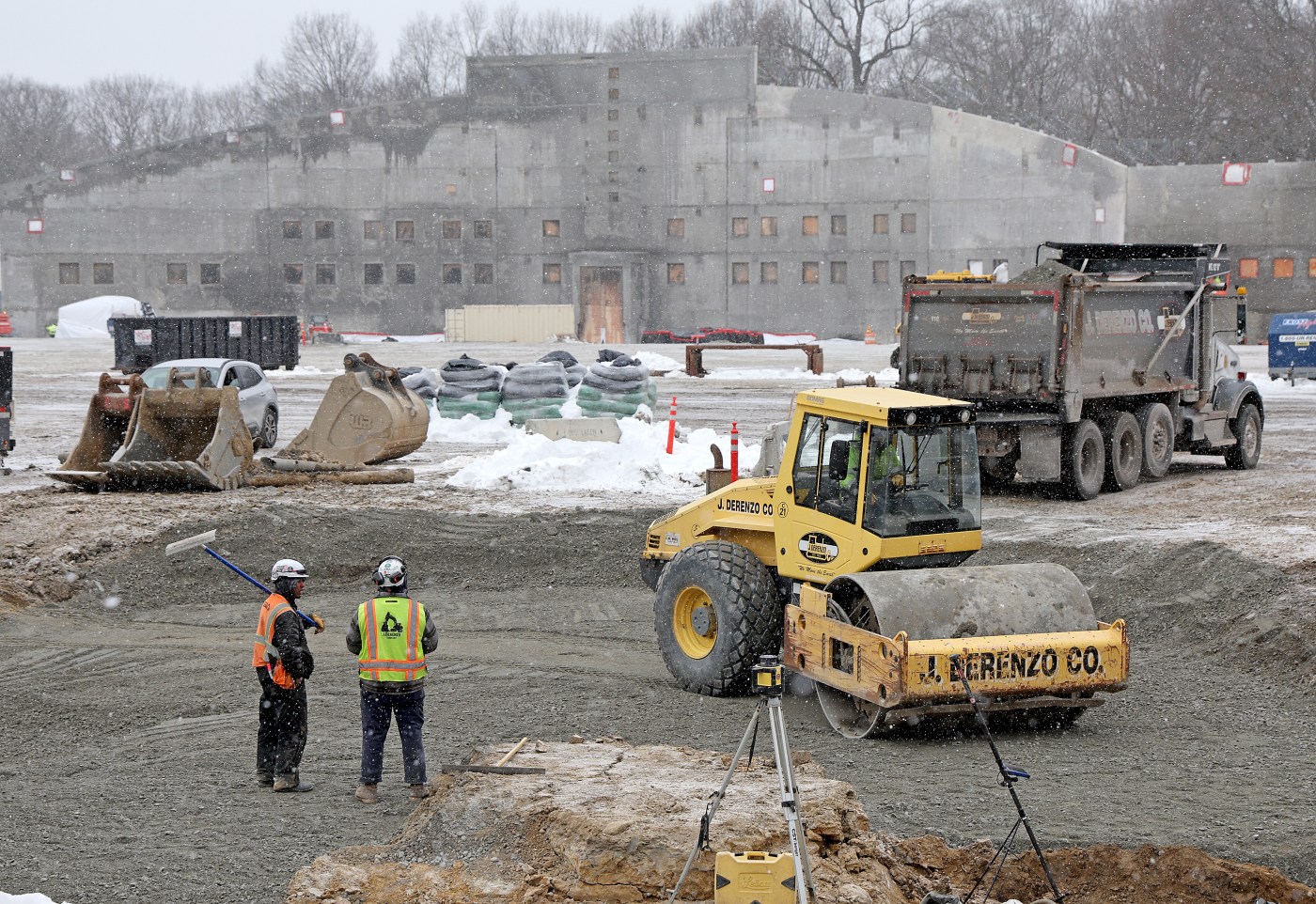
Gaskin: White Stadium diversity a familiar failure

Before Boston Legacy FC made its decision to bring a professional women’s soccer team to Boston, I met with members of the ownership group. We discussed procurement — specifically how Black-owned businesses would participate in the White Stadium project. They said the right things.
They referenced the “Massport Model,” spoke about diversity across ownership, financing, construction, and operations, and discussed ambitious (50% Minority Business Enterprise) participation targets. Despite their good intentions, I was skeptical. They showed no real sense of how difficult those objectives would be to achieve. No one appeared accountable for delivering the numbers. And there was no recognition of the fight it would take to overcome the structural headwinds that define construction in Boston.
White Stadium — at $325 million and counting — is the largest development project in the Black community in years. It could have represented a transformative opportunity for Black businesses and workers.
The project is divided into two parts: approximately $135 million from the city and roughly $190 million from private investors. We now have an idea of what the city will accomplish. As of today, of the $135 million, $102.5 million in subcontracting dollars awarded to date:
— 13.1% have gone to certified minority-owned business enterprises (MBEs). (Remember this is all MBEs, not just Black MBEs. We will be lucky if Blacks are half that number).
— 8.4% have gone to certified women-owned business enterprises (WBEs)
— 11.5% have gone to local businesses
Those numbers are public. They are the city’s reporting.
The private side had significant discretion in contractor selection and was in the strongest position to move the needle. Instead, we are seeing familiar results.
It did not matter that the City Council is more diverse, the chief of economic development is a Black man or that the mayor is a progressive woman of color. Without addressing the structural problems it doesn’t matter.
In strong development cycles — particularly during the Seaport boom and pre-COVID peak years — Boston has seen total construction starts in the $3 billion – $5 billion range annually. In many cities, that level of investment would have produced a significantly larger Black construction sector. It hasn’t because no one is addressing the root problem.
The Big Dig’s MBE participation was reportedly in the 1–2% range, though precise figures remain unclear. And despite decades of development totaling well over $50 billion, the pattern has not meaningfully changed — as White Stadium now demonstrates.
The barriers are structural: bonding requirements, capital access disparities, subcontractor networks that replicate incumbency, union seniority systems that disadvantage newer entrants, and procurement practices that reward familiarity over diversification.
During those tens of billions of dollars in development, only four projects achieved meaningful MBE participation: The Grove Hall Mecca Mall, The Kroc Center, The Boston Convention & Exhibition Center, and The Omni Hotel. Those four projects shared key characteristics — and those characteristics help explain why White Stadium is a case study in procurement failure.
Each successful project had a person committed to inclusion and equipped with real leverage. Sister Virginia Morrison fought with Mayor Thomas Menino and Steve Samuels to secure binding inclusion agreements at the Grove Hall Mecca Mall and monitored compliance daily. Samuels told me Sister Virginia went to the job site daily and if there weren’t enough Blacks on the site, he got a call on his cell phone demanding that he make it right. State Sen. Dianne Wilkerson wrote participation percentages directly into legislation for the Convention Center and personally monitored compliance going in and out of construction trailers in South Boston.
An entire team from the Dudley Street Neighborhood Initiative, including John Barros and close to two dozen committee members, Carlos Henriquez, and Councilor Chuck Turner, negotiated vendor and labor terms for the Kroc Center and oversaw implementation demanding photo IDs and social security numbers to make sure the people were actually hired. Richard Taylor made it his mission to see that the OMNI Hotel reflected DEI objectives, played a similar role in developing what became known as the “Massport Model,” ensuring diversity requirements were embedded in the Request for Proposal and executed in practice. It is now a Harvard case.
The Kroc Center project secured a union agreement to hire Black workers “out of order” — ahead of more senior (and typically white) workers. With small subcontractors — often employing fewer than 15 workers — they were told explicitly how many Black workers they needed to hire in order to secure the contract. Inclusion was not suggested; it was required.
The general contractor, Suffolk, contributed $1 million to an equity bonding fund. When Black subcontractors did not meet bonding requirements, they entered joint ventures with the general contractor and accessed that fund. Structural barriers were addressed directly, not accepted as excuses. Subcontractors were selected in part based on their track records in hiring residents, minorities, and women, and in utilizing MBE/WBE firms. Past performance mattered. Sen. Wilkerson allocated $1.5 million in legislation for Bruce Bolling’s firm to find qualified contractors.
The Kroc team implemented oversight. Weekly construction hiring team meetings reviewed contractor utilization reports. Compliance was monitored. Participation was tracked in real time. As part of monitoring and enforcement the Kroc Team maintained a forecasting model that made participation planned, not reactive. The Kroc team required the general contractor to provide a four- to six-month forecast of subcontractor packages and anticipated labor needs.
Without forecasting, participation becomes reactive. With forecasting, participation becomes planned.
From the City’s side, White Stadium gave little thought to MBE participation. There wasn’t even language in the RFP for a general contractor that required diversity participation and it went down from there. Neither the public nor private side began with a champion negotiating binding requirements before contracts were finalized or construction started. Both sides lacked the front-end leverage, the creative structural adjustments, the bonding support mechanisms, the weekly oversight infrastructure, and the advance forecasting discipline that defined the successful projects.
White Stadium is not an anomaly. It is a case study in what happens when procurement relies on aspiration instead of enforceable design.
Ed Gaskin is Executive Director of Greater Grove Hall Main Streets and founder of Sunday Celebrations


More Stories
Pakistan is in ‘open war’ with Afghanistan after latest strikes, defense minister says
By MUNIR AHMED and ABDUL QAHAR AFGHAN ISLAMABAD (AP) — Pakistan and Afghanistan traded attacks in a dramatic escalation of...
Pakistan is in ‘open war’ with Afghanistan after latest strikes, defense minister says
By MUNIR AHMED and ABDUL QAHAR AFGHAN ISLAMABAD (AP) — Pakistan and Afghanistan traded attacks in a dramatic escalation of...
US advises embassy staff in Israel to leave now if they want, as risk of war hangs over Middle East
By SAM MEDNICK and SAM METZ TEL AVIV, Israel (AP) — The U.S. Embassy in Israel on Friday told its...
US advises embassy staff in Israel to leave now if they want, as risk of war hangs over Middle East
By SAM MEDNICK and SAM METZ TEL AVIV, Israel (AP) — The U.S. Embassy in Israel on Friday told its...
Anthropic refuses to bend to Pentagon on AI safeguards as dispute nears deadline
By MATT O’BRIEN, AP Technology Writer A public showdown between the Trump administration and Anthropic is hitting an impasse as...
Anthropic refuses to bend to Pentagon on AI safeguards as dispute nears deadline
By MATT O’BRIEN, AP Technology Writer A public showdown between the Trump administration and Anthropic is hitting an impasse as...