
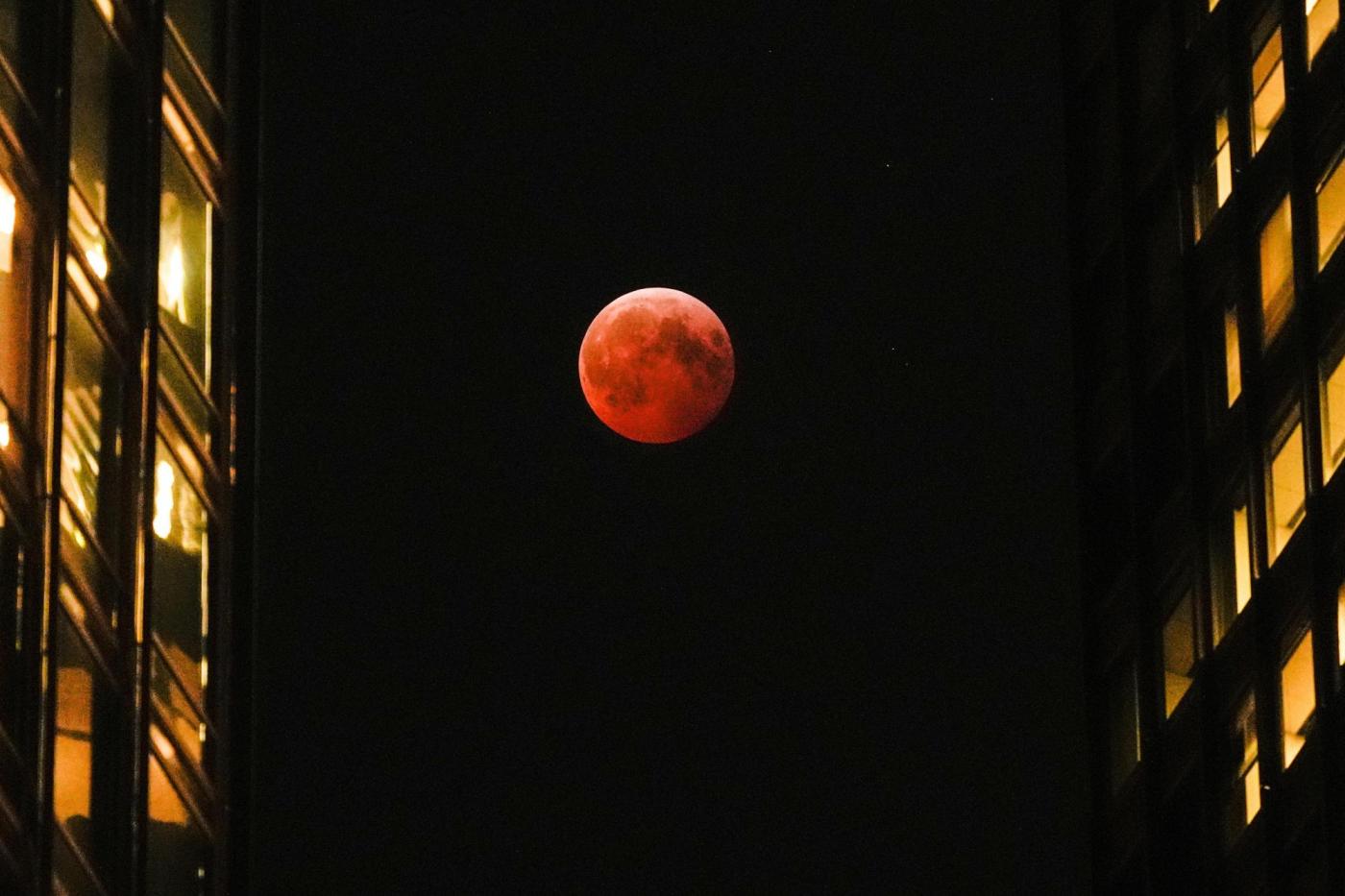
A total lunar eclipse will turn the moon blood red on Tuesday across several continents

By ADITHI RAMAKRISHNAN
NEW YORK (AP) — A blood-red moon will soon grace the skies for a total lunar eclipse — and there won’t be another until late 2028.
Related Articles
NASA revamps Artemis moon landing program to reduce flight gaps and risk
NASA’s Mike Fincke identifies himself as the ailing astronaut who prompted space station evacuation
Swirling beauty of the Milky Way galaxy’s heart is captured in a new telescope picture
NASA moves its Artemis II moon rocket off the launch pad for more repairs
NASA will return its moon rocket to the hangar for more repairs before astronauts strap in
The spectacle will be visible Tuesday morning from North America, Central America and the western part of South America. Australia and eastern Asia can catch it Tuesday night. Partial stages of the eclipse with small bites taken out of the moon can be seen from Central Asia and much of South America. Africa and Europe will be shut out.
Solar and lunar eclipses happen due to a precise alignment of the sun, moon and Earth. There are between four and seven a year, according to NASA.
The eclipses tend to follow each other, taking advantage of the sweet spot in the celestial bodies’ orbits. Tuesday’s total eclipse of the moon comes two weeks after a ‘ring of fire’ solar eclipse that dazzled people and penguins in Antarctica.
During a total lunar eclipse, the Earth is between the sun and full moon, casting a shadow that covers the moon. The so-called blood moon looks red because of stray bits of sunlight filtering through Earth’s atmosphere.
The show unfolds over several hours, with totality lasting about an hour.
Compared to a solar eclipse, “the lunar eclipse is a little more of a relaxed pace,” said Catherine Miller at Middlebury College’s Mittelman Observatory.
For those in the path, there’s no need for any special equipment to observe — just a clear, cloudless view of the sky.
Use a forecasting app or any online celestial calendar to look up the exact timing for your area. Venture outside a few times to see Earth’s shadow darken the moon, eventually revealing the reddish-orange orb.
“You don’t have to be out there the whole time to see the shadows moving,” said astronomer Bennett Maruca with the University of Delaware.
There’s a partial lunar eclipse on the docket for August, visible across the Americas, Europe, Africa and west Asia.
The Associated Press Health and Science Department receives support from the Howard Hughes Medical Institute’s Department of Science Education and the Robert Wood Johnson Foundation. The AP is solely responsible for all content.

More Stories
Josh Sargent deja Norwich City por Toronto de la MLS
TORONTO (AP) — Josh Sargent se incorporó el viernes al Toronto FC de la MLS procedente del Norwich City de...
Why Minnesota United didn’t say more about local ICE raids
Amid the federal immigration raids in Minnesota to start this year, Minnesota United remained quiet on the subject. Loons supporters,...
Palou y Ganassi cierran disputa contractual con McLaren tras fallo de 12 millones de dólares
Por JENNA FRYER ST. PETERSBURG, Florida, EE.UU. (AP) — Alex Palou y Chip Ganassi Racing llegaron a un acuerdo para...
Filial de empresa portuaria hongkonesa denuncia allanamientos y “grave” toma de documentos en Panamá
Associated Press CIUDAD DE PANAMÁ (AP) — La filial del conglomerado hongkonés CK Hutchison, que perdió la concesión de los...
Renee Good’s parents remember her love and laughter in interview with AP
DENVER — Renee Good loved sparkles and laughter and any excuse for a celebration. She loved pretty much everyone she...
Trump plantea la posibilidad de una “toma amistosa de Cuba” tras conversaciones con La Habana
Por WILL WEISSERT WASHINGTON (AP) — El presidente Donald Trump señaló el viernes que Estados Unidos está en conversaciones con...