
FBI Says 2020 Election Irregularities at Center of Georgia Investigation

By Joseph Lord
The FBI says that election irregularities in the 2020 presidential ballot count are at the center of its investigation into a Fulton County, Georgia, elections office.
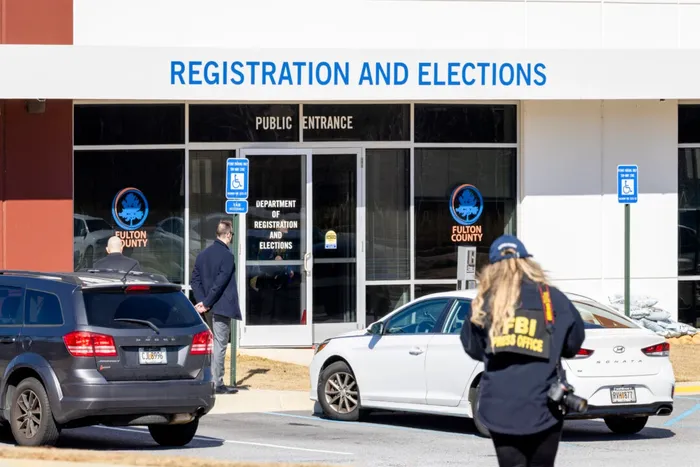
On Jan. 28, FBI and other U.S. officials carried out a raid on the elections office. Court records released by the U.S. District Court for the Northern District of Georgia—which authorized the search warrant for the federal raid—reveal the investigation centers around allegations of potential tampering in the 2020 election.
In an affidavit requesting a judge’s sign-off for the warrant, FBI Special Agent Hugh Evans requests “the seizure of election records, to include paper ballots, ballot images, and absentee ballot envelopes, currently retained by the Fulton County Board of Registration and Election.”
The affidavit lists a series of alleged ballot and vote count irregularities being investigated, including missing images of ballots in Fulton County’s records, duplicated ballots, tabulator tapes, and “pristine ballots.”
Evans’s affidavit ties the warrant to potential violations of 52 U.S.C. § 20511, though at this stage of the process, investigators needed only to convince a judge that a crime may have occurred.
The statute provides penalties of a fine or up to five years in federal prison for “a person, including an election official, who … knowingly and willfully deprives, defrauds, or attempts to deprive or defraud the residents of a State of a fair and impartially conducted election process,” including through “the procurement, casting, or tabulation of ballots that are known by the person to be materially false.”
Critics of the investigation have pointed to the outcome of state-level investigations and audits of the election, which upheld the reported outcome of the 2020 election.
Here’s what to know about the allegations listed in the affidavit.
Missing Ballot Images
One issue listed in the affidavit involves discrepancies in digital ballot images, including missing images.
Evans cited concerns from an unnamed witness who analyzed the results of the 2024 election and alleged there were “17,852 missing ballot images from the reported results on the Georgia Secretary of State’s website.”
The affidavit notes that the Georgia State Election Board, which is governed by a Republican majority, issued a letter of reprimand to Fulton County’s elections office, but declined to refer the matter for criminal prosecution.
Another witness listed in the document, a Republican-appointed member of the Georgia State Election Board, stated that she noticed irregularities while analyzing the ballot images—namely, the absence of a digital marker to ensure no manipulation of the images occurs.
Fulton County officials, in responding to claims related to ballot images, say that Georgia law did not require ballot images to be maintained as records during the 2020 general election. This was later altered through the passage of the Election Integrity Act by the state legislature in 2021, which mandated that digital ballot images be made and maintained as public records.
The affidavit also states that ballot images were treated as largely irrelevant to recounts conducted in Fulton County.
“Following the Recount, the Georgia Secretary of State conducted a full recount of Fulton County’s ballots. When the Secretary of State conducted the recount, they did not focus on the images taken by the scanners. They took the actual ballots that were cast and counted them one by one to come up with the total,” Evans wrote.
A witness in the document, the then-director of elections, described the images as “just duplicates.”
The Fulton County Board of Registration and Elections has stated in court that it has not preserved images from the election, which Evans described as an “impediment to ruling out non-criminal explanations for the activities during the election.”
The Fulton County Election Hub and Operation Center on Jan. 28, 2026, in Union City, Ga., near Atlanta, as FBI agents search at the main election facility. Mike Stewart/AP Photo
Duplicated Ballots
The second issue listed in the document involves duplicated ballots.
A witness who works as a data analyst reviewed and analyzed election data he downloaded from website “ZebraDuck.”
The witness “concluded there were duplicate ballots included in both the Original Count and the Recount” of the state’s 2020 presidential election in Fulton County, but also in other counties across Georgia.
Evans wrote that “Based on his review, [the witness] concluded that what he observed could be intentional [ballot duplication] but was not partisan.”
Evans relays findings that suggest that, where duplicated ballots appeared in Fulton County, they may have benefited Trump: Among the duplicates discovered by the analyst, Trump received 40 percent of the vote, 10 percent more than his average support in Fulton County.
The witness concluded that “the introduction of duplicate ballots was intended to make the recount numbers match more than to affect the outcome of the election.”
Evans notes that, if these ballots were intentionally added to make the recount match, it would constitute a criminal violation of 52 U.S.C. § 20511.
Another witness, a former investigator for the Secretary of State’s office, said that “the complaint of duplicate ballots was investigated by tallying ballots by hand for the Presidential race.”
He said that after investigators learned that 40 percent of the duplicated ballots cast a vote for Trump, investigators “concluded it was not intentional misconduct.”
Tabulator Tapes
Another potential irregularity listed in the document involves so-called “tabulator tapes.”
Tabulator tapes refer to printouts generated when a voting machine is closed, which show information on the total votes per candidate and total ballots scanned on that machine.
Clay Parikh, a cybersecurity expert with 20 years of experience in the field, told investigators after an analysis of the tabulator tape images from Fulton County that “closing tabulator tapes were missing for some machines and, of 138 closing tapes that were provided by Fulton County in response to Open Record Requests, only 16 tabulators accounted for approximately 315,000 ballots.”
One tabulator, Parikh said, was used to close out 15 tabulator machines for 12 different voting locations.
Parikh cited other irregularities indicating the possibility that, in some cases, machines’ data may have been moved via memory card, or that memory cards were placed into tabulating machines to print results.
If true, Evans wrote in the affidavit, “This would have allowed an opportunity for the tabulation to be tampered with.”
Parikh’s findings related to early voting, not in-person, Election Day voting, the report notes.
During Evans’s investigation, one witness described tabulator tapes as “the ‘holy grail’ for the final count.”
Another witness, a former investigator at the secretary of state’s office who analyzed the tabulator tape data, gave a different perspective, stating “that the ballots are what mattered.”
The individual said that they believed that all ballots were accounted for during the Fulton County Risk Limiting Audit, a hand count of all ballots cast in Fulton County.
Security envelopes for absentee ballots sit in stacked boxes as Fulton County workers continue to count absentee ballots at State Farm Arena in Atlanta on Nov. 6, 2020. Jessica McGowan/Getty Images
‘Pristine Ballots’
Finally, the affidavit addresses the issue of so-called “pristine ballots.”
The document defines these as “an absentee ballot that has no indications that it has been folded and mailed as a typical absentee ballot would.”
The section lists several alleged irregularities related to such ballots during the 2020 vote count.
One witness, a poll manager during the 2020 election, reported that she “received boxes of ballots that had broken security seals. When she asked about the security seals, she was told by an unknown individual that they did not matter.”
The same witness reported receiving a batch of 110 ballots, of which 107 were marked exactly the same way.
Another witness corroborated the report. The same witness reported observing, during the audit in Fulton County, two women “re-voting” ballots—filling in the pre-selected bubbles—because the machine wasn’t accepting the votes.
The witness reported that the paper used was different from the original ballots and said she didn’t know why the ballots were re-voted then, rather than during the original count.
The poll manager reported that another 60 ballots had come from a senior home, but were not folded.
A witness, who served as the secretary of state’s election director in 2020, told investigators that tampering with absentee ballots on a broad scale at the facility would be nearly impossible due to the level of surveillance and scrutiny at facilities.
However, the witness “stated there is no way to determine if someone within the process of counting votes substituted fictitious ballots for real ballots if the ballot totals matched the number of voters accounted for in absentee ballots.”
This would require removing real ballots, the witness noted, or the discrepancy “would be caught during the reconciliation process by comparing ballots to total voters.”
The former investigator for the secretary of state’s office told Evans that sneaking in fraudulent ballots would be difficult because of this factor.
The elections investigator said, “he did not know how someone would get ahold of a ballot because there were not extra ballots sitting around,” with the exception of provisional ballots, “which have to be accounted for.”


More Stories
House Passes DHS Funding Bill Amid Shutdown
By Jackson Richman and Nathan Worcester WASHINGTON—The House of Representatives passed a bill to fund the Department of Homeland Security...
Unemployment Claims Signal Labor Market Stabilization Ahead of Jobs Report
By Andrew Moran The number of Americans filing applications for state unemployment benefits was flat ahead of tomorrow’s highly anticipated...
More Than 20 States Sue Over Trump’s New Global Tariffs
By Matthew Vadum More than 20 states filed a lawsuit on March 5 in federal court against President Donald Trump’s...
At Least 9 Vessels Attacked in Gulf Since Iran War Began
By Owen Evans At least nine vessels have come under attack since the U.S.–Israel military operation against Iran began on...
Hegseth Signs Joint Declaration to Boost Counter-Cartel Efforts in Western Hemisphere
By Ryan Morgan DORAL, Florida.—U.S. Secretary of War Pete Hegseth joined military officials from across Latin America and the Caribbean...
Typical US Homeowners Stay 12 Years in Their Homes—20 Years in Los Angeles
By Mary Prenon U.S. homeowners stayed in their houses for about 12 years as of 2025—the longest median time since...