
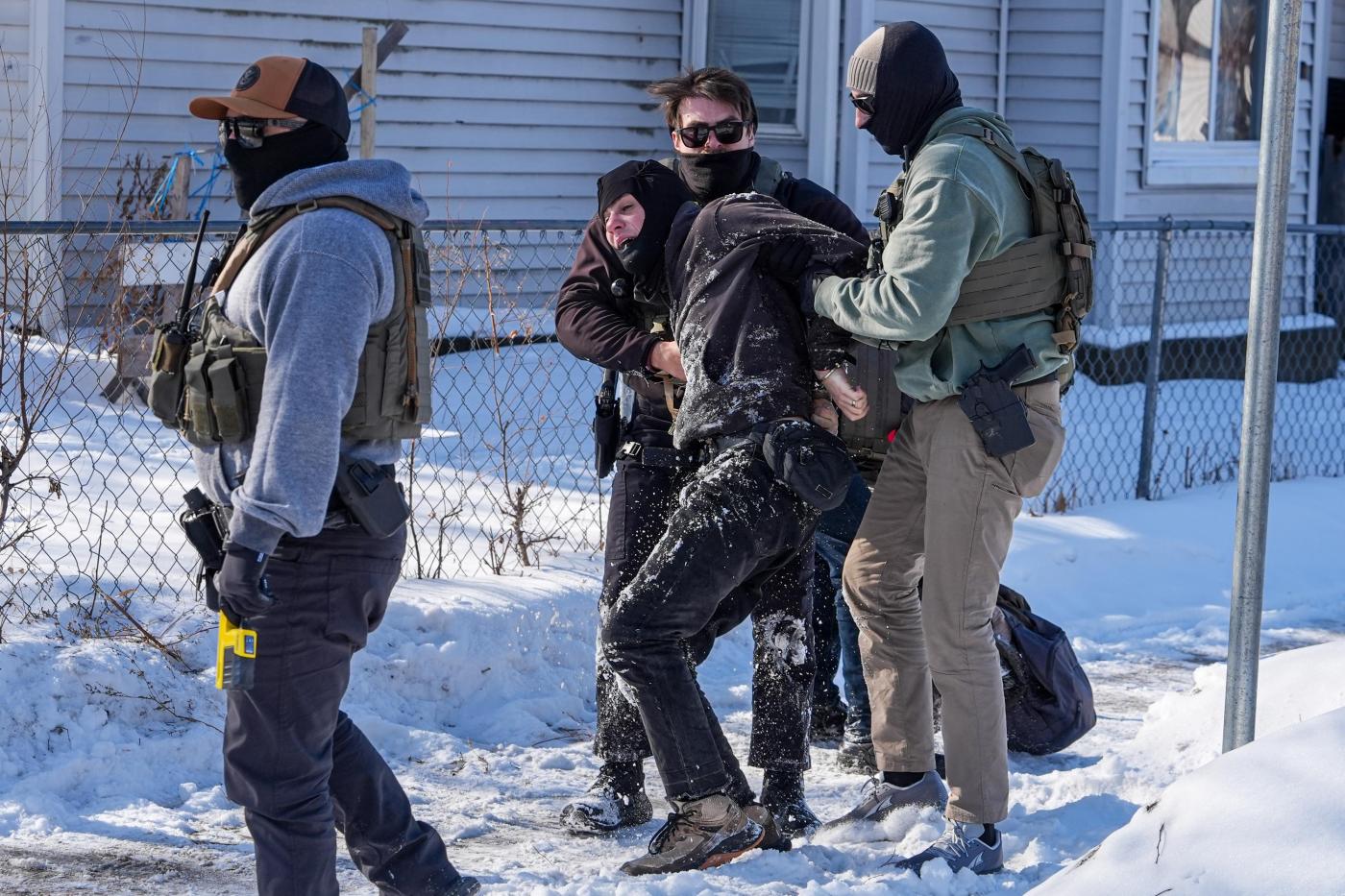
Ruling against the tide, a North Dakota judge denies emergency petitions for Minnesota ICE detainees

BISMARCK — New cases involving noncitizen Immigration and Customs Enforcement detainees have inundated Minnesota’s federal courts in the last month, prompting the 8th Circuit Court of Appeals to issue a plea to judges from several neighboring states to help handle the unprecedented deluge.
As the caseload continues to grow, the rulings of a North Dakota judge who opted to pitch in have been in sharp contrast to those of the majority of his peers, both in Minnesota and around the country.
In January, hundreds of emergency habeas corpus petitions were filed on behalf of the detainees, asking for judges to consider whether they are being held lawfully pending their removal proceedings. The petitions are not contesting removal orders, only the lawfulness of detaining the noncitizen plaintiffs during those proceedings.
The cases stem from new guidance issued by the Justice Department last July that any noncitizen should be considered an “applicant for admission,” thus subject to immediate arrest and mandatory detention pending their removal, regardless of their criminal, work or family history, how long they have been in the country, or pending paperwork for citizenship. Even though this new policy ran counter to the way the rules for arresting and detaining noncitizens had been enforced for decades prior, ICE immediately began operating accordingly.
At first, the number of lawsuits challenging the new policy was manageable — only about 50 noncitizen detainee habeas cases were filed between when the rule change was implemented and the end of October in Minnesota. But a flood of filings began in December, when ICE’s immigration crackdown in Minnesota, known as Operation Metro Surge, began. It reached a fever pitch last month, prompting the 8th Circuit Court’s appeal to nearby judges.
Judge Daniel Traynor, appointed in 2019 by President Donald Trump and chambered in Bismarck, was one of a handful of judges who volunteered to take on some of the Minnesota habeas cases starting in mid-January. In addition to Traynor, judges from federal courts in Iowa, Nebraska and Missouri are assisting the Minnesota courts with the cases.
Twenty-two such cases have since been assigned to Traynor in Minnesota. As of Thursday, Feb. 5, he had ruled on nine, denying the petitions of noncitizen detainees from countries such as Mexico and Ecuador in seven, granting release for a man who entered the U.S. from Mexico in 2002 at the age of 8 and who has protected status under the Deferred Action for Child Arrivals program, and denying the emergency motion for release of a Salvadoran father of three with no criminal history.
Traynor’s denials run contrary to the decisions of nearly every one of his colleagues both in Minnesota and North Dakota, as well as a vast majority of judges across the country.
An analysis by The Forum of the 236 cases challenging the Trump administration’s new rules around mandatory detentions that were filed in Minnesota between Jan. 22, when Traynor started his volunteer stint, and the end of the month, found the detainee plaintiffs prevailed in 134 of those cases. Fifteen different judges granted the habeas corpus petitions in those cases, either ordering their immediate release or that an immigration court bond hearing be held. Meanwhile, the petitions of just eight Minnesota detainees have been denied in that same time period, all but one of those by Traynor. The remaining cases were voluntarily dismissed or were still pending as of Feb. 3.
While Traynor has not ruled on any such cases in North Dakota, the state’s other federal judges have decided in favor of the noncitizen detainee plaintiffs in three cases — two by Judge Daniel Hovland and one by Judge Peter Welte.
In his court orders, Traynor readily acknowledges his decisions are anomalies, bucking both the national trend and judicial precedent, while insisting they are the correct ones.
“The overwhelming majority of district courts sometimes get the law very wrong,” Traynor wrote in one of his denials while quoting another court’s decision. “The Court is also aware that the federal government has operated under the Petitioner’s reasoning for decades. However, someone does not suddenly become right simply because they have held onto a wrong belief for a very long time.”
Traynor acknowledged that while the DOJ had previously advised that noncitizens were entitled to bond hearings or release during their removal proceedings, the change in executive agency policy in July and a subsequent finding by the Board of Immigration Appeals based on that change in September now justifies their detention.
“It is a sorrowful conclusion to require an otherwise law-abiding man be detained and kept from his family,” Traynor wrote in his decision denying the release of the Salvadoran father. “But the law requires his detention without bond under the circumstances presented in this case. The executive branch must be permitted sufficient flexibility to ensure our nation’s borders are secure and to have enough authority to conduct thorough inspections and removals. The Court’s role in all of this is simply to determine what the law is within the bounds of our constitutional structure.”
In their decisions finding in favor of the detainees, more than a dozen other judges said a different part of U.S. code governs detention of noncitizens already present in the U.S., and under that statute, detention is not mandatory and release on bond or recognizance is permitted.
“This case asks whether Respondents may detain a noncitizen … if the noncitizen entered the United States without encountering border officials and was later arrested within the country’s borders. The answer is no. Because Petitioner … is already in the country, not seeking admission at the Nation’s borders or ports of entry, Respondents cannot subject him to mandatory detention,” Judge Jerry Blackwell wrote in one of his many opinions granting habeas corpus petitions.
According to an analysis by Politico, as of Jan. 26, 347 judges across the country have rejected the administration’s detention policy in more than 2,500 cases, while just 20 judges have sided with the administration.
The Forum asked Traynor for comment on his assistance in the Minnesota cases though the Clerk of Court’s office in Bismarck, but did not receive a response.
Related Articles
St. Paul: Lake Phalen event seeks to shine light over ICE
Noah Feldman: ICE isn’t just breaking the law. It’s trying to rewrite it.
Other voices: Trump’s mass deportation strategy backfires
Far-right provocateur faces felony charge for damage to ‘Prosecute ICE’ sculpture
Leadership changes in Minnesota follow tensions among agencies over immigration enforcement tactics

More Stories
Petrol set to top £1.50 a litre as Iran war drives fuel price surge
UK drivers are bracing for a sharp rise in fuel costs, with petrol prices expected to exceed £1.50 per litre...
Dyson hit by £440m sales drop as Trump tariffs bite
Dyson has reported a £440 million drop in annual sales after being hit by US trade tariffs, although the group...
Octopus Investments to cut 20% of staff as AI reshapes asset management
Octopus Investments is set to cut around a fifth of its workforce as it accelerates the adoption of artificial intelligence,...
Next to invest £300m in UK logistics as new warehouse set to deliver £2.5bn boost
Next has unveiled a major expansion of its UK logistics network, committing more than £300 million to new warehouse infrastructure...
US warns Starmer’s EU reset could strain UK trade ties
The United States has warned that Sir Keir Starmer’s push to realign the UK more closely with European Union rules...
UK set for biggest growth hit among major economies from Iran war, OECD warns
The UK is expected to suffer the largest economic hit among major global economies from the ongoing Middle East conflict,...