
Isaacs Houses Residents Weigh Ditching Public Housing for Section 8

Residents of the Yorkville development will be the first NYCHA tenants of the year to vote on whether they want to abandon their traditional public housing model for one of two options that would ensure more funding, but could change how their buildings are managed.
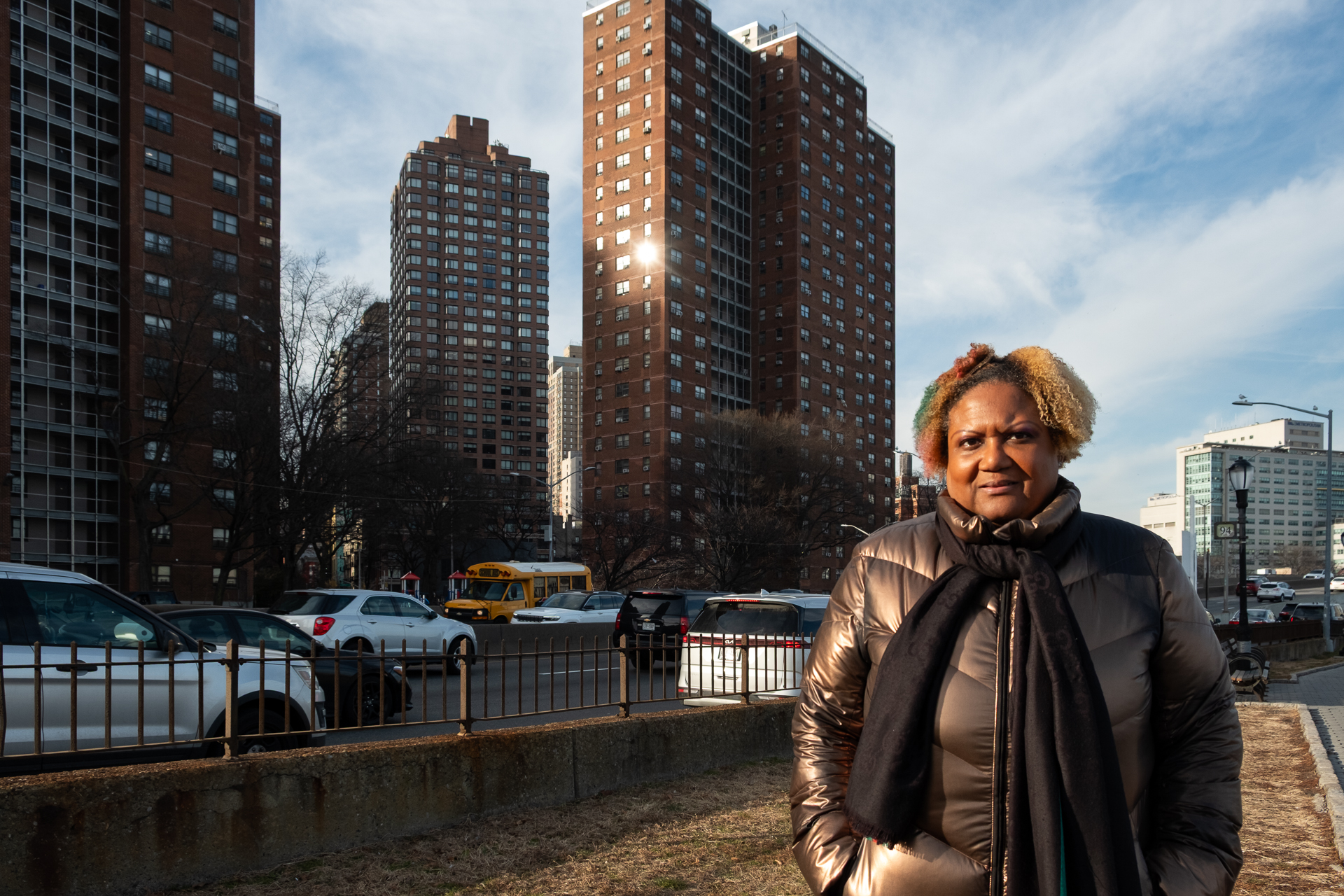
“At the end of the day, you know what you have with Section 9,” said resident Saundrea Coleman, who co-founded a tenant group that opposes the switch the Section 8. (Adi Talwar/City Limits)
Residents of Yorkville’s Stanley Isaacs Houses will be the first NYCHA tenants of the year to vote on whether they want to abandon their traditional public housing model for one of two options that would ensure more funding, but could change how their buildings are managed.
Starting Feb. 13, each resident over the age of 18 will have the opportunity to vote between three choices: to lease their buildings to private developers and switch to Section 8 as part of the Permanent Affordability Commitment Together (PACT) program, to switch to the state-managed Public Housing Preservation Trust that also utilizes Section 8, or to remain as Section 9, the federal government’s public housing program.
At its core, the vote is a choice of how to deal with the decades-long, chronic underfunding of public housing—slated to only be exacerbated throughout Trump’s presidency. Both of the new choices move residents to Section 8, a federal voucher with more guaranteed funding than Section 9 that would allow residents to keep paying 30 percent of their income towards rent.
With the buildings guaranteed a more consistent future revenue source, their managers would borrow money to fund large-scale renovations. But making the switch requires tenants to sacrifice the stability of Section 9, leading many to question if it’s worth tolerating temporary relocations—and in the case of PACT, higher eviction rates and increased surveillance—that they’ve heard about at other NYCHA developments that have converted.
“We all want repairs. That’s our goal. We all want to live in healthy homes, but there’s other ways to get it done,” said Saundrea Coleman, a resident who co-founded the Holmes-Isaacs Coalition, a tenant group opposing PACT and what she calls the “Preservation Distrust.”
“At the end of the day, you know what you have with Section 9,” Coleman said.
Isaacs Houses is the eighth NYCHA development where residents have been asked to vote on how to fund repairs. In previous elections, four campuses have voted to join the Trust, two to remain in Section 9, and one voted for PACT (though NYCHA has converted thousands of other units to private management without a vote, which is only required when the Trust is on the table).
NYCHA’s Stanley Isaacs Houses campus on Jan. 13, 2026. (Adi Talwar/CIty Limits)
If residents choose PACT, the buildings will be leased to developers who will receive private financing the government can’t access to renovate them. Developers will then pay back this loan and earn some profit with rents they collect as the buildings’ new managers. In the Public Housing Preservation Trust, bonds are floated to fund the renovations, which NYCHA, which maintains control of the buildings, also pays back with the Section 8 revenue stream.
While PACT has delivered significant renovations—raising $13 billion for capital repairs across 146 NYCHA developments, according to the latest tally—converted sites have seen higher eviction rates compared to Section 9. Residents don’t know which companies will take over until after the vote, and different companies have had vastly different records. Tenants at some privately managed developments have complained of eroded transparency and persistent repair issues.
Unlike PACT, which was created in 2016, The Public Housing Preservation Trust was only established in 2022, and there has not yet been time for buildings to vote, convert, and be fully renovated. For this reason, residents don’t yet have concrete examples to look at when considering the Trust.
“A lot of us have decided to move forward with Section 9 just for fear that PACT wouldn’t be a fit for us,” said Maribel Mejia, an Isaacs Houses resident of 25 years who also doesn’t want to vote for the Preservation Trust. “It seems like there’s a lot of nice developments that are happening through PACT, but it also seems like it’s a high risk for us because, god forbid, things don’t go as planned as far as construction goes.”
The Isaacs Houses are three buildings pressed alongside the FDR highway, lined by the East River on one side and The Holmes Towers, a different NYCHA development, on another. The more than 600 units have had an anomalous last decade, scoring an 86 out of 100 in their 2015 inspection from the U.S. Department of Housing and Urban Development—one of NYCHA’s highest scores—then falling to a 25 in 2017, one of the lowest, before immediately moving up to a 79 the following year. In its 2024 inspection, the Isaacs Houses earned an 80.
A view of NYCHA’s Stanley Isaacs Houses campus and its surrounding neighborhood. (Adi Talwar/City Limits)
Neither public records nor resident experiences explain why the score was so low for that year, but it is used by NYCHA as an explanation for why it selected the Isaacs Houses for the vote. Officials say they select developments based on a combination of building conditions and resident interest, primarily gauged through Tenant Associations.
Residents at the Isaacs Houses report inconsistent heating, frequent leaks and broken locks, as well as persistent rodent infestations. However, the buildings are in better shape than other public housing properties, with an estimated $400,000 in repair needs per unit, about $100,000 below NYCHA’s average.
“I don’t need any repairs because I’m happy, but they said because the buildings are old, they have to fix the system,” said Gladys Muñiz, who has lived at Isaacs Houses since it first opened in 1965. She plans on voting for the Trust.
Latasha Pryce, an English teacher who has lived in the buildings for 12 years, said the vote brings up a lot of unknowns. “I agree that you have to sacrifice some things. I think I’m just worried about, are we going from a not so great situation into a worse situation?” said Pryce.
“Who’s gonna take over the buildings? How will we go about repairs? What’s the process to switch over to Section 8? Some developments kick you out of your apartments temporarily and everyone’s kind of juggled around until they fix your apartment. Are they going to do that here?” Pryce added, in reference to the Fulton and Elliott-Chelsea Houses.
Those Lower Manhattan developments, part of PACT, are slated to be demolished and replaced by whole new buildings, part of a massive redevelopment plan that will also build 3,500 mixed-income homes, both market-rate and affordable units. While the majority of residents will remain in their current apartments until the replacement ones are built, an estimated 120 households have to temporarily move to other NYCHA-provided apartments during renovations.
The plan has split residents, and opponents have resisted demolition with protests and lawsuits. Their experience has resounded across the NYCHA community—for some, as a worst case scenario for what PACT could bring (though full demolitions have not happened at any of the other dozens of PACT developments, and there is no indication they would at the Isaacs Houses.)
NYCHA flyers in the hallway at the Isaacs Houses looking to dispel “myths” about Section 8. (Adi Talwar/CIty Limits)
“What I’m hearing is if you switch over they’re gonna fix up the place. But I’m also hearing that you can lose your apartment,” said Alex Beasley, who raised six children and three grandchildren in the Isaacs Houses, in reference to higher eviction rates at PACT developments and rumors that the program is a way for private developers to seize control of city-owned housing. “This is prime real estate right here. We’re on the Upper East Side.”
NYCHA, which hosted four informational meetings in recent months ahead of the vote, has pushed back against those rumors. “Neither the Trust nor the PACT plan results in privatizing public housing,” reads a set of flyers recently hung throughout the Isaacs Houses informing residents about the upcoming vote. NYCHA retains ownership of the land and buildings in both scenarios, the flyers note, and still has oversight over the developments.
The posters also emphasized the necessity of switching to Section 8 due to NYCHA’s funding needs, and said that tenants won’t lose rights and that evictions won’t increase because of the shift (in contradiction to reports from Human Rights Watch and the New York City Comptroller’s Office that found more eviction filings at PACT sites, findings which NYCHA previously disputed).
With these factors in mind, Isaacs Houses residents are still parsing through the different information they’re receiving from groups promoting all three options who are canvassing tenants about why their choice is the best path for the buildings.
“I need to do more research,” said Lissette Santos. She’s lived in NYCHA’s Stanley Isaacs Houses with her husband and four children for the past eight years. (Adi Talwar/City Limits)
“Part of me would like to see the projects be under better conditions, like repairs, cleaner, newer implements such as piping and stuff like that. However, at the same time, I’m scared because I do see a lot of things of how other projects have been privatized and how there are more evictions going on than the usual evictions under NYCHA,” said Lissette Santos, who lives in the development with her husband and four children.
“I need to do more research than what we’ve been provided. I feel like there should be more either meetings or something informing, but sometimes it can be biased.”
Voting at the Isaacs Houses can be done by mail or online from Feb. 13 through March 16, or in-person starting on March 12. More information can be found here.
To reach the editor, contact Jeanmarie@citylimits.org
Want to republish this story? Find City Limits’ reprint policy here.
The post Isaacs Houses Residents Weigh Ditching Public Housing for Section 8 appeared first on City Limits.


More Stories
Four takeaways from Brad Stevens’ Celtics trade deadline breakdown
The Celtics pulled off four trades ahead of Thursday’s NBA trade deadline. On Friday, president of basketball operations Brad Stevens...
Leadership changes in Minnesota follow tensions among agencies over immigration enforcement tactics
By REBECCA SANTANA and ELLIOT SPAGAT WASHINGTON (AP) — White House border czar Tom Homan’s announcement that enforcement in Minnesota...
Leadership changes in Minnesota follow tensions among agencies over immigration enforcement tactics
By REBECCA SANTANA and ELLIOT SPAGAT WASHINGTON (AP) — White House border czar Tom Homan’s announcement that enforcement in Minnesota...
Norfolk DA chief trial counsel Greg Connor is running for top job
The longtime chief trial counsel for the Norfolk District Attorney’s office has entered the race for the top job. The...
Oregon, Washington and tribes head back to court after Trump pulls out of deal to recover salmon
By CLAIRE RUSH PORTLAND, Ore. (AP) — Lawyers for conservation groups, Native American tribes, and the states of Oregon and...
Oregon, Washington and tribes head back to court after Trump pulls out of deal to recover salmon
By CLAIRE RUSH PORTLAND, Ore. (AP) — Lawyers for conservation groups, Native American tribes, and the states of Oregon and...