
NYC Cracks Down on Employment Agency Violations Following City Limits’ Investigation

Thousands of local job hunters in recent years—in particular, those with low incomes who are not native English speakers—have paid illegal upfront fees to employment agencies, or received only partial refunds for what they paid despite not landing work, according to the city.
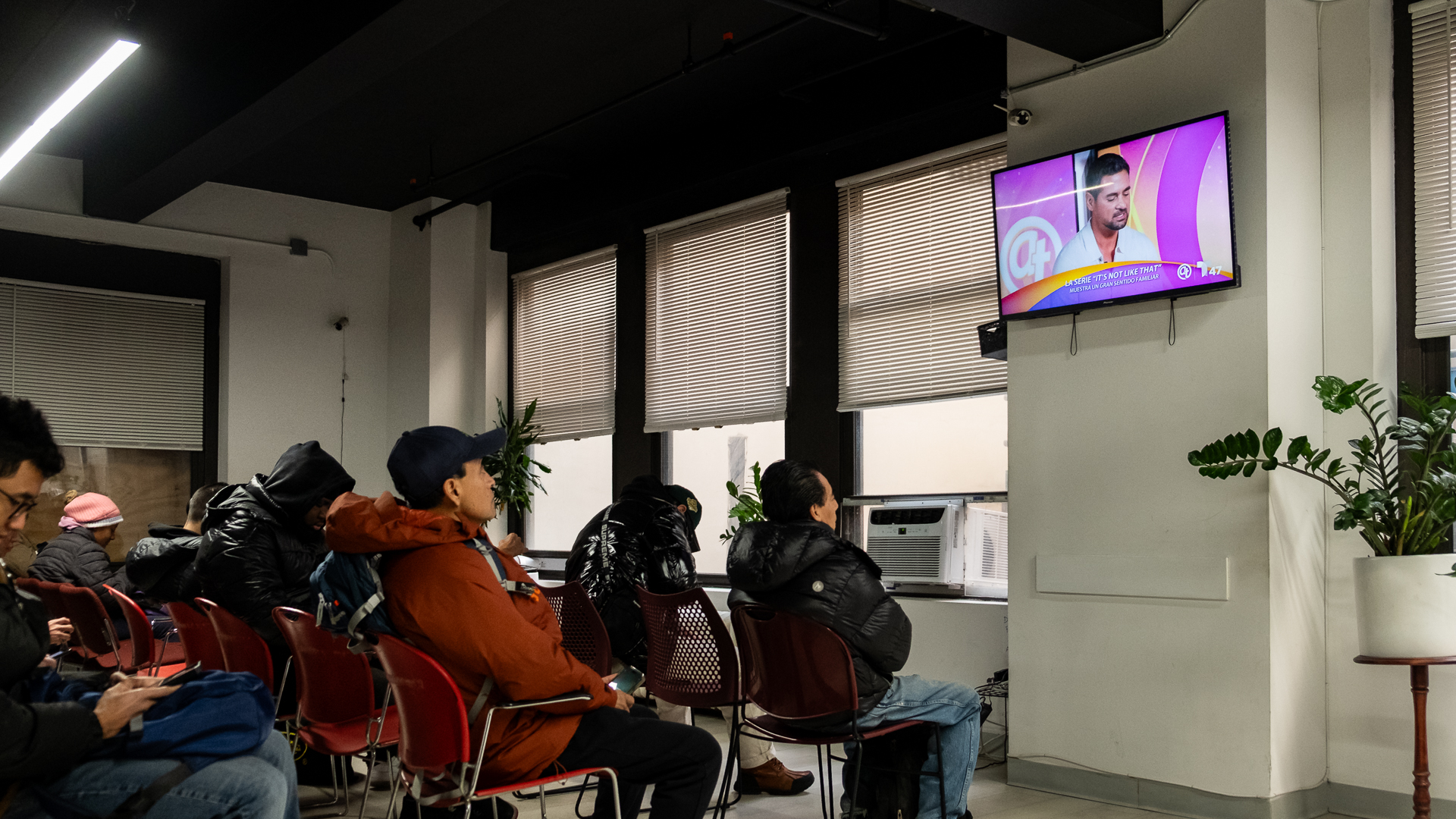
People waiting inside Eleny’s Employment Agency in Midtown Manhattan on a recent weekday. The firm is one of three the city’s Department of Consumer and Worker Protection looked into recently as part of a compliance review. (Adi Talwar/City Limits)
It’s common for some unemployed New Yorkers to look for work through an employment agency.
But thousands of local job hunters in the last four years—in particular, those with low incomes who are not native English speakers—have paid illegal upfront fees to these agencies, or received only partial refunds for what they paid despite not landing work, according to the city.
In 2023, as tens of thousands of immigrants and asylum seekers arrived in New York City, City Limits reported on those who’d turned to employment agencies for assistance—and paid fees for jobs that never materialized. “This is the perfect storm for unscrupulous employers and unscrupulous employment agencies,” Hildalyn Colon-Hernandez, deputy director at New Immigrant Community Empowerment, said at the time.
Following City Limits’ reporting, the city’s Department of Consumer and Worker Protection (DCWP), which regulates and licenses employment agencies, undertook a compliance review, examining the practices of companies that had received the most complaints.
“We sent a broader sort of request for documents to a number of employment agencies,” DCWP’s Deputy General Counsel Melissa Iachan said. “What we found in our review was that it appears that many of the employment agencies are engaging in lots of similar unlawful conduct, and it is going uncomplained about, largely because their deception is such that they even deprive consumers of knowing that they have certain rights.”
As a result, DCWP has litigated against three companies—including two that City Limits reported on in 2023—with the Office of Administrative Trials and Hearings (OATH), an independent administrative law court that resolves disputes and violations. So far, it’s resulted in the issuance of millions of dollars in civil penalties as well as restitution to compensate affected job seekers, officials said.
“With the sort of boom-boom-boom!—1-2-3—filing three cases in less than a year, we are hoping to put the industry on notice,” Iachan said.
According to the state’s Employment Agency Law, which the city enforces, companies shouldn’t require a deposit or advance fee from applicants looking for work. If this does occur, and the applicant is ultimately not placed in a job, they can demand a refund within seven days. DCWP also requires employment agencies to provide receipts that include this information in bold, so job seekers are aware of their rights.
The three companies DCWP investigated violated this rule, officials said. They include Golden Rose, an employment firm based in Crown Heights, Brooklyn, which officials say charged people advanced fees or deposits ranging from $50 to $150 and did not always refund them when required.
Golden Rose—which DCWP said worked with 2,553 customers in a one-year period—went before OATH in October 2025. In December, DCWP sent its post-trial briefing, and has requested civil penalties totaling $883,200 and $426,324 in restitution to compensate affected people.
A DCWP inspector documents the required postings at Eleny’s Employment Agency in Midtown Manhattan during an inspection last month. (Adi Talwar/City Limits)
Golden Rose requested the opportunity to respond to DCWP’s briefing, and is expected to do so in the coming weeks. A lawyer representing the company declined to comment, citing the ongoing proceedings.
In Midtown Manhattan, another firm, Eleny’s Employment Agency—which, according to DCWP’s civil action petition at OATH, is “the employment agency against whom the Department has received the most complaints in the last five years”—is accused of charging illegal fees ranging from $100 to $200 per applicant, using misleading documents, and failing to provide people with the information they’re entitled to under city rules.
A lawyer representing owner Eleny Asevedo disputed the alleged violations. “Her job placement rate is extremely high, and everyone who doesn’t get placed receives a full refund,” attorney Rebecca Szewczuk said in a statement. “She keeps perfect records, cooperates with inspection after inspection, and works hard to comply with the constantly changing laws of New York City, even when the City’s government can’t be bothered to notify her of the new rules.”
“Eleny operates her business alone, and she has helped so many to find work,” Szewczuk said, adding that the owner is “saddened that the City is trying to put her, and others like her, out of business for a quick buck.”
DCWP says the third agency it took before OATH, called CMP, also collected fees in advance and didn’t return them upon demand—which is against the law—and failed to include the required information on receipts given to customers, so people didn’t know they could get their money back.
Officials sought civil penalties of $2,266,500, and $979,610 in restitution—based on DCWP estimates for the number of CMP customers affected from 2022 to 2024, calculated as 6,818 people. In September, OATH sided with DCWP.
“We won,” Iachan said. “We 100 percent were successful, and we were awarded $2 million.”
The lawyer who represented CMP at OATH did not respond to a request for comment. However, the agency—which had two locations, one in Astoria and the other in Kingsbridge Heights—gave up its license and stopped operating in 2024, claiming financial hardship, making collection very challenging for both the city and affected consumers.
Iachan, along with Lindsay DeCicco, DCWP’s counsel who represented the department at OATH, explained that the city has a process to collect those funds: DCWP tries first, then it goes to the New York City Law Department, which contracts with external law firms to collect on money owed to the city.
But “given what we know about that company and the fact that they’ve not been operating, it’s probably not super likely we’re gonna see money at all,” Iachan conceded, disappointed.
A DCWP inspector reviewing Eleny’s Employment Agency’s paperwork during a recent inspection. (Adi Talwar/City Limits)
“While not every case results in direct restitution, DCWP seeks to obtain restitution for every complainant, both through individual mediation and through larger-scale enforcement actions, which are an important part of protecting workers and holding employment agencies accountable,” a spokesperson for the agency said in a statement.
In addition, DCWP started sending notice letters to all employment agencies in the city this week as part of a compliance campaign before companies apply to renew their licenses.
“Before submitting renewal materials, agencies should review their practices and records to ensure full compliance with all applicable requirements,” notes a version of the letter reviewed by City Limits.
To reach the reporter behind this story, contact Daniel@citylimits.org. To reach the editor, contact Jeanmarie@citylimits.org
Want to republish this story? Find City Limits’ reprint policy here.
The post NYC Cracks Down on Employment Agency Violations Following City Limits’ Investigation appeared first on City Limits.


More Stories
Slotkin rejects Justice Department request for interview on Democrats’ video about ‘illegal orders’
By JOEY CAPPELLETTI, Associated Press WASHINGTON (AP) — Democratic Sen. Elissa Slotkin of Michigan is refusing to voluntarily comply with...
ICO fines Imgur owner £247k over children’s data failures
The UK’s data protection watchdog has fined the owner of image-sharing platform Imgur nearly £250,000 after finding serious failures in...
Nigeria crea comando militar para frenar avance de islámicos tras ataque que dejó más de 160 muertos
Por OPE ADETAYO LAGOS, Nigeria (AP) — El gobierno de Nigeria anunció una nueva operación militar para enfrentar a los...
Chinese carmaker Chery to launch fourth brand in the UK
Chinese state-owned carmaker Chery is pressing ahead with its rapid UK expansion by launching a fourth brand in the British...
US and Russia agree to reestablish military-to-military dialogue after Ukraine talks
By KAMILA HRABCHUK, Associated Press KYIV, Ukraine (AP) — The U.S. and Russia agreed on Thursday to reestablish high level...
US and Russia agree to reestablish military-to-military dialogue after Ukraine talks
By KAMILA HRABCHUK, Associated Press KYIV, Ukraine (AP) — The U.S. and Russia agreed on Thursday to reestablish high level...