
Amid NYC Cold Snap, Tenants Report Most ‘No Heat’ Complaints on Record

The city received nearly 80,000 calls about lack of residential heat and hot water in January, more than any other month on record. Some tenants say their buildings are falling through the cracks.
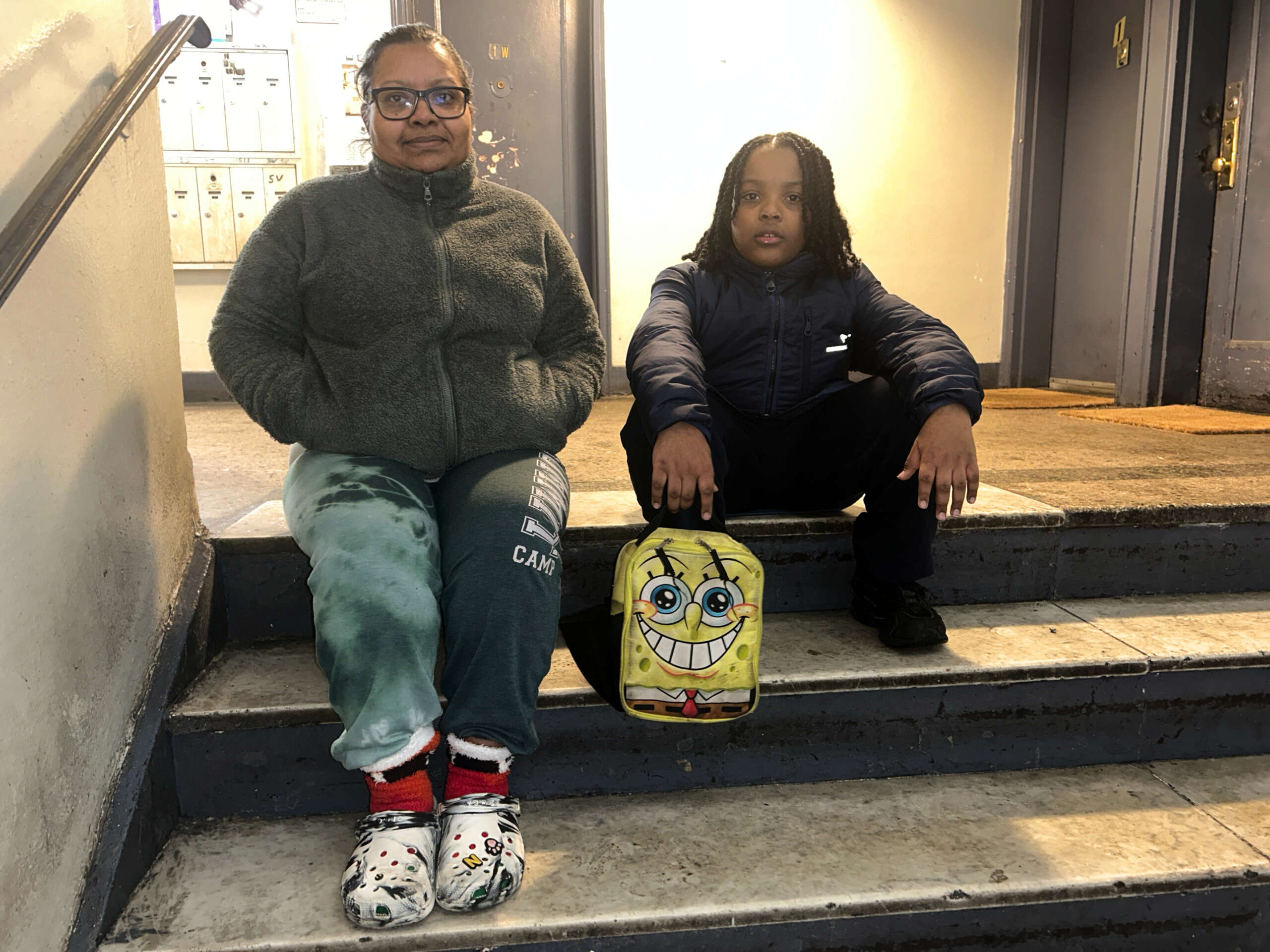
Nicole Gallan, a tenant in Flatbush, Brooklyn, with her 10-year-old son. They’ve been without heat in recent weeks, and living and sleeping in layers of clothing. (Patrick Spauster/City Limits)
During nine straight days of below freezing temperatures, tens of thousands of New Yorkers went without heat at home, complaints made to the city suggest.
Officials have encouraged people without heat to talk to their landlord and call 311 if problems persist—and the city’s housing agency is now fielding more complaints than ever. During the last week of January, 30,000 tenants called in, the most heat complaints ever recorded in a seven-day period, according to city data.
While the department of Housing Preservation and Development (HPD) tries to respond to as many as possible, some tenants say their buildings are falling through the cracks.
“We’ve been calling, but nothing happens,” said Nicole Gallan, a tenant in Flatbush, Brooklyn.
Tenants in her building at 155 Linden Blvd. have called 311 160 times about heat in the past week and a half. Gallan said a repairman was there to fix the boiler last weekend, but the mechanicals are so old they continuously break. The building’s manager, MP Management, declined to comment.
HPD issued at least three heat violations in the building this week (the agency did not immediately comment for this story). When an inspector came to Gallan’s apartment, she said that they measured the temperature at 43 degrees.
Gallan has lived in the apartment for 25 years. Her kids, 10 and 23, sleep in layers. “Two pants, two tops—we’re all bundled up,” said Gallan.
She runs a space heater when she can, but her electricity is inconsistent too. With several tenants trying to run electric heat—which they pay for themselves—the electric circuits are frequently blown, she said.
City inspectors issued at least three heat violations at Gallan’s building in Flatbush this week. (Patrick Spauster/City Limits)
Landlords are required to keep apartments at 62 degrees Fahrenheit during the day and 68 degrees at night throughout the city’s “heat season,” which stretches from Oct. 1 to May 31. If you are having trouble getting consistent heat in your apartment, here are some tips for how to get help.
The Mayor’s Office said 16 people have died outdoors in the cold so far.
A spokesperson for Mayor Zohran Mamdani, Matt Rauschenbach, said that “safe, healthy, affordable housing isn’t a luxury, it’s a right.” He said that the city wants to hear directly from tenants at upcoming Rental Ripoff Hearings.
In all, the city received nearly 80,000 calls about lack of residential heat and hot water in January, more than any other month since the city began recording the data in 2010. The record month broke January 2025’s record high by more than 12,000 calls.
The uptick in calls demonstrates some long-standing complaints with the city’s 311 system and HPD’s responses.
No heat or hot water is considered an immediately hazardous “class C” violation which should trigger an inspection within a few days. But residents don’t know when inspectors will come—and they often come during work hours—meaning tenants may not be home to give them access.
“There’s no way for me to let you into my apartment. So it’d be nice if they had some sort of scheduling system where you could provide your availability and they could do the inspection based on your availability, as opposed to just showing up,” said Kathleen Davis, a supportive housing tenant in the Bronx.
The issue is something new Mayor Zohran Mamdani pledged to address when he was running for office. “When a tenant reports a code violation to 311, they get routed to one of many different agencies and, in most cases, have no ability to track when inspectors are coming,” his campaign platform reads. “We will enable tenants to schedule an appointment with an inspector and receive reminders over text.”
Rauschenbach said that the Mayor’s Office to Protect Tenants is looking closely at how housing codes are enforced by working with HPD and tenant leaders to “fix a system that’s been broken for too long.”
Enforcement can be tricky. Some buildings with inconsistent heat may be warm in the common spaces, but below the legal standard in certain apartments. Sometimes the heat is inconsistent at a particular time of day, and inspectors might miss it.
Nicole Gallan’s building in Flatbush, where residents have called 311 160 times about heat in the past week and a half. (Patrick Spauster/City Limits)
Kenny Burgos, CEO of the landlord group New York Apartment Association, said that older heating systems are inconsistent, sometimes overheating some apartments on upper floors, and leaving others cooler.
Other buildings go years without consistent heat, as former Comptroller Brad Lander reported last year. Lander criticized HPD under former Mayor Eric Adams for not intervening when buildings have persistent problems (the agency will sometimes do repairs directly in emergencies, and then bill the landlord.)
Burgos said that rent stabilized buildings like 155 Linden are more likely to have heat problems because they are older and in financial distress, without money for heating systems.
He partly blamed New York’s rent regulations, which state lawmakers strengthened in 2019 and which limit annual rent increases for about 1 million stabilized apartments across the city. Tenant advocates argue regulation is essential for keeping low-income New Yorkers housed in a city of ever-increasing rents, but landlords say it limits their ability to make repairs.
“A boiler can cost you well over $300,000 to replace, and when you have buildings that are being completely defunded by an increase in cost pushed on by the city and state through property taxes, through water bills, through underfunded rent guidelines board adjustments, and capped revenues, as well as 2019 rent laws,” said Burgos.
Davis says inspectors came to her building earlier this week, but since she was at work, she couldn’t let them into her apartment to measure the temperature, which she says is consistently below the legal limit.
“I’m on the verge of getting sick from the lack of heat,” she said.
Inspectors did not issue a heat violation at the building. HPD contacted building management and some tenants by phone and closed out several building-wide complaints earlier this week, according to complaint records.
Burgos suggested that many landlords are replacing older heating systems to comply with new energy-efficiency rules that may result in apartments being cooler than tenants expect, but not rising to the level of a violation.
Heat and hot water complaints had already been on the rise in New York City. They jumped 12 percent last year and 60 percent since 2016, according to City Limits’ prior reporting.
HPD previously told City Limits that some of the increase could be due to successful education and outreach efforts that encourage tenants to call and use the resources available to them. The agency said it’s also stepped up enforcement. New Yorkers aren’t just calling more, HPD is issuing more violations—over 9,000 in each of the past two years, double what it issued in the past.
The cold in New York City is expected to persist through mid-February.
Are you having trouble getting heat in your apartment? Have you been able to get the city to come for an inspection? Send tips to patrick@citylimits.org
To reach the editor, contact Jeanmarie@citylimits.org. Want to republish this story? Find City Limits’ reprint policy here.
The post Amid NYC Cold Snap, Tenants Report Most ‘No Heat’ Complaints on Record appeared first on City Limits.


More Stories
In a shot at Mayor Wu, Senator Collins asks state to help Boston dig out from snowstorm
In a veiled dig at the mayor, state Sen. Nick Collins formally requested that the state step in to help...
Judge: Deal reached to protect identities of Epstein victims in documents release
By MICHAEL R. SISAK and LARRY NEUMEISTER NEW YORK (AP) — A deal was reached between lawyers for victims of...
Judge: Deal reached to protect identities of Epstein victims in documents release
By MICHAEL R. SISAK and LARRY NEUMEISTER NEW YORK (AP) — A deal was reached between lawyers for victims of...
Federal immigration officials scout warehouses as they eye more detention space
By HEATHER HOLLINGSWORTH, DAVID A. LIEB and MORGAN LEE Federal immigration officials are scouting warehouses and beginning to purchase some...
Federal immigration officials scout warehouses as they eye more detention space
By HEATHER HOLLINGSWORTH, DAVID A. LIEB and MORGAN LEE Federal immigration officials are scouting warehouses and beginning to purchase some...
Woman pleads guilty to charges related to posing as BPS student at 3 high schools
The 34-year-old woman who posed as a student at three BPS high schools in 2022 and 2023 pleaded guilty to...