
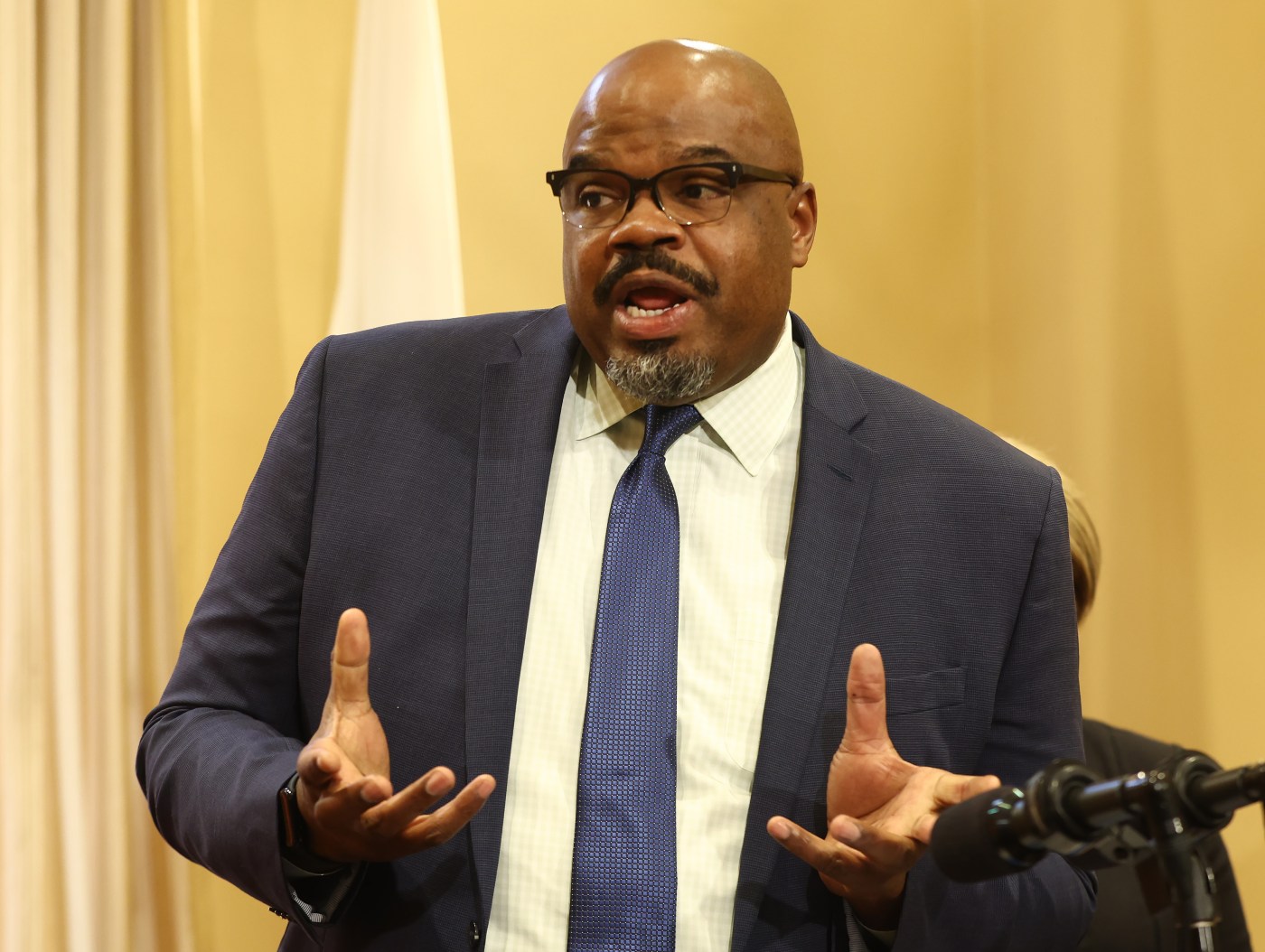
Massachusetts education secretary reflects on post-pandemic progress in schools

The Massachusetts Secretary of Education reflected back on the schools’ progress under the first years of the Healey administration and the challenges still ahead in a “State of Education” address — looking back over pandemic recovery, the post-MCAS requirement future and more.
“Across early childhood, pre-K–12, and higher education, our progress is real — and it is accelerating,” said Education Secretary Patrick Tutwiler during his address this week at the Rennie Center’s annual summit. “But it is also unfinished.”
The Healey administration began their term three years ago — six years out from the start of the pandemic — focused on three organizing principles in education to “stabilize, heal, and transform,” Tutwiler stated.
Throughout the speech, the secretary laid out progress and plans following those goals in several key areas, including early education, literacy, local funding, “reimagining” high school, post-MCAS overturn graduation requirements, and higher education.
The secretary began with early education, touting the administration’s “Gateway to Pre-K” agenda that has helped pre-K seats by 22,000 since before the pandemic, funded $1.2 billion for child care financial assistance, invested nearly $37 million in universal access to pre-K and more.
“Yesterday, Governor Healey’s House 2 budget proposal recommended nearly $1.9 billion for early education and care — an extraordinary investment that builds on our previous commitments,” Tutwiler said.
Rennie Center data shows district pre-K enrollment in 2025 just over 2019 enrollment across Massachusetts.
By the end of 2026, the education department said, the administration aims to deliver “universal, high-quality” preschool funding for all four-year-olds in Gateway Cities.
Of literacy, Tutwiler said, the state has requested $25 million to expand literacy resources, adding to $10 million previously given to 45 districts for instructional material and more and $25 million for tutoring.
Across Massachusetts, only 42% of students are meeting literacy proficiency in grade 3, compared to 56% in 2029, according to Rennie Center data.
The education department reflected on school funding changes, noting Healey’s new budget proposes raising special education and transportation funding by about $128 million for the previous year, increasing universal school meals funding by $18 million, providing $20 million in rural school aid and more.
For high school, Tutwiler highlighted the expansion of early college and career pathway programs, noting that enrollment increased 20% to 80,000 students now participating in the last three years. A proposed $53 million investment, he added, would further expand early college to over 100 schools.
The Healey administration aims to enroll 100,000 students in early college programs by 2036, the department said.
“(T)hroughout 2025, the K–12 Statewide Graduation Council worked to answer a pivotal question: What does it truly mean to prepare every student for the life they choose?” said Tutwiler, speaking to the council set up after voters overturned the MCAS graduation requirement in 2024. “The result is our Vision of a Graduate, which goes beyond academic content to center the skills and experiences essential for success—critical thinking, communication, problem-solving, civic engagement, and social-emotional readiness.”
The council released initial recommendations for statewide graduation requirements post-MCAS in December, including a controversial end-of-course testing provision among the seven-fold outline. The secretary and education commissioner are set to release a final version in the summer of 2026.
“This renewed vision of readiness leads us naturally to the next stage of the educational journey — higher education, where opportunity and economic mobility come into clear focus,” Tutwiler said.
Related Articles
Trump administration says San Jose State broke the law by allowing a transgender volleyball player
He left the US for an internship. Trump’s travel ban made it impossible to return
New York school violated civil rights law by changing name from ‘Thunderbirds’ to ‘T-Birds,’ US says
Florida deregulated nursing schools. Scam colleges and failing students followed
Conservative group says Los Angeles school policy hurts white students in federal lawsuit
Within higher education, Tutwiler highlighted the administration’s progress in doubling funding for financial aid, making community college free for residents, and eliminating tuition and fee costs for Pell grant-eligible students at public colleges.
The department noted undergraduate enrollment at public colleges and universities grew 5.7% between 2024 and 2025, including an 11.4% jump in community college enrollment.
“In Massachusetts, we are choosing to face our challenges—honestly, urgently, and collaboratively,” said Tutwiler. “And because we are facing them, we are changing them. We are opening pathways, closing gaps, and transforming lives.”


More Stories
OECD urges reeves to overhaul ‘inefficient’ UK tax system
Rachel Reeves has been told by one of the world’s most influential economic bodies that Britain’s tax system is holding...
Easter lifts footfall but retailers brace for April cost squeeze
Britain’s high streets enjoyed a welcome lift last month as an early Easter drew shoppers back through the doors, but...
Google takes on Opentable with AI that books your dinner in seconds
Google has fired the opening shot in a battle for Britain’s restaurant booking market, rolling out an artificial intelligence tool...
Retail backers of SEIT face wiping out half their money as green trust raises the white flag
Thousands of small investors who piled into one of London’s best-known green investment vehicles are staring down the barrel of...
White House warns staff over Iran war bets – media
The warning comes as markets have spiked on several occasions before big announcements by President Trump The White House has...
JLR battery plant lands £380m as government unveils £700m EV package
Jaguar Land Rover’s under-construction gigafactory in Somerset has been handed a £380 million taxpayer grant as part of a £700...