
No jail for anti-violence fraudster Monica Cannon-Grant

Monica Cannon-Grant was sentenced to six months of home confinement and four years of probation during a sentencing hearing on federal corruption charges in connection with her stuffing her pockets with the proceeds of an anti-violence charity in Boston.
Prosecutors had sought a year-and-a-half in jail.
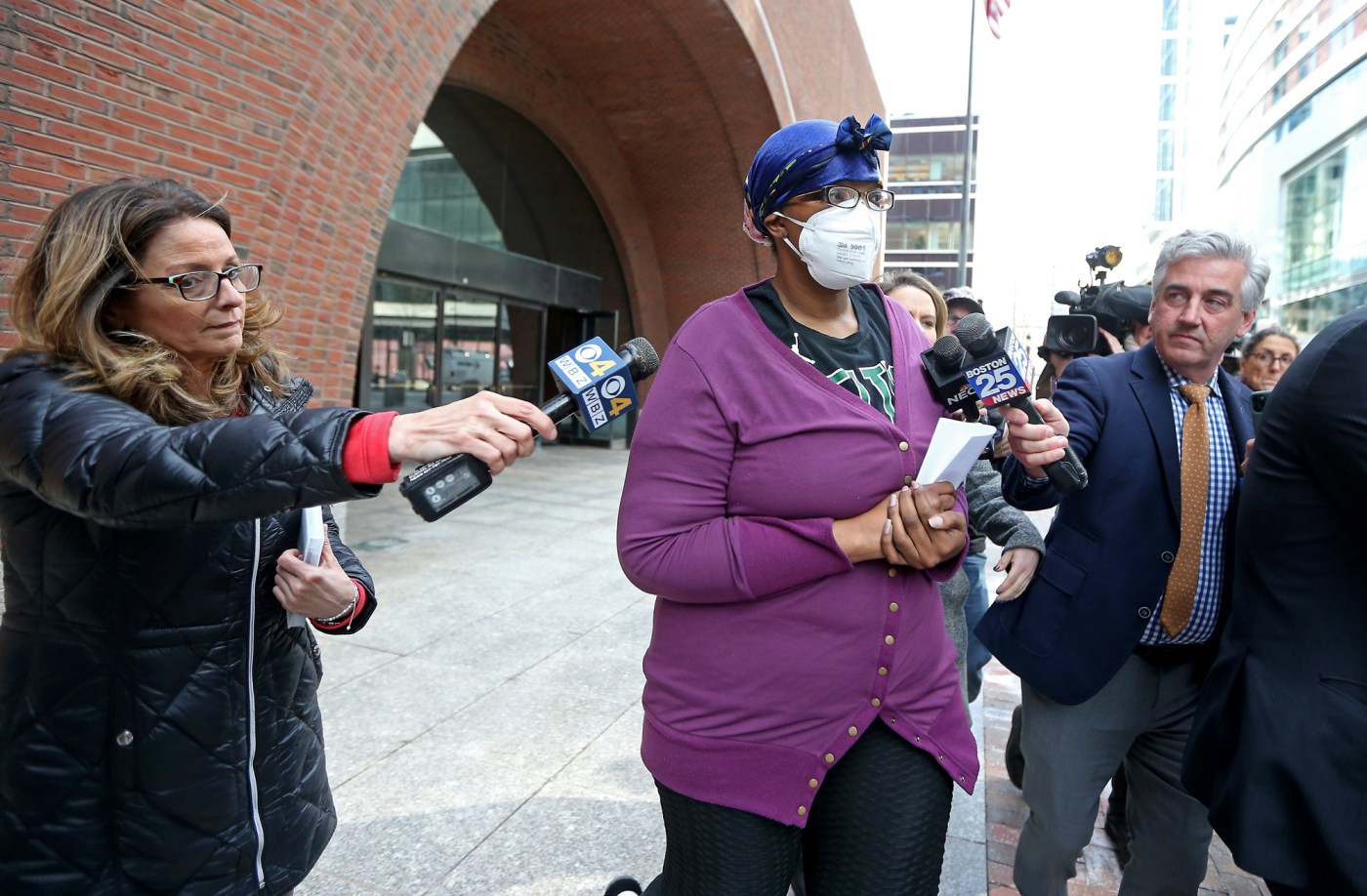
Cannon-Grant had not comment outside th courtroom Thursday, and dashed into a waiting SUV and drove away.
She was also ordered to pay $106,003 in restitution and more than $19,000 to the IRS.
“I know the actions being spoken of today do not define me and I will not let them define me going forward,” Cannon-Grant told U.S. District Court Judge Angel Kelley before the judge took a recess to weigh her sentencing options.
The defendant wore what appeared to be the same purple-ish cardigan sweater she wore at her initial federal arraignment in May 2022. Her attorney said that Cannon-Grant’s mother, husband, and some of her children were in the courtroom for the sentencing. Also present was former federal prosecutor Adam Deitch, who had been co-prosecutor on this case before leaving to run for Norfolk DA.
Cannon-Grant told the court she had done good work for her community, outlined a hard-scrabble early life in Boston neighborhoods “plagued by violence and poverty” and a home life also prone to violent outbursts from her alcoholic father.
She got pregnant at 17 while still in high school and the father was also abusive. She later found and married Clark Grant, who was a good partner with whom she raised her children, but he was killed in a motorcycle accident in March 2023, and that putting her in prison and away from the care of her children could be devastating.
As for her actions, Cannon-Grant said “I take full ownership of my actions” and was “truly apologetic” over them, but that she is also “extremely proud of what I have accomplished.”
She also said that “there were so many people who didn’t want me to succeed,” so much so that “some made death threats against my family and I” and that she had to suffer “racist” abuse by online detractors.
‘Who is Monica Cannon-Grant?’
Attorneys from both the prosecution and the defense presented to Judge Kelley a multifaceted defendant who had both done good in her community and had committed massive fraud.
“I think we would all agree that this is a really tough case. It would be a tough case for any judge to sentence,” federal prosecutor Dustin Chao began his presentation. “Because we are all faced with the question ‘Who is Monica Cannon-Grant?’”
Is she, he asked, the do-gooder for those who live in challenging circumstances and someone who suffered those same challenges “mired in poverty and violence” as those she helps. “Or,” he continued, “is she the person the government says she is?”
Kelley stopped him here with a question: “Can’t she be both?”
“I believe she can. She’s both pictures. Or should I say she’s probably,” he emphasized this word, “both of these pictures?”
He says that she herself has “sowed doubt” about who she is in her own disclosures to the court and her own activities, he said.
“This doubt matters in this case because a sentence in this case can do something about that. A serious sentence in this case can restore faith in the system,” Chao said. “A serious sentence in this case will essentially tell the public that if you lie and steal money you will be held accountable.”
Chao had argued for a prison sentence of 18 months, forfeiture in the amount of $227,063 and restitution in the amount of $106,003.
The matter of forfeiture was not yet decided in Thursday’s hearing.
Cannon-Grant was also ordered to attend a mental health program and can’t apply for credit without approval from probation as long as the restitution remains unpaid.
Additionally, she will be subject to GPS monitoring.
Defense attorney Emma Notis McConarty had argued that “Good people can make bad decisions” and urged Judge Kelley that “It is important to look at (Cannon-Grant) through both lenses.”
She said that her client should receive no prison time, arguing that one-third of people facing federal similar charges calculated at the same offense weight in the pre-sentence report — which is 15 — got no prison at all. She added that “a sentence of two years of probation is not nothing” and could serve as an adequate deterrent to anyone considering similar crimes.
The case
Cannon-Grant and her late husband Clark Grant ran the charity Violence in Boston (VIB) after Cannon-Grant became a local star in race-equity activism following the death of George Floyd at the hands of police Officer Derek Chauvin in Minneapolis in May 2020. Floyd’s killing spurred national protest and the Black Lives Matter movement.
But the donations and grants flowing into VIB went not toward social justice work, but straight into the leaders’ pockets.
In May 2022, prosecutors in the U.S. Attorney’s office in Boston unsealed an 18-count indictment against the couple alleging that they used “VIB as a vehicle to personally enrich themselves and their designees.” The feds upped the ante the following March with a 27-count superseding indictment alleging even more fraud across three distinct conspiracies: personal use of donations to VIB, misuse of public funds including the Pandemic Unemployment Assistance program, and fraud related to the mortgage on the couple’s Taunton home.
Grant was killed in a motorcycle accident in March 2023 at age 39 and the charges against him were dropped. Cannon-Grant’s case docket shows she had five attorneys, either hired or appointed, before she entered into a plea deal on Sept. 18, 2025.
Under the agreement, she pleaded guilty to 18 of the charges: three counts of wire fraud conspiracy, 10 counts of wire fraud, four counts related to false or unfiled tax returns, and a single count of mail fraud.
This is a developing story.
Boston Herald file photo
Monica Cannon-Grant has changed her plea. (Stuart Cahill/Boston Herald)



More Stories
Budget tax breaks worth £100m come into force for founders and start-ups
Fresh incentives designed to turbocharge Britain’s start-up and scale-up economy have officially taken effect, with the government forecasting that the...
Easter and Eid collision sends British lamb prices to a record high
Supermarket shoppers face paying more than £16 per kilo for a leg as overlapping religious festivals, shrinking flocks and buoyant...
Vince calls on Miliband to halt North Sea oil exports as Iran war rattles supply
One of the Labour Party’s most prominent financial backers has called on Ed Miliband to slam the brakes on North...
Reform UK becomes first British political party to launch its own podcast
Reform UK is venturing into podcasting with a weekly show that will offer listeners behind-the-scenes access to Nigel Farage and...
Labour’s tax uncertainty is pushing Britain’s wealthiest towards the exit
The majority of Britain’s ultra-wealthy individuals are actively weighing up whether to leave the country, driven not so much by...
Barclays bets on the high street once more with new branches and the return of the bank manager
Barclays is charting a decisive U-turn on the high street, with plans to open new branches across the country and...