
Boston City Council takes another stab at moving to elected School Committee

The Boston City Council is renewing a years-long push to move to an elected School Committee, a shake-up that was approved by nearly 80% of voters five years ago but has faced staunch resistance from Mayor Michelle Wu, who appoints the committee.
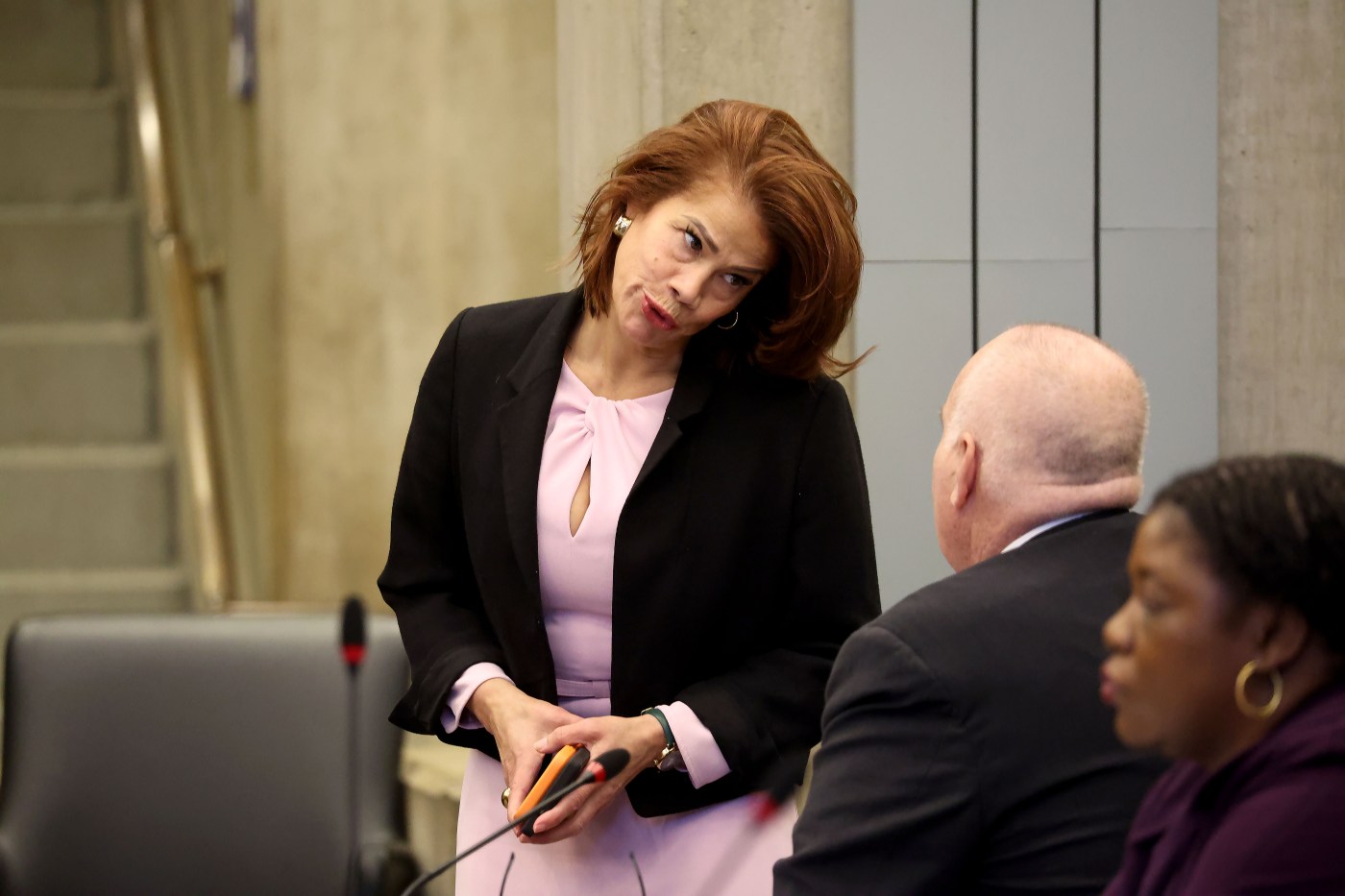
Councilors Julia Mejia and Brian Worrell introduced legislation on Wednesday that would restructure the School Committee from a mayoral-appointed body to an elected one.
“Boston is the only municipality in the entire state of Massachusetts that has an appointed School Committee structure,” Mejia said, adding that the Council should support her home rule petition “if we’re serious about democracy, and if we’re serious about giving people an opportunity to elect their representatives.”
The Council legislation seeks to change the School Committee, which includes seven voting members appointed by the mayor, to a 13-member elected body that would be modeled after today’s City Council. Nine district members would represent the same districts as councilors and there would be four at-large members.
The petition would incorporate a phased-in approach to committee reorganization. There would be a two-year period where there would be nine elected members and four appointed. The committee would transition to fully elected after the following election.
The Council narrowly passed a similar measure in February 2023, via a 7-5-1 vote. Worrell was one of the five councilors to vote against moving to an elected committee, but appears to have flipped his position by becoming a co-sponsor for this year’s proposal.
The 2023 Council vote was quickly vetoed by Wu, which blocked the legislation from moving onto the state Legislature for consideration.
Wu reiterated her opposition to an elected School Committee through a spokesperson on Thursday.
“In a moment when public education is being undermined by the federal administration, the School Committee has been an important partner in creating opportunity, support, and accountability for every student and delivering for our families,” Wu spokesperson Michael Osaghae said in a statement. “An appointed school committee provides the strong leadership, stability, and authority needed to partner productively with our school communities to build on the district’s progress.
“The Boston School Committee has shaped and improved BPS policies before they come to a vote through debate and discussions. Over the last four years, graduation rates and attendance are up, the district has more facilities projects underway than in the last 40 years combined, and BPS test scores have leapfrogged 28 other districts across the state, so that we are now at the top of our peer group of districts as categorized by DESE.
“Under Superintendent Skipper’s leadership and in close partnership with the School Committee, we will continue to advance our work forward to ensure that BPS is the first choice for all our families in Boston,” Osaghae added.
Wu supported a hybrid elected-appointed committee when she was running for mayor in 2021.
While Wu has emphasized the need for stability by maintaining the status quo, opponents of today’s appointed School Committee model have said it has created a body that’s just a rubber stamp for what the mayor and superintendent want.
Lisa Green, chair of the Bostonians for an Elected School Committee, previously told the Herald that moving to an elected body would put “an end to mayoral control of Boston’s schools — a political power grab that’s been destabilizing BPS since 1991.”
Related Articles
Battenfeld: Wintertime in Wutopia — Snow-clogged streets, sidewalks plague Boston
Boston City Council term begins with chaos, insults and a demand for an apology
Boston Police ignored all 57 immigration detainer requests from ICE last year
Boston City Council wades into Roxbury development fight, with challenge to Mayor Wu’s plan
Boston Mayor Wu files court brief calling for end to President Trump’s ICE surge in Minnesota
In 1991, the City of Boston passed a home rule petition that was codified into state law and led to the first appointed School Committee, and the consolidation of the powers of the School Committee into the office of the mayor, per Mejia and Worrell’s filing.
Mejia argued at this week’s Council meeting that residents issued a mandate to city officials five years ago, when they voted to move to an elected School Committee.
Boston voters by nearly 80% voted in favor of an elected school committee in a non-binding 2021 ballot question.
Every municipality in Massachusetts, except for Boston, elects its School Committee.


More Stories
US court rules against Pentagon in killer AI dispute
The Department of War had ordered contractors to drop Anthropic after it refused to allow military use of its technology...
Which Interior Flooring is Best?
Where do you start when choosing new flooring? When shopping for new flooring a good place to start is to...
Petrol set to top £1.50 a litre as Iran war drives fuel price surge
UK drivers are bracing for a sharp rise in fuel costs, with petrol prices expected to exceed £1.50 per litre...
Dyson hit by £440m sales drop as Trump tariffs bite
Dyson has reported a £440 million drop in annual sales after being hit by US trade tariffs, although the group...
Octopus Investments to cut 20% of staff as AI reshapes asset management
Octopus Investments is set to cut around a fifth of its workforce as it accelerates the adoption of artificial intelligence,...
Next to invest £300m in UK logistics as new warehouse set to deliver £2.5bn boost
Next has unveiled a major expansion of its UK logistics network, committing more than £300 million to new warehouse infrastructure...