
No end in sight for Lowell High School rebuild costs

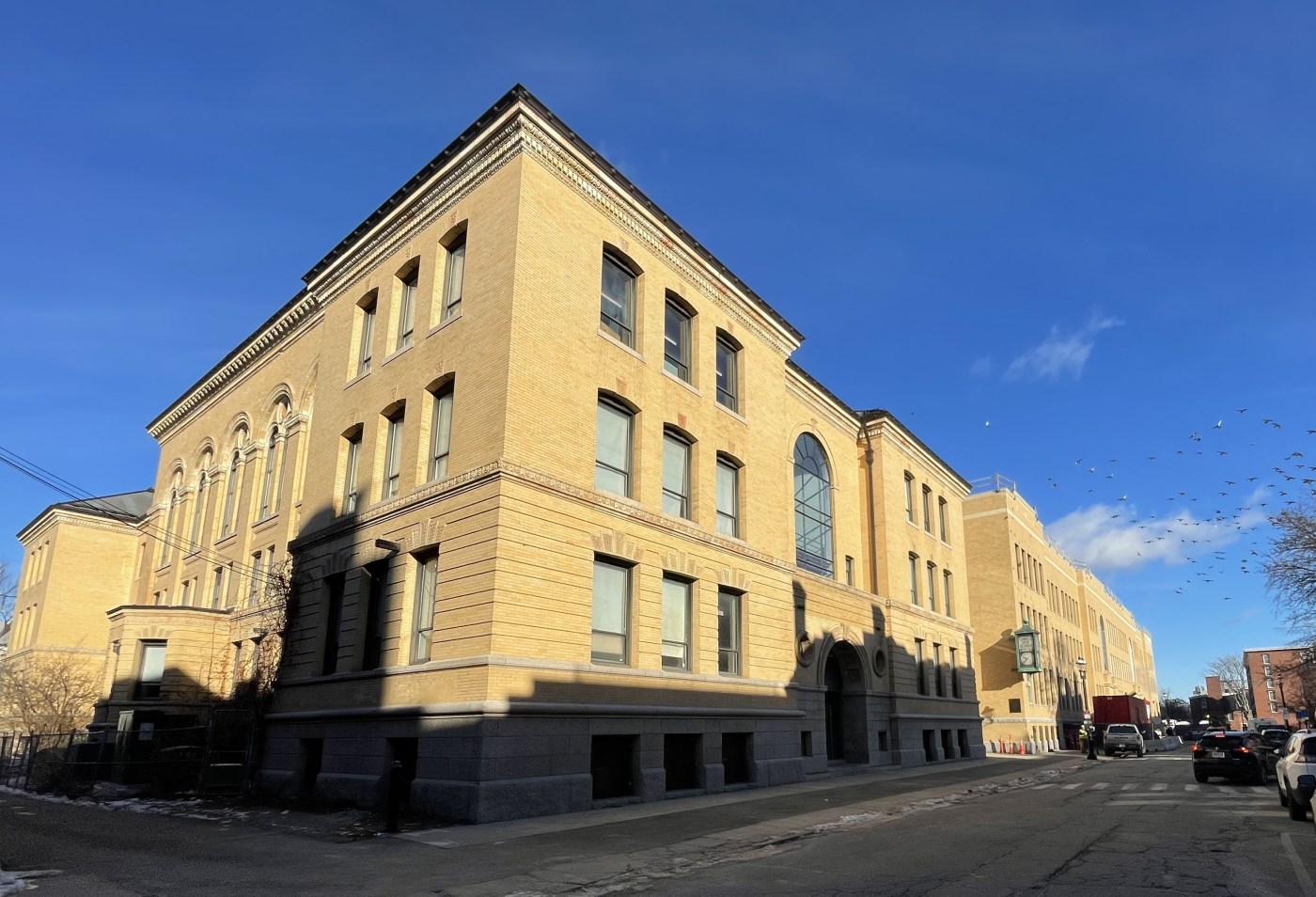
LOWELL — Structural steel issues identified in the 1892 Coburn Hall building, the Phase 4 part of the Lowell High School rebuild and renovation, may cost the city even more money in order to complete the almost decadelong project.
Despite repeated questions from city councilors, the project team of Suffolk Construction, the architect firm of Perkins Eastman and the owner’s project manager Skanska USA could not provide hard details or projected costs to the newly discovered structural issues that may raise the price of the already $418 million school.
“We’re going to get some information Thursday or Friday of this week,” Skanska Project Director Kevin Kane said during the Tuesday night meeting at City Hall. “We have Perkins Eastman and the structural engineer reviewing the condition that we found that didn’t meet what we understood to meet the contract documents from the 1990s renovations.”
Councilor Rita Mercier provided some context from a tour the councilors took of the facility Jan. 17.
“The beams that hold up the 1892 building,” she said, while clarifying that she wasn’t an engineer. “You [Kane] said you didn’t know if they are reinforced with sister joints. And you said you didn’t know how many we need or if we need any. That’s concerning to me.”
It’s the second major structural issue found in the 134-year-old building off Kirk Street in Downtown Lowell.
In a December meeting, Skanska Project Manager Jim Dowd told the body that the basement floor in the building would have to be replaced at the cost of $2 million due to soil settling under the slab, a condition that was not found during the initial site inspection and development.
Although the building project is roughly 75% completed, the original $21.2 million construction contingency has already been expensed in Phases 1 through 3. A construction contingency is money set aside to pay for change orders from new requests or unforeseen construction requirements. The $21.2 million was built into the initial $381 million budget figure for the project.
On the council’s December agenda was a loan order for an additional $39 million construction contingency. The loan order vote did not pass since two-thirds of the councilors present did not vote in favor. The vote required eight votes in favor.
The project team came back with a reduced ask of $36 million, which was on Tuesday’s agenda for a public hearing. The loan order will provide the necessary authorization to keep the construction project funded and moving forward.
The $36 million cost overrun is the result of structural issues with the renovation of the basement slab in the 1922 building that in turn delayed the project timeline by an entire year from the summer of 2026 to the fall of 2027. The $2 million in slab repairs to the 1892 building is built into that overall figure.
No one from the public spoke in favor of the loan order, but resident Theresa Roach expressed her concerns about the rising costs of the project.
“Almost a quarter of the population of Lowell is senior citizens, and we live on a fixed income,” she said by Zoom. “If the property taxes go up, that’s big expense for a lot of us to pay.”
She said the tax on her home would go up $63 a year for the loan costs alone, in additional to any other increases that will be set in the upcoming fiscal 2027 budget.
“We actually can’t afford it,” she said. “I’m afraid we’ll be taxed out of our homes.”
The Lowell High School project remains the largest capital investment in the city’s history.
Assistant City Manager for Fiscal Affairs/Chief Financial Officer Conor Baldwin explained that the estimated tax to cover the additional $36 million loan order on the average single-family home, assessed at about $500,000, is roughly a $72 increase.
But that figure is a baseline amount, said City Manager Tom Golden.
He told the council that the debt service on the construction loan will be 1.6% of the projected tax rate for fiscal 2027. That percentage will be on top of whatever the tax rate increase is for what Golden called “the cost for doing business in the city,” which could be an additional 2.5-3%.
“That does not include the cost of paper towels, oil, gas or any type of contractual obligations we have with our employees,” he said. “It could be a 4.6 to 4.8% increase overall. The costs are coming due.”
The four-phased construction was approved in 2016 and broke ground in 2020. The project is funded in part by the Massachusetts School Building Authority, which approved reimbursement for $280 million of the $381 million cost. The city financed the $100 million difference.
With the latest loan order, the city will be financing almost $140 million. If the problems had been discovered before MSBA approval, those costs potentially could have been included in the total state financing package, with less burden on Lowell taxpayers.
Since fiscal 2021, the Lowell High School project has represented a growing share of the city’s overall debt-service obligations. In 2021, LHS debt service accounted for almost 3% of total general fund debt service.
By fiscal 2024, this share had increased to more than 23%, and with the issuance of additional bonds in fiscal 2025 and 2026, the percentage climbed above 31%.
“Based on current projections, LHS debt service will represent approximately 34.73% of total General Fund debt service in fiscal 2027,” Baldwin said in a memo to Golden dated Jan. 6.
The council approved the loan order by a 9-1 vote. Councilor Corey Robinson voted no and Councilor Sean McDonough, a Lowell High teacher, recused himself.
Even councilors who voted in favor of this latest construction contingency increase said they would not approve any future requests.
“If more requests come in, I’m not voting for it,” Councilor Sidney Liang, who represents the Acre neighborhood, said. “At this point, it keeps bleeding and bleeding and it needs to stop. People are really hurting out there and this is something I do not like to see. I will support this, but I will not support another round of money. This cannot continue, it needs to stop.”


More Stories
US court rules against Pentagon in killer AI dispute
The Department of War had ordered contractors to drop Anthropic after it refused to allow military use of its technology...
Which Interior Flooring is Best?
Where do you start when choosing new flooring? When shopping for new flooring a good place to start is to...
Petrol set to top £1.50 a litre as Iran war drives fuel price surge
UK drivers are bracing for a sharp rise in fuel costs, with petrol prices expected to exceed £1.50 per litre...
Dyson hit by £440m sales drop as Trump tariffs bite
Dyson has reported a £440 million drop in annual sales after being hit by US trade tariffs, although the group...
Octopus Investments to cut 20% of staff as AI reshapes asset management
Octopus Investments is set to cut around a fifth of its workforce as it accelerates the adoption of artificial intelligence,...
Next to invest £300m in UK logistics as new warehouse set to deliver £2.5bn boost
Next has unveiled a major expansion of its UK logistics network, committing more than £300 million to new warehouse infrastructure...