
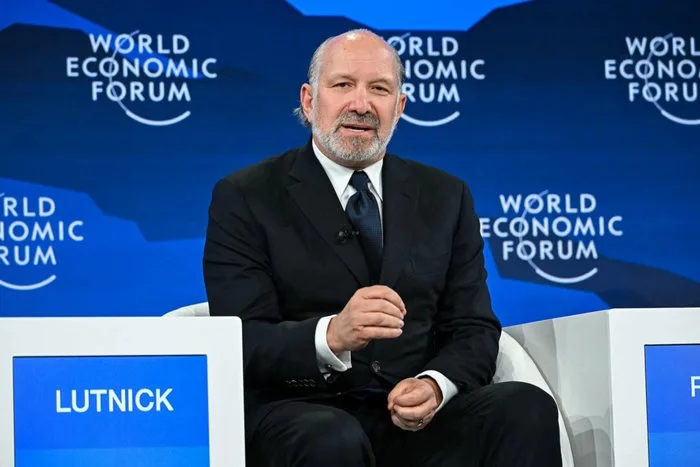
Lutnick Says US Can Hit 6 Percent Growth If Fed Cuts Rates

By Tom Ozimek
Commerce Secretary Howard Lutnick said on Jan. 20 he expects the American economy to expand at an annual rate above 5 percent in the first quarter of 2026, saying that interest rates are too high and that lower borrowing costs could push growth above 6 percent.
While speaking during a panel discussion at the World Economic Forum (WEF) in Davos, Switzerland, Lutnick framed his growth outlook as part of a broader America First economic strategy that he said would prioritize domestic workers, rebuild industrial capacity, and reduce U.S. reliance on foreign supply chains for critical goods such as semiconductors and medicines.
“Our rates should be much lower so that our economy can finally flourish,” Lutnick said. “I think we’re going to grow more than 5 percent GDP this quarter, and that’s for the $30 trillion U.S. economy. And if rates were lower, you would see us hit 6 percent—what is holding back is ourselves.”
Lutnick’s comments came as a number of members of the Trump administration have traveled to the WEF gathering of global elites to discuss U.S. economic and industrial policies while defending plans for higher tariffs and a tougher approach on trade with some allies and rivals.
Rate Cuts, Growth Forecasts
Lutnick said the traditional U.S. policy approach—tightening monetary policy when the economy is strong and easing it when growth weakens—has effectively capped expansion at mediocre levels.
He said that the United States, which he said has “the best credit in the world,” should not be paying higher interest rates than other major sovereign borrowers.
“There’s been a classic policy that when the U.S. economy does well, raise rates and put brakes on it,” he said. “President Trump thinks quite differently.”
Lutnick said it defies logic that the U.S. government is paying a higher rate to borrow from markets than many other major economies.
“Why are we paying a higher rate than all the other credits of the world? It makes no sense,” he said. “Our rates are too high. It’s just binary. Our rate should be much lower so that our economy can finally flourish.”
The commerce secretary’s comments that Federal Reserve monetary policy is too tight align with repeated statements by President Donald Trump, who has said he believes the Federal Reserve is stifling the economy by being too slow to cut rates. Trump has called for rates as low as 1 percent, telling The Wall Street Journal during a Dec. 12 interview that the United States “should have the lowest rate in the world.”
Federal Reserve Chairman Jerome Powell and some other central bank officials have defended their interest-rate decisions, saying that price pressures remain elevated and more time is needed to assess incoming economic data to confirm that inflation is moving sustainably toward the Fed’s target of 2 percent. The current federal funds rate is within a range of 3.5–3.75 percent, with markets expecting two cuts of 25 basis points each in 2026.
Lutnick’s growth optimism comes as recent economic indicators have pointed to firmer momentum, even as many Americans remain downbeat about the cost of living.
The Federal Reserve Bank of Atlanta’s GDPNow model recently estimated 5.3 percent annualized growth for the fourth quarter of 2025, reflecting stronger readings for consumption, private investment, and government spending.
At the same time, some economists have said that perceptions of economic stress persist even when headline data appear solid—driven by the lingering effects of past inflation, weak hiring momentum, and financial strain among some households, including rising debt burdens and reduced savings.
While speaking in Davos on Jan. 20, Treasury Secretary Scott Bessent said that many Americans are suffering from “inflation PTSD” from the highest rate of inflation in 49 years under the Biden administration. In June 2022, the pace of inflation hit 9 percent, a multi-decade high.
“They are right to be upset,” Bessent said. “The Biden administration created an affordability crisis like we have not seen. We are working to bring that down.”
Bessent added that he believes the U.S. economy will see nominal growth of 7–8 percent for all of 2026, which would put real growth at 4–5 percent.
“In the first quarter, we are going to see substantial tax refunds, maybe up to $1,000 for working households, $1,000 per worker,” Bessent said.
“So we will see these substantial tax refunds, Americans will adjust their withholding, and they will get an automatic bump up in their weekly or monthly paychecks.
“So I think that we are on the cusp of an acceleration that working Americans will feel.”


More Stories
US Arranging Charter, Military Flights for Americans in the Middle East
By Savannah Hulsey Pointer The U.S. State Department is looking to help Americans in the Middle East find a way...
New Target CEO Forecasts Turnaround to Retailer’s Lackluster Sales in 2025
By Rob Sabo Target Corp. reported on March 3 slumping sales in the fourth quarter of fiscal 2025, but its...
France Sending Nuclear-Powered Aircraft Carrier to Mediterranean: Macron
By T.J. Muscaro France’s nuclear-powered aircraft carrier Charles de Gaulle has set sail for the Eastern Mediterranean under the orders...
Trump Says US Has ‘Virtually Unlimited’ Weapons Stockpiles
By Guy Birchall President Donald Trump said on March 3 that the United States has a “virtually unlimited supply” of...
Trump Criticizes Starmer, Says Special Relationship in Peril
By Owen Evans President Donald Trump has criticised British Prime Minister Keir Starmer and warned that the historic U.S.–UK Special...
Alone Season 11 is Live on Netflix: Know About Release Date, Participants, and Winner
Why is Alone season 11 getting a sudden hype after its original release date on 13 June 2024? There are...