
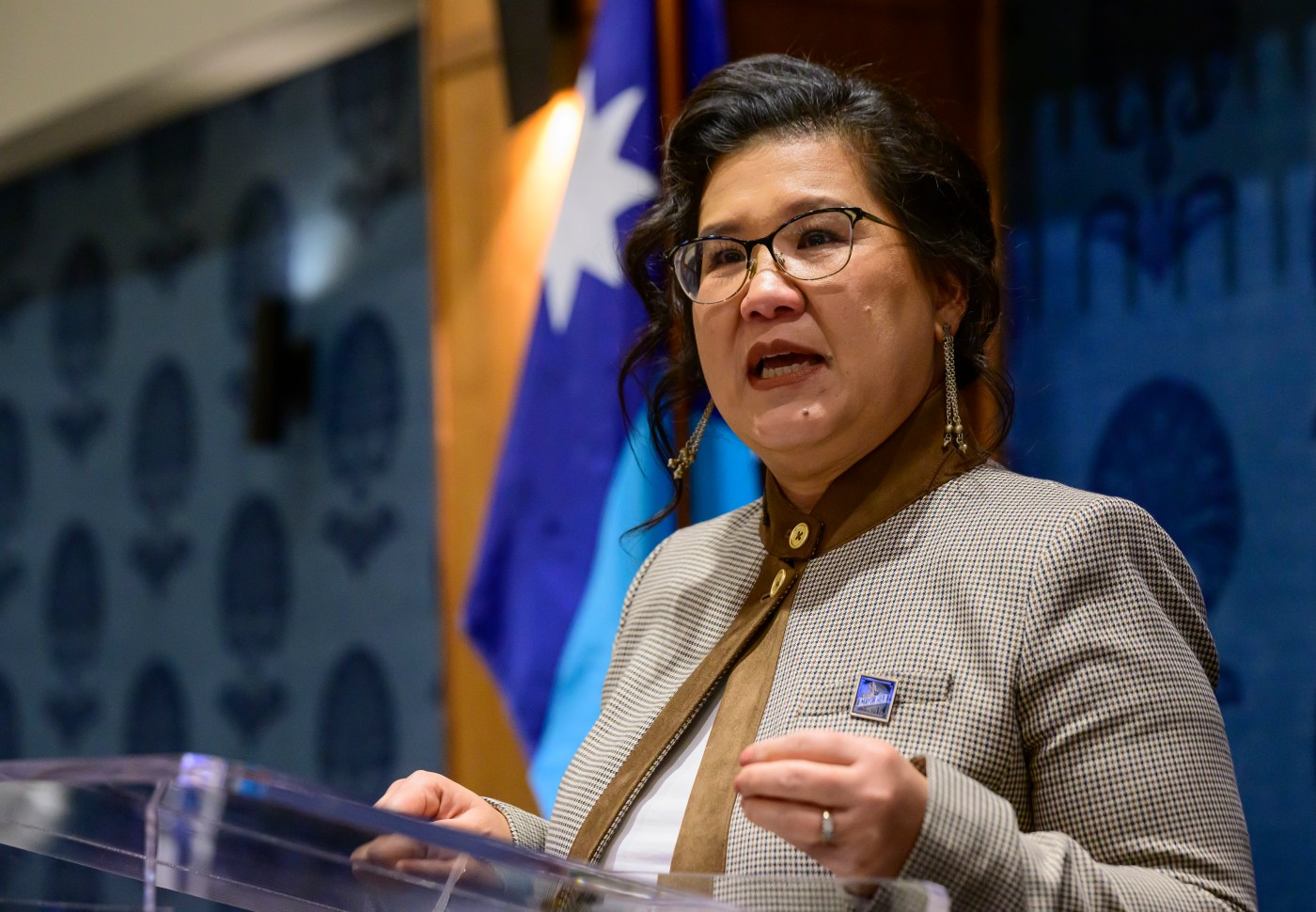
Kaohly Her concerned ICE impact on St. Paul businesses, safety

St. Paul Mayor Kaohly Her and Minneapolis Mayor Jacob Frey on Wednesday addressed the ongoing immigration crackdown in their cities and federal subpoenas brought against their them this week during a public discussion at the University of St. Thomas.
Two weeks after the fatal shooting of 37-year-old Renee Good by a U.S. Immigration and Customs Enforcement agent during a confrontation in Minneapolis, Her said she is “absolutely” concerned that something similar could eventually unfold in St. Paul as thousands of enforcement officers continue to make arrests in the Twin Cities.
“Every single time we get reports that there is a large gathering of ICE vehicles… I say a prayer, hoping that it doesn’t end the same way,” the new mayor said during a “Breakfast with the Mayors” event moderated by KSTP news reporter Tom Hauser.
St. Paul Mayor Kaohly Her, left, Minneapolis Mayor Jacob Frey, center, and moderator KSTP Reporter Tom Hauser, talk about the impact the ICE surge has made on the Twin Cities at the annual St. Paul Area Chamber and Minneapolis Regional Chamber Breakfast. (John Autey / Pioneer Press)
Both Frey and Her noted that it is difficult for their city police departments to contend with the presence of thousands of ICE and U.S. Border Patrol agents when the Minneapolis police department has around 600 officers, and St. Paul has just under that number.
‘This isn’t about who is inflaming a situation’
Her and Frey also disputed characterizations of Minnesota officials’ rhetoric as stoking tensions in the state.
“This isn’t about who is inflaming a situation. This is political retribution, and our president has said that very publicly that that is what he is going to do,” Her said. “It doesn’t matter what we say or do right now … we are a target, and we’re going to continue to be a target, and let’s not forget that the aggressor is the federal government.”
Her, who took office earlier this month, said she was “surprised” when FBI agents arrived at the St. Paul mayor’s office Tuesday to deliver the subpoena seeking records in connection to a Trump administration probe into whether she and other Democratic Minnesota officials obstructed immigration enforcement operations.
“We are talking with our legal team and figuring out a path forward,” Her said in response to a question about what the city planned to do next. “This is not something that we … come across every day, so you want to make sure they really understand and comply.”
Immigration enforcement surge
The annual Breakfast with the Mayors event, organized by the Minneapolis and St. Paul Area chambers of commerce, shifted from its usual tone this year as Minnesota leaders’ conflict with the Trump administration remains in the national spotlight. Wednesday’s event focused largely on the immigration enforcement surge.
Her indirectly weighed in on this weekend’s storming of a St. Paul church service by anti-immigration enforcement protesters, who identified a pastor there as being in charge of the ICE field office in St. Paul.
The protest at Cities Church on Summit Avenue drew condemnation from national conservative figures, disapproval from Democratic Gov. Tim Walz and the threat of federal charges by the U.S. Department of Justice. Her said the federal government shouldn’t ask others to do things that it is not willing to do itself.
“That is an ongoing investigation, so I don’t want to comment specifically on that,” she said. “(But) if our federal government wants us to condemn the actions in one place, which I am very much willing to do, that means we also have to condemn the fact that ICE agents are not letting people get (medical) examinations … There are a lot of sacred spaces that we should be adhering to.”
Frey: Federal subpoenas ‘intimidation’
Frey called the subpoenas an attempt at “intimidation” and stood by what he called his city’s efforts to protect residents.
“You do not get to subpoena and federally investigate mayors because they speak up for their constituencies, which, by the way, is one of the core functions in our city charter,” he said. “You do not get to randomly yank Somali people and Latino people off the street because of the way that they look. You do not get to just ask for their passports because they happen to look like they’re not from here. By the way, if you’ve around Minneapolis and St Paul the last 25 years — they do look like they’re from here.”
Her and Frey did touch on some business-related issues, though largely as they related to the immigration crackdown and actions by the Trump administration.
Asked if they believed further negative media attention on the state would harm economic activity in the long run, Her said she believed long-term investors and developers, such as those working to revitalize downtown commercial real estate, understand that current political difficulties for the region will pass.
Though she expressed concern about the negative effects of ICE operations on local business traffic, which has seen declines in some areas of the Twin Cities amid the heightened enforcement presence.
“When consumers can’t consume, it impacts our taxes … But I don’t think that Trump and the federal government understand the economic impact this has on us,” she said. “Closing a business happens very quickly, but starting one up can take years, which means this is going to impact us, even if they were out here in another couple of months, this is going to have a lasting economic impact.”
Related Articles
St. Paul schools: 6,000 students to do online learning due to immigration actions
Yacht Club Festival promoters announce new country music fest at Harriet Island
St. Paul ordinance would ban law enforcement staging at city property for immigration enforcement
Minnesota: Amtrak cancels some services ahead of brutal winter weather
Legal referee tosses petition for restraining order against St. Paul mayor
Frey urged shopping in Minneapolis’ “cultural corridors” and neighborhoods to help support local and immigrant business owners affected by the surge.
“They need us right now, Latino and Somali and Hmong and Southeast Asian owned businesses,” he said. “They need us to get them through this now. And so be there for them. I think that is of critical importance.”

More Stories
Easter and Eid collision sends British lamb prices to a record high
Supermarket shoppers face paying more than £16 per kilo for a leg as overlapping religious festivals, shrinking flocks and buoyant...
Vince calls on Miliband to halt North Sea oil exports as Iran war rattles supply
One of the Labour Party’s most prominent financial backers has called on Ed Miliband to slam the brakes on North...
Reform UK becomes first British political party to launch its own podcast
Reform UK is venturing into podcasting with a weekly show that will offer listeners behind-the-scenes access to Nigel Farage and...
Labour’s tax uncertainty is pushing Britain’s wealthiest towards the exit
The majority of Britain’s ultra-wealthy individuals are actively weighing up whether to leave the country, driven not so much by...
Barclays bets on the high street once more with new branches and the return of the bank manager
Barclays is charting a decisive U-turn on the high street, with plans to open new branches across the country and...
Amazon bets on Whole Foods to salvage its troubled UK grocery ambitions
Amazon is dusting itself off for another tilt at Britain’s fiercely competitive grocery sector, this time by converting its abandoned...