
Readers and writers: Bidania’s latest shows a new side of Hmong experience

Vong Bidania’s earliest childhood memory, faded now like an old color photo, is of an orange bus pulling out of a refugee camp in Thailand.
“I was so young, I’m not sure if this is real or something I made up in my head. But I knew it was sad, everybody crying, holding their hands out the bus windows. It’s daytime in my memory, but I know we left at night,” Bidania said in a conversation from her home in a Twin Cities suburb.
(Courtesy of the author)
That bus and those goodbyes are in Bidania’s new book “A Year Without Home” (Nancy Paulsen Books, $18.99), her first middle-grade novel and her first in verse. It has already earned starred reviews from Publishers Weekly, Booklist and School Library Journal for beautiful prose and a gripping story.
The narrator is 11-year-old Gao Sheng, the author’s older sister, and Bidania uses the real names of her other siblings in the book: brother Yia and sisters May la, Good Xai and Round Moon (the baby who is Bidania). They all grew up in St. Paul.
We meet the Thao kids first in the Hmong village of Pa Kao in the highlands of Laos, where they live in a big, multi-generational house. They and their cousins roll down their hill for fun, eat fruit from the peach trees and play with Ao Ka, their precious dog. It’s a happy life, even though they sometimes have to flee into the jungle to be safe from bombing during the Vietnam war.
Gao Sheng is sometimes annoyed because as the oldest daughter she is responsible for cutting vegetables, looking after her siblings and young cousins and always acting like a proper Hmong girl — quiet and obedient and never asking questions she longs to ask.
“My name, Gao Sheng,/is a classic name,/a name meant for girls/who are elegant, graceful, charming-/all embarrassing things I am not!”
Gao Sheng loves her brother, but she also resents the freedom he has as the only son who will someday be head of the family. Later in the story, in a heartbreaking scene, she realizes how much her little brother means to her.
As the novel begins in May, 1975, everyone in the the village knows the Communists are coming and they will hunt down men like the Thao children’s father, who was a captain in the Noble Lao Army. They leave in a hurry, missing the plane that was evacuating those who helped the American military. Gao Sheng’s dad and his brothers travel through the jungle, while her mother, aunts and 11 children head for the river in taxis. Reunited with the men, the family crosses the Mekong in canoes to refugee camps in Thailand on a dark and rainy night.
“The canoe wobbles/shakes from side to side./I grab my seat/to keep steady,/try to listen for my relatives/boarding the other canoes/around us,/but all I hear/is the sound/of/my own/frightened breath.”
At the two camps where they live for months, the family sometimes sleeps on hard tabletops because there aren’t enough beds for the ever-growing refugee population. They live with strangers, whole families crowded into small rooms as they wait for permission to immigrate to other countries. In one camp Gao Sheng breaks a cultural norm by helping her father and uncles with a big project, amazing her relatives with her physical and mental strength.
When the family finally gets permission to leave, their first home in the U.S. is the town of Sparta, Wis., where they are sponsored by a church.
Hmong refugees began to arrive in Minnesota 51 years ago, so there are a growing number of books about their experiences. Some authors don’t spend much time discussing life in the camps and that’s what is unusual about Bidania’s novel; it’s all about the family’s life before their escape and their time in the hot, dusty camps where the refugees made their lives as normal as possible while living in a facility with guards. The men play soccer and women and girls shop at an open air market outside the gates on Sunday mornings before the guards arrive. Gao Sheng enjoys going to school. After residents are given food allotments, the Thao family is able to eat their mom’s good cooking instead of the thin soup served in the cafeteria.
“I hope young readers will see history with a more fully dimensional picture, learning what it’s like to be ripped away from everything you’ve known,” Bidania says of her book, in which Gao Sheng can take only a packet of peach tree seeds when her family flees, hoping to grow her favorite fruit in a new home she knows nothing about.
Minnesotan V.T. Bidania launches her first middle-school novel, “A Year Without Home,” Jan 24, 2026 at Red Balloon Bookshop in St. Paul. (Courtesy of the author)
Bidania has been a writer since she was 5 and wrote a story about a frog, with crayon illustrations. She loved books so much she spent most of her free time reading at the family’s home on Holly Avenue. After earning a journalism degree from St. Catherine University and an MFA in creative writing from the New School in New York, Bidania worked in children’s publishing until she and her husband, Win, moved back to Minnesota to be closer to family. They have two sons in college.
If Bidania’s name sounds familiar to readers of children’s lit, it’s because she is the author of the Astrid and Apollo books featuring twins who live in St. Paul, the first children’s books series with Hmong-American characters.
Bidania was drawn to middle-grade books because she finds the writing “gorgeous,” and although she has no formal poetry training the format intrigued her.
“I wanted to write a book that packed as much punch as the ones I read like ‘Unsettled’ (by poet Reem Faruqi), with lots of white space,” she says.
In “A Year Without Home” the dancing type takes its cue from the mood of the poem it illustrates. Sometimes it’s one word going straight down or slanting sentences forming a paragraph. There might be only a few lines on a page. In our visual world this is a fun way to keep readers 10 and older interested.
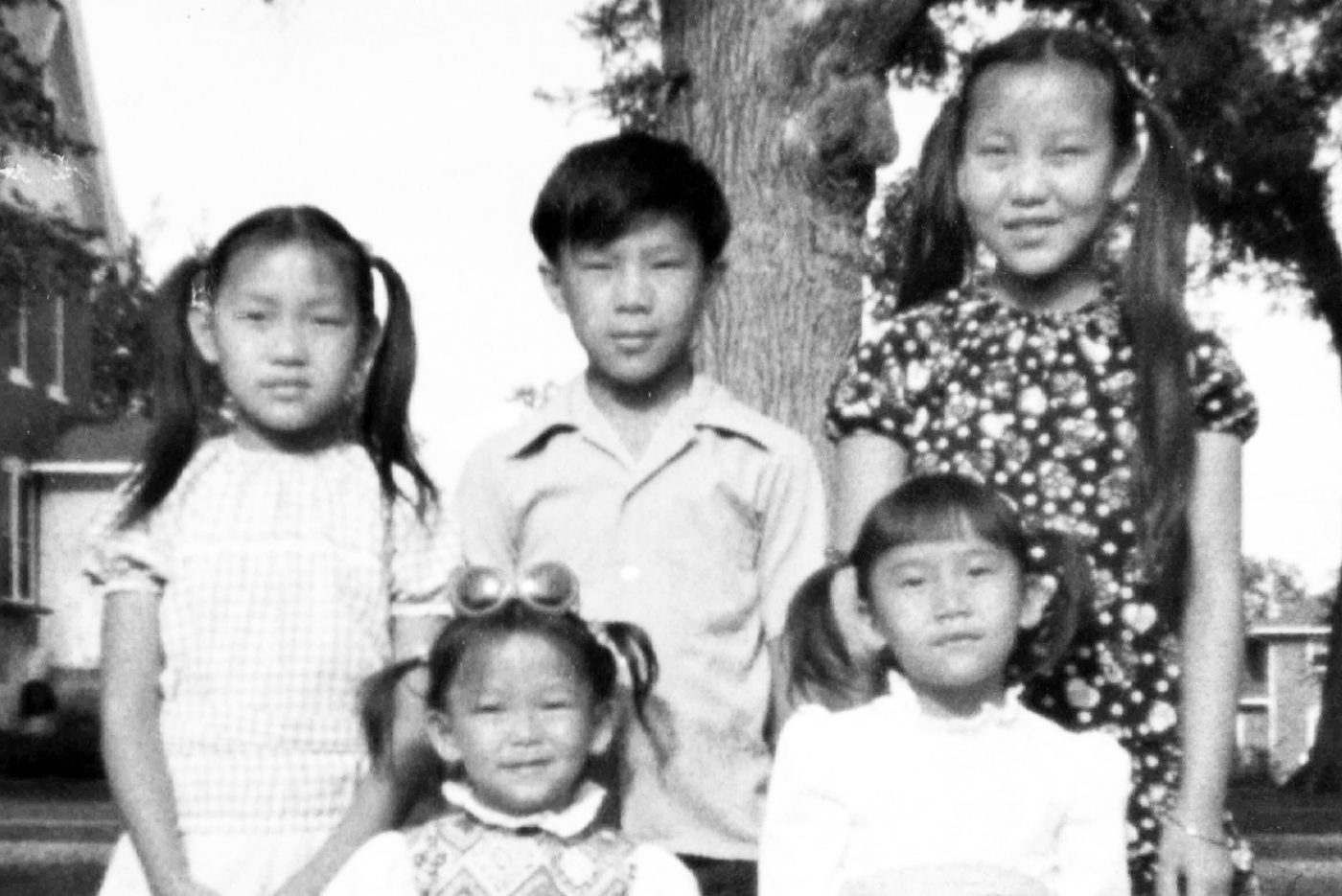
An undated black and white courtesy photo of the Thao siblings in Sparta, Wis., their first home in America. Back row, from left: May la, Yia, Gao Sheng. Front from left: Round Moon and Good Xai. (Courtesy of the Thao Family)
Bidania spent a lot of time researching her book, which takes place in the confusing and frightening time between the end of the Vietnam War and the beginning of Communist takeover. To be historically accurate, she interviewed relatives and others who lived through it and read whatever government documents she could find about a war that was conducted so much in secret. She also traveled to Laos in 2024 to look for the house on the hill depicted in the book, but she didn’t find it. It was the rainy season, roads were impassable, and anyway the house had been swallowed by jungle.
Although the book doesn’t name the Thao siblings’ parents, they are real-life heroes. Their late father, Nao Vu Thao, always kept his family safe during their journey to America. Working with Catholic Charities, he helped hundreds of immigrants from many countries resettle in Minnesota and was widely respected in the Hmong community and in St. Paul. HIs wife, Sia Thao, organized the family’s escape from their village, keeping her sisters-in-law and the children together and courageously handling being questioned by police who were looking for her husband.
“A Year Without Home” ends in May 1976, with the family living in Sparta, Wis., where they were sponsored by a church. Bidania deliberately concluded the story there, without taking her characters to St. Paul where they eventually settled.
“We faced racism on a regular basis in St. Paul but I didn’t want to write trauma porn, rehashing that in the book,” she explains. “People like to hear about our suffering. It’s like ‘Oh, you poor people.’ Hmong people did face many challenges during and after the war but I wanted to write about a side of us some people don’t know — our homes, families, communities — a human story. I wanted to educate young readers about the history of the Hmong that is not taught in schools. I want them to know that their peers are experiencing wars right now all over the world. They should be aware of this and have some empathy for what today’s refugees are going through.”
Bidania will launch her book at 4 p.m. Saturday at Red Balloon Bookshop, 891 Grand Ave., St. Paul, in conversation with Payal Doshi, author of the middle-grade fantasy “Rea and the Blood of the Nectar,” and a four-book series of chapter books, “Magic Gems,” coming out later this year. Free, but reservations are encouraged. For more information, visit redballoonbookshop.com.
Related Articles
Readers and writers: Follow women through difficult lives in two disparate debut novels
Readers and writers: A first look at the titles coming in 2026
Readers and writers: A book to end the year, and a look back at a great year for readers
Readers and writers: Great fiction and a primer on AI
Readers and writers: Get lost in the past in these memoirs


More Stories
From Scotland Yard Commander to Global Security Entrepreneur: Dr Ali Dizaei’s Leadership Story
There are career journeys that follow a straight line, predictable, uniform, and comfortable. And then there are journeys shaped by...
The Naughty AI President: A New Age of Governance
In the race to build better systems of governance, humanity has always chased an impossible ideal: the perfect ruler. Rational,...
Sends shares Q1 2026 business update and product progress
Sends reported Q1 2026 updates sharing news on digital cards, app redesign, ClearBank integration, and fintech industry recognition. Sends, a...
Government doubles down on gaming with £30m funding package as sector eyes global growth
The government has fired the starting gun on a £30 million funding offensive aimed at Britain’s video games sector, urging...
Rising energy costs from Middle East conflict set to leave UK households £480 worse off this year
Rising energy costs triggered by the escalating Middle East conflict are on course to strip nearly £500 from the finances...
UK firms risk being left behind as AI adoption gap widens, warns PwC
British businesses are in danger of being left stranded in the middle of the pack on artificial intelligence, with a...