
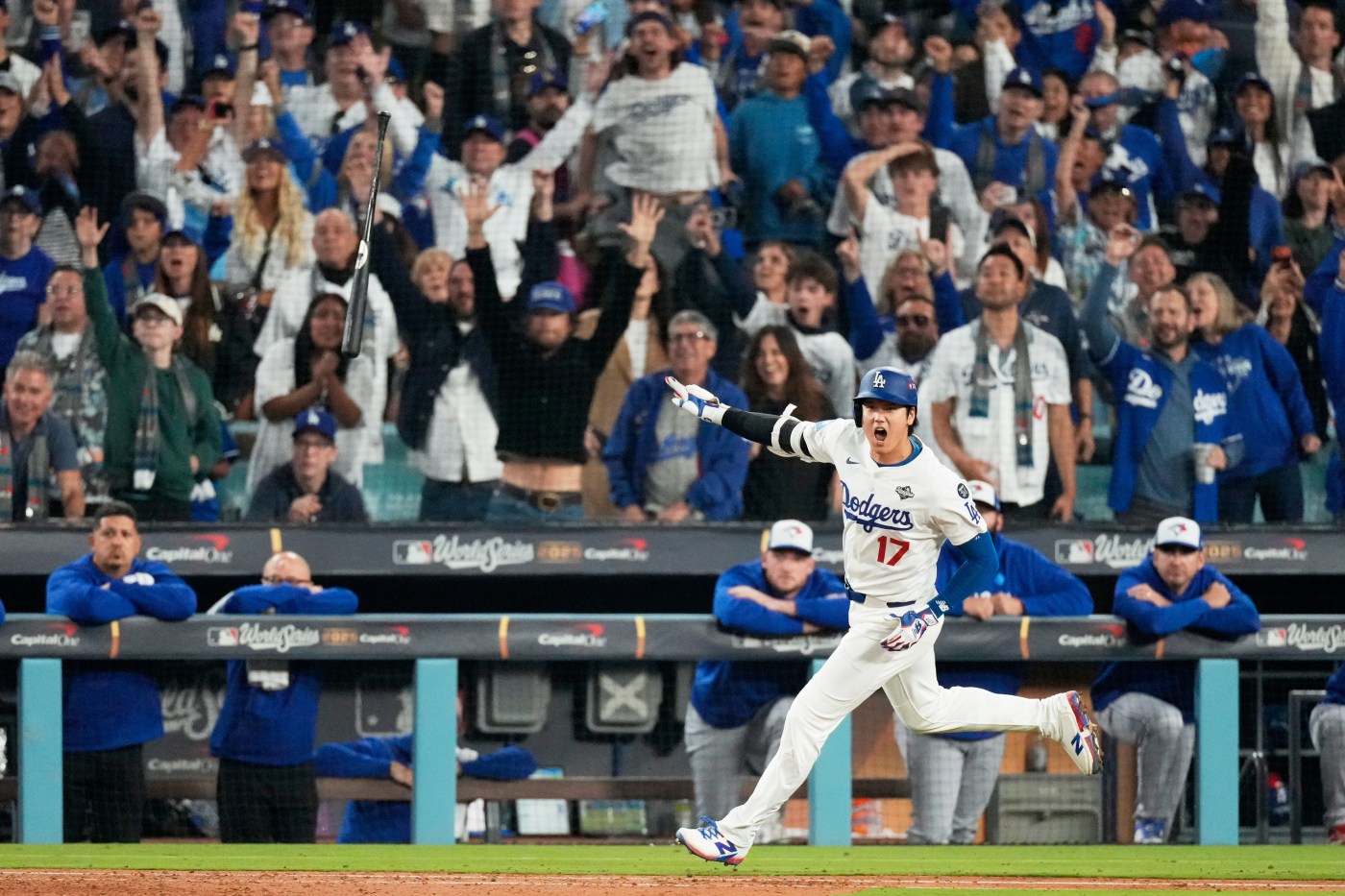
MLB notes: Don’t buy narrative that Dodgers are bad for baseball

Throughout the week there were rumblings across baseball that Kyle Tucker was nearing a decision. The top free agent outfielder on the market was projected to land a huge deal, and all signs pointed to the Toronto Blue Jays and New York Mets as the favorite to land the four-time All-Star.
Then on Thursday night, the news came like a bolt from the blue.
The Dodgers had done it again.
Related Articles
Alex Bregman’s failed contract talks with Red Sox enter Massachusetts ambulance debate
Report: Top free agent infielder signs with New York Mets
Red Sox righty ‘honored’ to pitch for Team USA in World Baseball Classic
Promising Dominican teens headline Red Sox international signing class
Analysis: With Ranger Suarez, Red Sox rotation ranks among game’s elite
The two-time defending World Series champions shocked the baseball world, signing Tucker to a reported four-year, $240 million deal that includes $30 million of deferred money and opt outs after the second and third seasons. Tucker now joins a stacked lineup that already included Shohei Ohtani, Mookie Betts, Freddie Freeman, Will Smith and Teoscar Hernandez, ensuring the Dodgers will remain heavy favorites to claim their third straight championship this coming fall.
The news was met by exactly the response you’d expect.
How can the Dodgers keep doing this? How is anyone else supposed to compete? You had calls for a salary cap, cries for more parity and caterwauling about how the Dodgers’ spending will inevitably spark a work stoppage that wipes out the whole 2027 season.
Essentially the outcry could be boiled down to one simple idea: the Dodgers are bad for baseball.
Nonsense.
Top free agent outfielder Kyle Tucker recently agreed to a four-year deal to join the two-time defending champion Los Angeles Dodgers. (AP Photo/Nam Y. Huh, File)
The Dodgers are great for baseball, and their overwhelming dominance has helped bring renewed attention to a sport that has often struggled to maintain its cultural relevancy over the past two decades. Everyone loves a good David vs. Goliath story, and if the monstrous ratings from the past two World Series are any indication, even those who claim to be turned off by the Dodgers can’t look away.
Besides, people said the same thing about the Patriots throughout the Tom Brady-Bill Belichick era. Last time I checked, the NFL is doing just fine.
Obviously MLB has a different economic system than most other major American sports, but what the Dodgers are doing is hardly anything new.
From the beginning baseball has been a sport of haves and have-nots, and for nearly a century the New York Yankees stood as the sport’s unquestioned Big Bad. I’m old enough to remember the days where the Yankees’ payroll annually dwarfed everyone else in the league, and if there was a player George Steinbrenner wanted, he was going to sign him, no matter the cost.
The Dodgers have simply assumed that mantle, but their success isn’t only rooted in dollars and cents.
Besides having unmatched financial resources, the Dodgers are also an exceptionally well-run organization. Even if MLB were to implement a salary cap, Los Angeles would probably still be a perennial World Series contender because they do such a great job identifying talent and putting its players in the best position to succeed.
How often have we seen a high-profile, big-money signing blow up in the Dodgers’ face? There have been a few missteps, but Los Angeles’s big bets usually pay off. And by the way, their smaller bets do too, which is how the Dodgers could top a recent MLB.com poll for best farm systems despite not having a single draft pick higher than No. 20 since 2013.
That relentless competence obviously drives people crazy, but the other part that bothers opposing fans is the understanding that their clubs could do more.
The Dodgers are not the only organization in MLB with deep pockets. The Mets are owned by one of the world’s richest men, and big-market clubs like the Yankees and Red Sox are still enormously wealthy. Those and others in their stratosphere are perfectly capable of winning a bidding war for top players, but often aren’t willing to go the extra mile to get their guy.
Smaller market clubs are obviously in a tougher spot, but even if those teams can’t realistically compete with the Dodgers financially, many are capable of spending more to field a competitive roster but are run by cheapskate owners who simply choose not to.
The payrolls carried by clubs like the Marlins, Pirates and Athletics in recent years is nothing short of embarrassing, and their skinflint behavior is made more abhorrent by the fact that a portion of the luxury taxes collected from clubs like the Dodgers goes to small market clubs specifically to invest in their rosters. The whole point of the competitive balance tax system is those funds are supposed to help close the gap between large and small market teams, but that doesn’t work when the small market owners turn around and pocket the money for themselves.
Those owners — who enrich themselves at the expense of their teams, their cities and the sport as a whole — are the ones who are actually bad for baseball.
But here’s the good news. Even with all of their advantages, the Dodgers are not inevitable.
The Dodgers have won the last two World Series, yes, but this past October the Blue Jays came within literal inches of dethroning the defending champs. Going further back, the Dodgers have won 12 of the last 13 NL West titles, but before these past two titles they only had one World Series banner to show for it.
That’s because unlike in basketball where one or two great players can carry you to a title, baseball is inherently random. But the game rewards savvy teams that make smart decisions and develop players well, which is why teams like the Rays can hold their own year-in and year-out, and why big money teams like last season’s Mets sometimes crash and burn.
So yes, the rich got richer this offseason and the Dodgers are going to win a lot of games in 2026. But along the way they’ll make headlines in every city they visit, and when someone eventually dethrones them it will resonate all that much more.
That can only be good for baseball.
According to a tally of publicly available ballots, former Red Sox great Manny Ramirez will not be elected to the Hall of Fame in his 10th and final year of eligibility. (Staff Photo by Matthew West)
Manny officially eliminated
We’ve known for a long time that Manny Ramirez would never be elected to the Baseball Hall of Fame by the BBWAA voters, but now it’s official.
Ramirez’s time has run out.
According to public ballots compiled by Ryan Thibodaux and his tracker team, Ramirez has been mathematically eliminated from reaching the 75% threshold needed to earn induction in his 10th and final year of eligibility. As of this writing, Ramirez is polling at 40% with approximately half of the total vote known, and according to Thibodaux’s estimates there are not enough outstanding ballots to make up ground even if he appeared on every single one.
Ramirez’s candidacy will now be handed off to a future Era Committee, and considering how suspected performance-enhancing drug users like Barry Bonds and Roger Clemens have fared, the former Red Sox great will likely never earn a spot in Cooperstown.
It’s an unfortunate outcome for one of the game’s most memorable figures.
Regarded during his career as one of the greatest right-handed hitters of all-time, Ramirez was a 12-time All-Star, a nine-time Silver Slugger winner and played a pivotal role in leading the Red Sox to two World Series championships. For his career, he batted .312 with 555 home runs, 1,831 RBI and a .996 OPS, and from 1998-2005 he strung together eight consecutive seasons in which he finished top-10 in the AL MVP vote.
Those numbers would have made Ramirez a home run, no doubt first-ballot inductee under normal circumstances, but things were never that simple.
Throughout his career the phrase “Manny Being Manny” entered the public lexicon thanks to the slugger’s quirky and at times mercurial attitude. His behavior at times veered into problematic territory, and late in his career Ramirez was twice suspended for violating MLB’s drug policy.
While some voters have been willing to forgive players whose performance-enhancing drug use predated MLB’s drug policy, players who tested positive after the fact have generally found a much less receptive electorate. Such it was for Ramirez, who never polled above 35% in his first nine tries and won’t fare much better in his last attempt.
The official Hall of Fame voting results will be unveiled on Tuesday at 6 p.m. ET.
Roman Anthony of the Boston Red Sox was all smiles after his two-run homer during the fifth inning of a game against the Colorado Rockies at Fenway Park last season. (Photo By Matt Stone/Boston Herald)
Anthony cracks Top 50
Roman Anthony only has 71 big league games under his belt, but the promising Red Sox outfielder is already earning widespread acclaim from across the sport.
MLB Network unveiled No. 41-50 on its 2026 Top 100 Players Right Now rankings this week, and Anthony clocked in at No. 41 overall. Anthony finished just ahead of Minnesota’s Byron Buxton (No. 42), free agent Cody Bellinger (No. 43) and Seattle’s Bryan Woo (No. 44), and notably also ahead of former Red Sox slugger Rafael Devers (No. 46).
Anthony is the fourth Red Sox player to appear on the list so far, following Jarren Duran (No. 58), newcomer Ranger Suarez (No. 79) and Aroldis Chapman (No. 84). Garrett Crochet will almost certainly be included within the top 40, which will be unveiled in three parts between Jan. 19-22.


More Stories
Agencia del gobierno iraní dice que al menos 1.045 personas han muerto en la guerra por ahora
DUBÁI, Emiratos Árabes Unidos (AP) — Agencia del gobierno iraní dice que al menos 1.045 personas han muerto en la...
Kirill Kaprizov passes Marian Gaborik as Wild’s top goal scorer
It started to feel like superstar winger Kirill Kaprizov might never score again. He failed to bury multiple chances on...
Guardia Revolucionaria de Irán amenaza con la plena “destrucción de la infraestructura militar y económica de la región”
DUBÁI, Emiratos Árabes Unidos (AP) — Guardia Revolucionaria de Irán amenaza con la plena “destrucción de la infraestructura militar y...
US-Israeli bombardment of Iran intensifies, as Tehran vows to destroy Mideast infrastructure
By JON GAMBRELL, DAVID RISING and SAMY MAGDY DUBAI, United Arab Emirates (AP) — Israel and the U.S. intensified their bombardment of...
US-Israeli bombardment of Iran intensifies, as Tehran vows to destroy Mideast infrastructure
By JON GAMBRELL, DAVID RISING and SAMY MAGDY DUBAI, United Arab Emirates (AP) — Israel and the U.S. intensified their bombardment of...
US soldiers were killed in Iranian drone strike on operations center at Kuwait civilian port
By KONSTANTIN TOROPIN and REBECCA BOONE WASHINGTON (AP) — An operations center targeted by an Iranian drone strike that killed...