
After 22 years, Karen Ann Muscovitz’s family still has unanswered questions

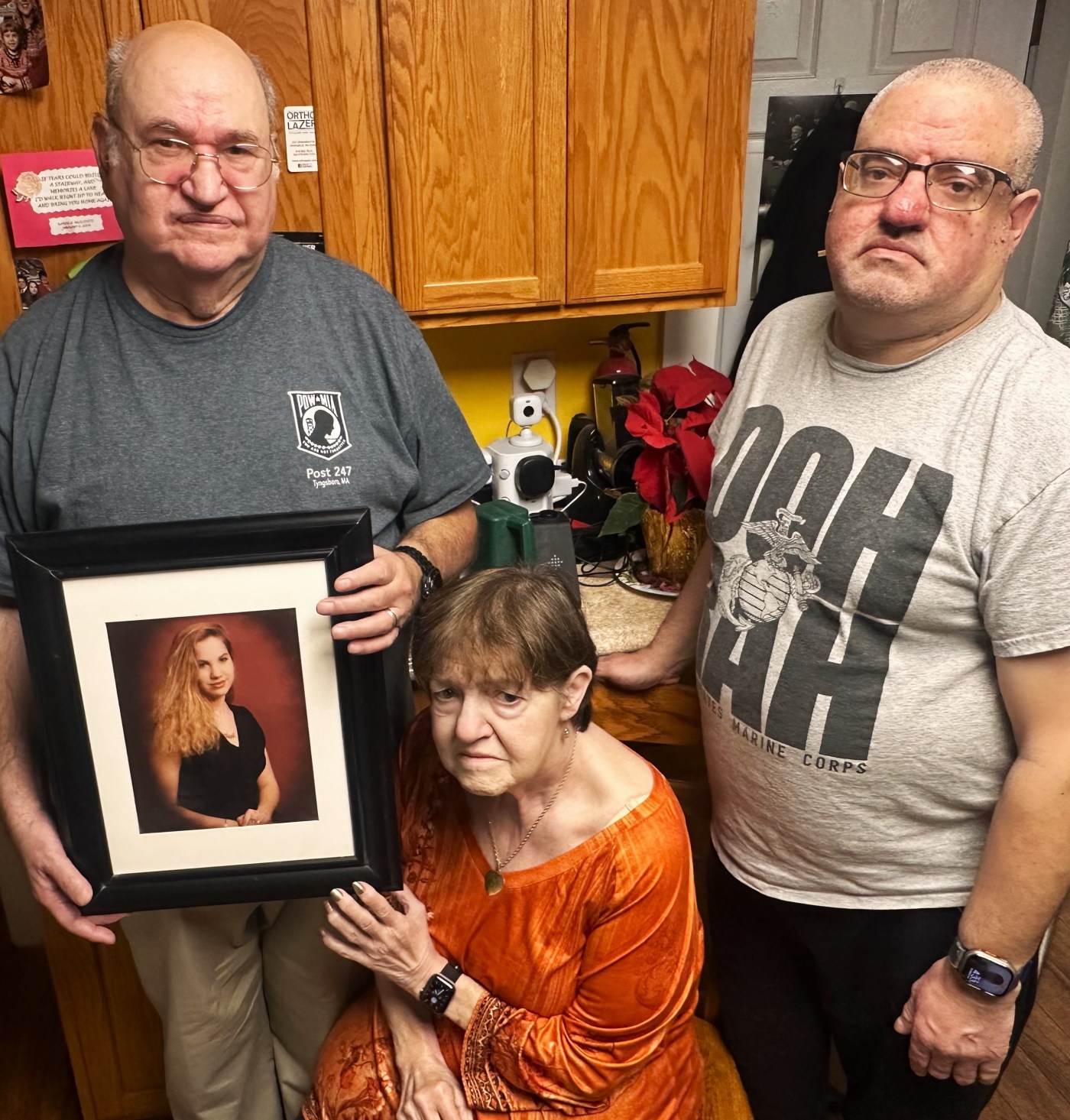
LOWELL — In the Pawtucketville home where Karen Ann Muscovitz grew up, a photo of her hangs above the kitchen table, positioned so her smile seems to look out over her family. Printed on the image are the dates of her life: July 13, 1976, to Jan. 4, 2004.
It’s been 22 years this month since she was murdered, but the loss still shapes the rhythm of the house.
“Twenty-two years,” her father, Arnie Muscovitz, said as he sat at the kitchen table sorting through court documents. “Quarter of a century almost. I’m fighting it everyday.”
Karen Muscovitz was killed when she was 27, strangled and beaten inside an apartment in Melbourne, Florida, where she had moved to live with her boyfriend.
Arnie Muscovitz said he didn’t want her to go, but he couldn’t talk her out of it.
The fatal attack came at the hands of Karen’s boyfriend’s brother, Travis Lee Edwards, who had been diagnosed as a paranoid schizophrenic.
The anguish for the family was immediate and overwhelming.
Edwards was charged with first‑degree murder, and what followed was a long, grinding legal process.
Arnie Muscovitz flew to Florida dozens of times over the years that followed for hearings and, eventually, Edwards’ trial. The cost was enormous and required fundraisers and even a home‑equity loan to keep going.
“I wanted to be there for my daughter,” he said.
Edwards was convicted of murdering Karen in 2010, a verdict that lifted a tremendous weight from the family’s shoulders.
But that relief didn’t last.
In 2012, an appeals court overturned the conviction, plunging them back into uncertainty and pain.
At the kitchen table, Arnie Muscovitz slides over the documents showing the court’s decision.
The paperwork shows that a judge ruled that Edwards was mentally incompetent to stand trial and unlikely to regain competency.
After years of psychiatric evaluations and treatment inside a state hospital, the court dismissed the murder charge without prejudice — meaning it could be refiled if he ever became competent.
The judge ordered Edwards to remain involuntarily committed to the Department of Children and Families, with the hospital required to notify prosecutors at least 30 days before any potential release.
In the years since the conviction was overturned, Arnie Muscovitz has made a habit of checking in on the case, trying to keep track of his daughter’s killer. During one of those calls he learned something he never expected: Edwards had been released from Northeast Florida State Hospital.
Arnie Muscovitz shows off a letter addressed to a judge from the Department of Children and Families. Dated Dec. 2, 2022, it stated that Edwards “no longer meets involuntary commitment criteria” and that the hospital intended to discharge him. The State Attorney’s Office had been copied on the notice, as had the Brevard County Sheriff’s Office.
Karen Muscovitz’s family had not.
For them, the discovery reopened a wound that had never truly closed.
Arine Muscovitz said he wants Edwards to be behind bars, but the path to that outcome appears narrow.
The Sun contacted the State Attorney’s Office in Florida’s 18th Judicial Circuit to ask what options remain. In a written response, spokesperson Matt Reed said prosecutors cannot refile murder or kidnapping charges unless Edwards is newly evaluated and found competent to stand trial — something that has not happened.
When the state psychiatric hospital released Edwards in 2022, Reed said, it determined only that he no longer met the criteria for involuntary commitment. It did not find him competent for trial.
Because the original charges were dismissed after Edwards was deemed incompetent for five consecutive years, prosecutors today have no legal authority to request a new competency evaluation unless they first file charges — and they cannot file charges without that evaluation.
“One plausible option for the state attorney refiling murder charges,” Reed said, “would be if Edwards commits a new offense somewhere and a court‑ordered evaluation in that case finds him competent to stand trial.”
Reed also confirmed that in 2024, the State Attorney’s Office located Edwards living in a psychiatric “step‑down” facility in Leesburg, Florida — a halfway house for people leaving state hospitals who are still too ill to live independently.
Court records from the 2012 appeal offer a stark picture of Edwards’ mental state.
The judges noted that Edwards was a “chronic paranoid schizophrenic” who began experiencing delusions in his early twenties, believing he received revelations from God and that police and government officials were part of organized crime.
In 1999, his mother sought guardianship, and a court found him incapacitated, placing him under a limited guardianship. His brother Brent — Karen Muscovitz’s boyfriend — was appointed guardian, and Edwards ultimately moved into his Melbourne home, where Karen Muscovitz would end up living.
In addition to the pain and the frustration, Karen Muscovitz’s family hold on to the good memories and the photographs.
Alice Muscovitz lifts the necklace she never takes off — a gold heart etched with her daughter’s forever-young face. She points out that Arnie bought it for her after Edwards’ trial.
Then there are the stories of Karen Muscovitz, like the trip to Old Orchard Beach in Maine when her hair turned green after a swim in the pool.
The science behind the hair-color mishap is a bit fuzzy, but the memory still brings out a laugh.
“She had gone in the pool and then came into the house, and I said, ‘Oh, you’re smart! Green hair?’” Alice Muscovitz recalled. “She goes, ‘Yeah right, ma.’ She had no idea.”
Karen Muscovitz caught sight of herself in the mirror and screamed.
It took weeks for her hair to return to its natural color.
Alice described Karen as a “vivacious girl,” someone who drew people in without trying, adding, “Everybody liked her, except the girls who were jealous of her.”
Karen loved to sing and dance, and she loved children.
Alice remembers two little girls watching in awe as Karen danced at a graduation party. One asked her mother if she could dance with Karen.
“The mother asked Karen, and Karen said, ‘Anytime, come on, let’s go!’” Alice said, smiling at the memory. “The two girls, they were mesmerized. That’s Karen.”
Follow Aaron Curtis on X @aselahcurtis, or on Bluesky @aaronscurtis.bsky.social.


More Stories
Milla Jovovich ready to kick it in ‘Protector’
It’s been 20 years since Milla Jovovich was crowned “Queen of Kick Butt” and, as her latest action-packed “Protector” shows,...
Moore: Don’t let Congress ruin college sports
Should the revenues made by big-time college athletics be “shared” by all the schools? Do we want “revenue-sharing” socialism to...
Lucas: A Healey-Wu detente with Trump the stuff of dreams
I dreamed that Boston Mayor Michelle Wu and Gov. Maura Healey met with President Donald Trump at the White House....
Editorial: Trump wants Iranians to rise up — will they?
Celebrations broke out across Iran in the wake of U.S. and Israeli strikes over the weekend that killed the country’s...
Buckley gives another monster performance in ‘The Bride!’
On March 15, Jessie Buckley almost surely will be presented with the Academy Award for best actress for her terrific...
Apple apuesta a que furor por su película de F1 lleve espectadores a las carreras por streaming
Por JOE REEDY Apple tuvo éxito el año pasado, cuando llevó la Fórmula 1 a la gran pantalla. Espera que...