
Exiled Iranian Prince Lays Out Plan to Retake Country

By Ryan Morgan
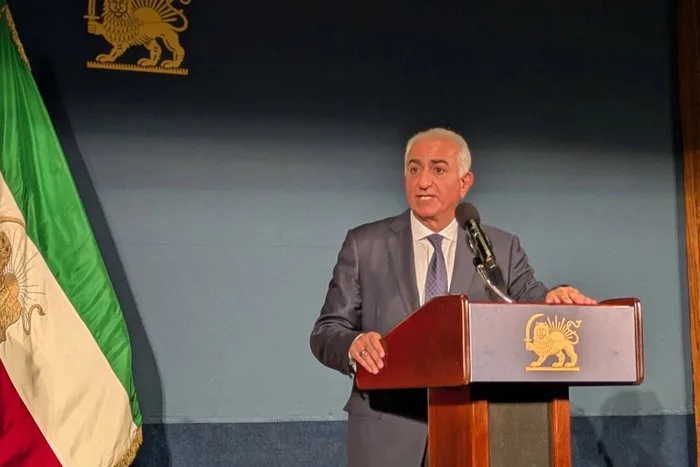
WASHINGTON—In a news conference at the National Press Club on Jan. 16, Iranian opposition figure Reza Pahlavi appealed to the United States and the international community to back his plan to overthrow Iran’s current rulers and place himself in power, at least through a transitional phase.
Pahlavi, the son of the last Iranian shah, Mohammad Reza Pahlavi—who was ousted in the Islamic Revolution of 1979—has lived in exile for decades. Responding to recent civil unrest and economic woes in his homeland, Pahlavi called on the international community for support.
“Today, as my compatriots call on me for leadership, I reaffirm my lifelong pledge by stepping in to lead the movement that will take back our country from the anti-Iranian hostile force that occupies it and kills its children,” he said. “I will return to Iran. I am uniquely positioned to ensure a stable transition.”
Protesters throughout the country have described a deadly clampdown at the hands of security forces working for Iran’s current rulers.
The Epoch Times could not independently verify the death toll from the ongoing civil unrest in Iran, but figures range from several hundred to several thousand killed. Pahlavi put the number at more than 12,000 within a 48-hour span of time.
During his remarks, Pahlavi laid out a series of steps the international community could take to hasten the collapse of the current Islamic Republic. He also described how he would lead Iran through the process of drafting and ratifying a new constitution.
Pahlavi Calls for Military Strikes, More Sanctions
In his call for support, Pahlavi said more Iranian lives could be saved if the international community backs his bid to take power.
“With or without the world’s help, the regime will fall. It will fall sooner, and more lives will be saved if the world turns its words into action,” he said.
Pahlavi said an international intervention would not require any commitment for boots on the ground. Instead, he posited the Islamic Republic’s fall could be hastened through airstrikes targeting command and control centers for security forces like the Islamic Revolutionary Guard Corps (IRGC).
“I’m calling for a surgical strike on those means,” Pahlavi said.
Members of Iran’s Revolutionary Guards Corps (IRGC) march during the annual military parade in Tehran on Sept. 22, 2018. Stringer/AFP/Getty Images
Pahlavi called for additional non-military measures to undermine Khamenei, including continued international sanctions.
He also called for international help to facilitate online access for the people of Iran, including by enabling satellite communications services and conducting “cyber operations to disable the regime’s ability to shut down the Internet.”
After the Ayatollah
During the news conference, Pahlavi asked the international community to be ready to quickly recognize his transitional government when the time comes.
In 1953, the United States and the United Kingdom helped orchestrate a coup to remove then-Iranian Prime Minister Mohammad Mosaddegh and solidify Pahlavi’s father’s claim to power as the shah of Iran.
As he helped organize the 1979 Islamic revolution, Ayatollah Ruhollah Khomeini downplayed his intent to turn Iran into an Islamic theocracy, only to later embrace such theocratic practices after removing Iran’s monarch.
Pahlavi said his team has plans for the first 100 days of a transitional government, as well as for Iran’s long-term economic recovery and national stabilization.
He described an initial democratic referendum for the Iranian people to elect representatives for an assembly that will draft a new constitution for the country. He said this draft constitution would then be put to a vote and that this process could repeat until a majority agrees to ratify a new governance model.
Trump Raises Doubts
Though Pahlavi described a plan for a democratic transition, he may face challenges in finding support, President Donald Trump said Jan. 14.
In an interview with Reuters, Trump questioned whether Pahlavi would have a broad appeal within Iran.
“He seems very nice, but I don’t know how he’d play within his own country. And we really aren’t up to that point yet,” Trump said.
People gather during a protest in Tehran, Iran, on Jan. 8, 2026. Anonymous/Getty Images
During his press conference, Pahlavi declined to comment on whether he has spoken with the Trump administration or other international leaders.
While many Iranians may be ready to cast off their current rulers, they may not be on board with Pahlavi’s plan, House Foreign Relations Committee member Rep. Mike McCaul (R-Texas) told The Epoch Times this week.
“There’s no clear path to leadership right now in my estimate and the briefings I’ve had,” McCaul said.
McCaul noted Iranian dissident groups like the Mojahedin-e-Khalq (MEK) have also begun to prepare their own candidates in a bid for power.
The U.S. government designated the MEK as a foreign terrorist organization in 1997, but reversed the designation in 2012.
Khosro Isfahani, a senior analyst for the National Union for Democracy in Iran, told The Epoch Times that the MEK and other dissident groups within Iran only have a marginal base of support.
“They don’t have a base in the country. They are irrelevant,” Isfahani said from the sidelines of Pahlavi’s Friday news conference.
Guy Birchall and Nathan Worcester contributed to this report.

More Stories
Iran Declares Strait of Hormuz Open, but Warns of Risk From Mines
By Chris Summers Iran said on April 9 that the Strait of Hormuz is open to all civilian shipping but...
Remote-Job Postings Rise 20 Percent Sequentially in 1st Quarter: Report
By Mary Prenon Although many American companies, both large and small, have called employees back to the office over the...
Updates on XO, Kitty Season 4 Renewal: Release Date, Cast, and Spoiler
Netflix’s popular romantic comedy drama, XO, Kitty is back with all new connections and a story. The American television drama...
US State Department Issues Travel Advisory for 3 African Nations
By Naveen Athrappully The U.S. Department of State recently issued travel advisories for Nigeria, Ethiopia, and São Tomé and Príncipe,...
US Forces Will Remain in Region Until Iran Complies With Agreement: Trump
By Victoria Friedman U.S. President Donald Trump said on April 8 that warships and personnel will remain in the region...
Homeward Bound: Artemis II Leaves Lunar Space, Reveals ‘Earthset’ Photos
By T.J. Muscaro HOUSTON—The Artemis II astronauts are on their way home from the moon. NASA’s Reid Wiseman, Victor Glover,...