
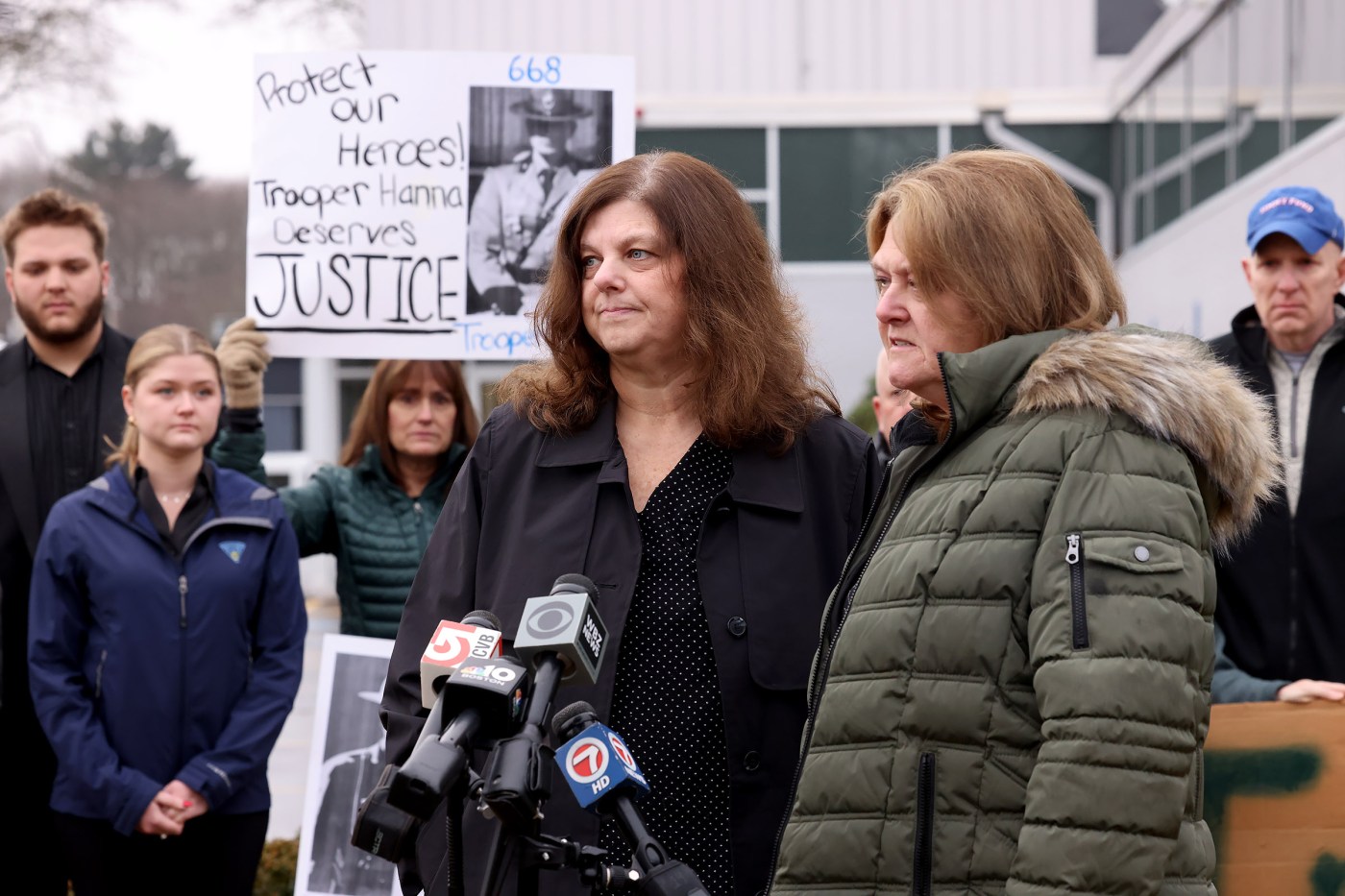
Parole Board expresses doubt about release of Trooper Hanna killer

At his first chance for parole since being convicted for the 1983 murder of Trooper George Hanna, Jose Colon said he is sorry for his crimes and has evolved during his four decades behind bars.
But during a four-hour-long hearing Thursday, it appeared that the Massachusetts Parole Board didn’t seem to think he’d changed enough.
Colon was convicted of first-degree murder alongside two other men for killing Hanna during a routine traffic stop in Auburn in February of 1983. He admitted to shooting the trooper six times and then leaving him for dead.
Although he was initially sentenced to life in prison without the possibility of parole, because Colon was 20 years old at the time of the crime, he qualified for reconsideration under a 2024 Supreme Judicial Court ruling. The controversial decision noted that “emerging adults” — offenders 18 to 20 — must be given the chance for parole.
By his own admission, Colon said what he did was “unforgivable.”
“I’m sorry for all the years I took away from your family,” Colon said. “For the experiences you will never have together.”
At times during his speech to the board, he paused and wept.
A psychologist who spoke in favor of Colon’s parole said that his case fit well under the SJC ruling, particularly because Colon was under the influence of two older co-defendants, one of whom was a brother-in-law whom Colon looked up to.
“I would never do anything like that by myself,” Colon repeated several times during the hearing.
The psychologist also told the board that Colon had been reluctant to work with her and did not want to blame his history, which included an abusive father, for his crime.
Despite the remorse, which several said they believed was genuine, each Parole Board member expressed concern that Colon had not taken enough accountability or participated in proper rehabilitation to be considered for release.
Board Chair Angelo Gomez noted that Colon had only taken classes in the past year or so.
“Why haven’t you made the investment at 50, at 60?” Gomez asked. “Why are you doing it now?”
“My sentence was to die in prison,” Colon said, explaining that he had “very little hope” until the SJC decision. He and his lawyer also noted that Colon was incarcerated in some prisons that had few classes and/or limited options for someone facing a life sentence without the chance of getting out.
Gomez said that he’d like to see Colon go to more counseling and attain more education. “You haven’t done anything to show stabilization,” he told Colon.
Another Parole Board member Dr. Charlene Bonner agreed. “Remorse without accountability is not indicative of rehabilitation,” she said.
Bonner characterized some of Colon’s descriptions of the killing as “incredulous.”
“It was a deliberate act,” she said, explaining that a reasonable person would find it hard to believe that Colon had shot Hanna with his eyes closed, something Colon claimed several times over the course of the hearing.
She also pointed to clear signs of Colon’s anti-social behavior at the time of the murder. “Most people avoid shooting a police officer,” Bonner said. “Even hardened criminals don’t usually cross that line.”
“Are you still that person?” she asked.
Several board members also brought up two disciplinary tickets issued to Colon in prison for alleged cannabinoid use at the end of last year. Colon denied using the drugs and said urine tests had come back clear.
Bonner argued that tests don’t always catch synthetic drugs and that if the drug use was true, it would make him higher risk of reoffending if released.
“I think you need work,” she said. Using a baseball analogy for Colon, who’d told the board that he’d once loved playing before a teenage injury, “you’re on first base.”
After Colon and the board spoke, several officials, as well as people who knew Hanna, got the chance to voice opposition to Colon’s potential release.
State Police Colonel Geoffrey Noble told the board Colon “made a deliberate decision to attack and kill a law enforcement officer. We must never minimize that fact.”
Robert Meier, a retired State Police sergeant, recalled showing up to the hospital the night Hanna was shot. His supervisor had sent him to try to get a statement from the trooper who was brought in still conscious.
But Meier was too late, he said. “I observed my friend dead on the operating table.”
Hanna’s parents and his wife also arrived after Hanna was pronounced dead, leaving them no chance to say a final goodbye.
“I gathered Hanna’s bloody uniform and took it with me,” Meier said. “I watched as George’s body was secured in the morgue.”
Hanna’s brother John, who also became a trooper, described the aftermath.
“My family has lived with the devastation of that night for 40 years,” he said, something the passage of time has not lessened.
“The question is not [Colon’s] age then, it’s whether he has matured now,” John Hanna said. “He has not.”
Related Articles
Editorial: Trooper George Hanna’s killer mustn’t go free
Retired Mass State Police major remembers Trooper Hanna ahead of his killer’s parole hearing
Massachusetts murderer who killed Trooper Hanna is up for parole, as Maura Healey pushes against his release
Massachusetts Parole Board has released 39 murder convicts who were initially sentenced to life without parole
Massachusetts convicted murderer who killed taxi driver is granted parole: ‘This man snatched my husband away’
Finally, two of Hanna’s three children, Deb and Kim, got up to speak, taking with them two photos of their father. They faced one at the board in front of them and another toward the crowd and their father’s killer.
Through tears, Deb Hanna described the happy, carefree family she grew up with until her father’s death. She was 14 when her father was killed, and she mourned all the hugs, the big life moments, and the advice they never got to share.
She recalled watching her father get ready for work, putting on his uniform with care. She remembered the many weekend games of “Hanna ball,” played in the miniature Fenway Park her father had built in their backyard.
“My father does not get parole from death. My family does not get parole from grief,” she said. “I am asking you, from the deepest place of love and loss, do not release the man who took my dad from us.”


More Stories
Middle East war triggering global energy ‘shock’ – IMF
Disruptions to oil and gas supplies will leave lasting “scars” on the world economy, managing director Kristalina Georgieva has said...
What is fueling unrest across the EU?
The bloc is facing an energy crisis due to the Strait of Hormuz disruption, with soaring diesel prices triggering protests...
OECD urges reeves to overhaul ‘inefficient’ UK tax system
Rachel Reeves has been told by one of the world’s most influential economic bodies that Britain’s tax system is holding...
Easter lifts footfall but retailers brace for April cost squeeze
Britain’s high streets enjoyed a welcome lift last month as an early Easter drew shoppers back through the doors, but...
Google takes on Opentable with AI that books your dinner in seconds
Google has fired the opening shot in a battle for Britain’s restaurant booking market, rolling out an artificial intelligence tool...
Retail backers of SEIT face wiping out half their money as green trust raises the white flag
Thousands of small investors who piled into one of London’s best-known green investment vehicles are staring down the barrel of...