
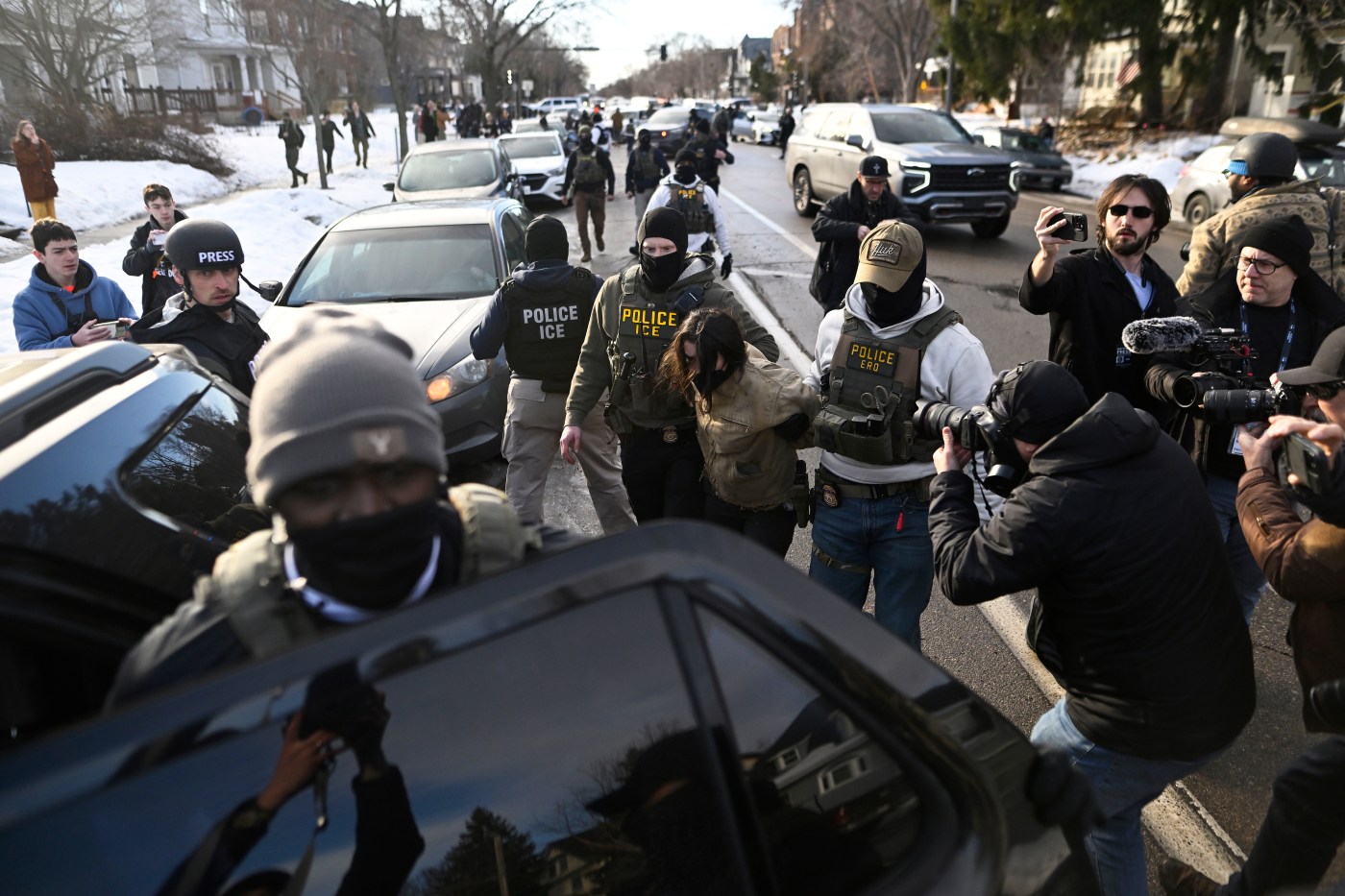
With ICE officers in masks and in city spaces, St. Paul City Council looks at beefing up its separation ordinance

Front-line workers at St. Paul’s libraries and recreation centers are trained to get their supervisor if federal immigration officers show up, but with the surge of ICE to Minnesota, a city council member questioned Wednesday if they’d have time.
“At this point, truthfully, federal agents just don’t care,” said St. Paul City Council Vice President HwaJeong Kim. “I think they’re going to waltz in our rec centers and our libraries, they’re going to identify and racially profile people.”
St. Paul City Council members discussed Wednesday strengthening the city’s separation ordinance that says city employees are not authorized to enforce federal immigration policies. The ordinance has been in place since 2004.
Council members have been working on a draft ordinance, which is now under review by the city attorney’s office, said Council President Rebecca Noecker at the council’s organizational committee meeting.
“I think every single person around this table shares that sense of urgency,” Noecker said. “… We are going to bring this (ordinance) forward as soon as we possibly can.”
The cities of St. Paul and Minneapolis, with the state of Minnesota, filed a lawsuit Monday seeking to suspend the Trump administration’s immigration crackdown in the state. A federal judge did not make an immediate decision during a Wednesday hearing.
An ICE officer fatally shot Renee Good, 37, in Minneapolis last week, which has drawn continuing protests.
City council member Anika Bowie said she also wants the council to look at budgetary actions they can take to respond to increased ICE arrests because “people are in total crisis right now” with business owners “so fearful that they have to close their doors.”
Actions council could take up
Policies that St. Paul and other local governments can bring forth, said John Boehler, policy counsel for the American Civil Liberties Union of Minnesota, speaking during Wednesday’s meeting, include:
Masks, IDs: Banning all law enforcement use of masks or face coverings within the city limits and/or require agency identification, name and badge number to be displayed at all times. The policy is in place in Los Angeles County and California, with exceptions for undercover officers, though the Trump administration has sued California over it.
Community spaces: Protect “vulnerable community spaces” by requiring a warrant for law enforcement entry into city-funded or city-run facilities, which include medical facilities, schools, daycares, libraries, courthouses, parks and community centers for immigration matters.
Human rights hotline: Establish a phone hotline or online portal through the city’s human rights departments where residents “can document constitutional abuses by the federal government.”
Data collection: Restricting data collected by automatic license plate readers to city of St. Paul or St. Paul police department servers. “We have begun investigating how these are used in the state of Minnesota,” Boehler said. “… We know that in other states … law enforcement agencies were helping ICE use these license plate readers to track immigrants, protesters … and anybody that they want to track and trail.”
The St. Paul Police Department has license plate readers on squad cars, but the data is not uploaded into a server that outside agencies can access on their own, according to a department spokesman. There is also an auditing process to track who accesses the data in the department.
Role of St. Paul police
City Council member Nelsie Yang said she’s heard St. Paul Police Chief Axel Henry say at meetings, “If you see a vehicle that doesn’t have a license plate, call it into 911, we will come and check it out. If you have somebody at your door knocking and you don’t know who they are, you’re suspicious, you’re afraid, call 911, we will come and verify who it is.”
But Yang said she’s “not confident that this is information or training that is consistent from the top down.” A business owner said in a Tuesday meeting that a vehicle without a license plate was parked by the business for an hour. The owner asked an officer nearby to check it out, but the officer said, “They’re busy” and had to go somewhere else, Yang said of what the owner related.
City Council member Molly Coleman said she’s been increasingly hearing from community members “that there is a real desire to have our St. Paul police officers protecting our residents from … dangerous behavior of ICE. … There’s been accidents resulting from the way ICE vehicles have been driving through our city.”
Training for city employees ongoing
St. Paul’s separation ordinance is grounded in the U.S. Constitution’s 10th Amendment, said Assistant City Attorney Edmundo Lijo, of the St. Paul City Attorney’s Office Immigrant & Refugee Program.
The ordinance says St. Paul police can not “undertake law enforcement action for the sole purpose of detecting the presence of undocumented persons,” Lijo said.
“A big piece of why we have the separation ordinance is about trust and public safety,” he added. “People think it’s about immigration enforcement. It’s not.” If victims and witnesses of crime are afraid to come forward, “it makes it a lot harder for our police to solve crimes,” Lijo said.
Related Articles
Kickoff to rebuild Ramsey Stone House on Wednesday
Some St. Paul-area restaurants closing, limiting hours over ICE presence
Coon Rapids man killed in North St. Paul; St. Paul man in custody
Vote now for canine royalty of the St. Paul Winter Carnival and Doggie Depot
4-year prison term for Minneapolis man who shot at vehicles during separate St. Paul road rage incidents
City employees have been receiving training in the separation ordinance since the spring and it’s ongoing. They’ve looked at the scenario of a federal agent showing up at a library or rec center and asking questions, Lijo said.
“We did not want that frontline employee to be responsible or feel like they’re the person on the spot and have to make those decisions about how to interact with that agent,” he said. They supposed to tell the agent, “Wait until my supervisor arrives.”
That’s a strong first step “because we want to create a very clear separation … for our staff and their safety,” council member Kim said, but there are workers who “feel compelled to protect the children that are coming to our rec centers, and the children and families that are coming to the libraries.”


More Stories
From Scotland Yard Commander to Global Security Entrepreneur: Dr Ali Dizaei’s Leadership Story
There are career journeys that follow a straight line, predictable, uniform, and comfortable. And then there are journeys shaped by...
The Naughty AI President: A New Age of Governance
In the race to build better systems of governance, humanity has always chased an impossible ideal: the perfect ruler. Rational,...
Sends shares Q1 2026 business update and product progress
Sends reported Q1 2026 updates sharing news on digital cards, app redesign, ClearBank integration, and fintech industry recognition. Sends, a...
Government doubles down on gaming with £30m funding package as sector eyes global growth
The government has fired the starting gun on a £30 million funding offensive aimed at Britain’s video games sector, urging...
Rising energy costs from Middle East conflict set to leave UK households £480 worse off this year
Rising energy costs triggered by the escalating Middle East conflict are on course to strip nearly £500 from the finances...
UK firms risk being left behind as AI adoption gap widens, warns PwC
British businesses are in danger of being left stranded in the middle of the pack on artificial intelligence, with a...