
US Holiday Spending Jumped in December, Signaling Consumer Strength Into 2026

By Tom Ozimek
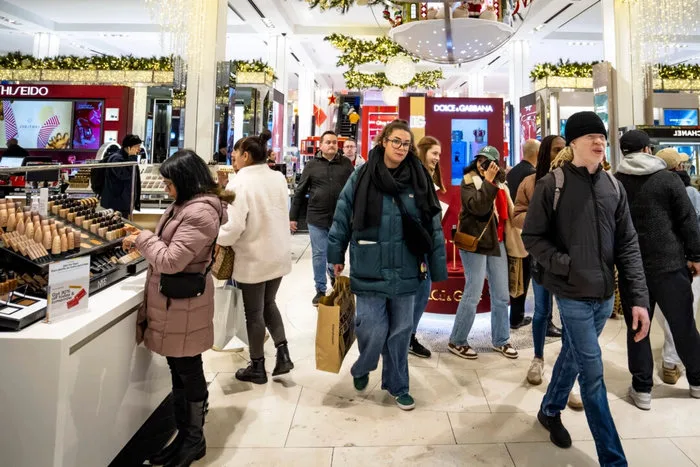
American consumers closed out the holiday season with a strong December spending surge, adding to evidence that household demand remains resilient even as confidence surveys show lingering unease about the economy.
Retail sales during the final two months of 2025 rose 4.1 percent from a year earlier, according to a Jan. 12 report from the National Retail Federation (NRF), pointing to total spending of just more than $1 trillion.
Retail sales excluding automobiles and gasoline stations rose 1.26 percent in December from November on a seasonally adjusted basis and increased 3.54 percent from 2024.
Core retail sales—excluding restaurants in addition to auto dealers and gas stations—climbed 1.6 percent month over month in December and rose 3.58 percent year over year.
NRF President and CEO Matthew Shay described the retail sales growth numbers as a “sharp surge” that showed consumers continued to spend eagerly on friends and family over the holidays.
“Continued economic momentum helped land 2025 holiday sales near the top of NRF’s forecast, reaffirming that consumers remain on solid footing,” Shay said.
The acceleration was broad, with sales up across all nine retail categories on a monthly basis and higher in six of nine categories on a yearly basis. Clothing, sporting goods, and digital products led year-over-year gains.
The December figures, which paint a picture of economic resilience and consumer strength heading into 2026, are based on anonymized credit and debit card purchase data. Official government data on retail spending, released monthly by the U.S. Census Bureau, are not yet available for December.
In November, NRF predicted that retail spend would reach just above $1 trillion over the holiday season, despite some gloomier sentiment surveys suggesting a possible consumer retrenchment.
“American consumers may be cautious in sentiment, yet remain fundamentally strong and continue to drive U.S. economic activity,” Shay said in November, while NRF chief economist Mark Mathews described the U.S. economy as showing “surprising resilience” in a year marked by persistent inflationary pressures and trade-related uncertainty.
Other measures also pointed to a strong holiday season. Adobe said recently that U.S. consumers spent a record $257.8 billion online from Nov. 1 through Dec. 31, up 6.8 percent from a year earlier and above its forecast of $253.4 billion.
Visa Consulting & Analytics likewise reported a solid season, estimating that U.S. holiday spending rose 4.2 percent from Nov. 1 through Dec. 23 across all payment types, including cash and check.
Mastercard also pointed to steady demand, reporting that U.S. holiday retail sales—both in-store and online—rose by nearly 4 percent from Nov. 1 through Dec. 21. The company said shoppers bought earlier in the season, took advantage of promotions, and blended brick-and-mortar purchases with online spending.
“Consumers demonstrated flexibility and confidence this season,” Michelle Meyer, chief economist at the Mastercard Economics Institute, said in a statement.
Consumer spending powers the U.S. economy, accounting for roughly two-thirds of output. Real gross domestic product (GDP) rose at a forecast-beating pace of 4.3 percent year over year in the third quarter, driven by higher exports and strong consumption.
Consumer Strength Underpins Growth Outlook
The strong holiday-season spending data comes as forecasters have grown more upbeat about U.S. growth, while continuing to flag consumer spending as the decisive factor for 2026.
Bank of America Chairman and CEO Brian Moynihan said in a recent interview that consumer demand remains steady even as some confidence readings have softened.
“At the end of the day, people are spending. They have good credit quality. They are employed … it’s pretty solid right now,” Moynihan said on CBS’s “Face the Nation” on Dec. 28.
Moynihan said Bank of America’s internal transaction data showed consumer spending rose more than 4 percent year over year during the Thanksgiving-to-early-December period. He said the key risk going forward is whether consumers remain engaged.
“The real question is—will the consumer keep spending in the U.S.?” he said, adding that Bank of America economists have upgraded their economic growth forecasts for 2026 sharply, now projecting a 2.4 percent pace of growth, far higher than the 1.5 percent prediction just four months ago.
This month, the Atlanta Federal Reserve’s GDPNow model raised its estimate of fourth-quarter real GDP growth to 5.4 percent on Jan. 8 from 2.9 percent a day earlier after incorporating fresh data on trade, consumer spending, and services activity.
A day later, the Atlanta Fed lowered the forecast slightly to 5.1 percent after the U.S. Census Bureau released data showing that fourth-quarter real residential investment growth contracted by 5.8 percent.
Fitch Ratings also upgraded its outlook, saying delayed government data showed firmer momentum in the second half of 2025 than previously assumed. Fitch now estimates U.S. GDP will grow by 2 percent in 2026, up from a previous projection of 1.9 percent.
Still, sentiment signals remain mixed. The Conference Board’s Consumer Confidence Index fell to 89.1 in December from 92.9 in November, but expectations for future household finances improved to their most positive level since January 2025, while inflation expectations eased.
The labor market has cooled but remains stable. The economy added 50,000 jobs in December, down from 56,000 in November, while the unemployment rate ticked down to 4.4 percent, according to the Bureau of Labor Statistics.
With consumers finishing 2025 on a strong note, economists now look to future data releases to see whether that spending momentum carried into 2026 and continued to power the U.S. economy.


More Stories
US Property Taxes Grow 3 Percent on Average in 2025, Outpacing Inflation
By Rob Sabo Property taxes are rising across the United States and, on average, have outpaced inflation. Homeowners in 2025...
Shane Lowry Makes Golf History With His 2nd Masters Hole-in-One
By Ross Kelly There are millions of casual golfers around the world who dream some day of recording an ace...
Treasury, IRS Propose Rules for 1 Percent Remittance Tax on Some Money Sent to Foreign Countries
By Naveen Athrappully The Internal Revenue Service and the Department of the Treasury proposed regulations on Friday regarding the new...
Hezbollah Leader Says Group Would Continue to Fight Israel After Strikes
By Jack Phillips The leader of Lebanese terrorist organization Hezbollah has said that his group would continue to fight Israel,...
IBM to Pay $17 Million to Settle Allegations of Discrimination
By Jacki Thrapp IBM will pay millions of dollars to resolve allegations that it failed to comply with anti-discrimination requirements...
Trump Says US ‘Loading up the Ships’ Ahead of Iran Talks, Signals Military Option If Diplomacy Fails
By Tom Ozimek President Donald Trump said the United States is preparing military options if negotiations with Iran fail to...