
Judge Blocks Parts of Trump’s Election Order on Citizenship Proof, Ballot Deadline Rules

By Tom Ozimek
A federal judge has blocked key parts of President Donald Trump’s election-related executive order in Washington state and Oregon, two vote-by-mail states, ruling that the president exceeded his constitutional authority by attempting to dictate how states run federal elections.
U.S. District Court Judge John H. Chun for the Western District of Washington ruled in favor of Washington and Oregon on Jan. 9, permanently halting enforcement of core provisions of Trump’s executive order that directed various federal officials and government agencies to take actions aimed at safeguarding the integrity of U.S. elections.
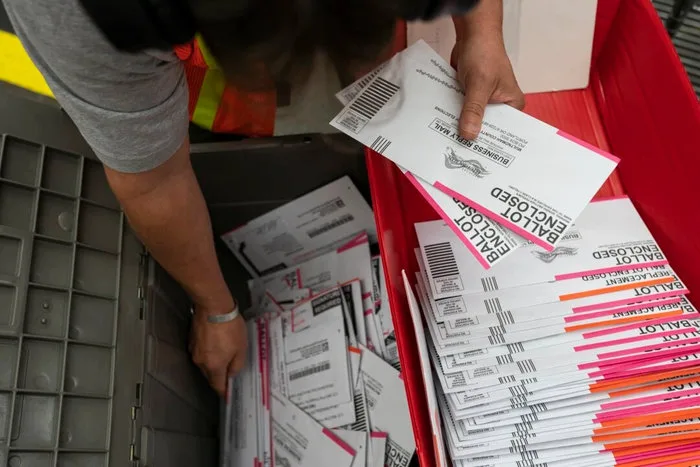
Trump’s order sought to require documentary proof of citizenship for voter registration and mandate that all mail-in ballots be received by Election Day, even if postmarked on time, with the threat of loss of federal election funding for noncompliance.
“Free, fair, and honest elections unmarred by fraud, errors, or suspicion are fundamental to maintaining our constitutional Republic,” Trump wrote in the order, signed on March 25, 2025. “The right of American citizens to have their votes properly counted and tabulated, without illegal dilution, is vital to determining the rightful winner of an election.”
Washington and Oregon, both universal vote-by-mail states, argued in a lawsuit that Trump’s order would disrupt their election systems, impose significant new costs, and disenfranchise eligible voters.
“To protect against despotism, the Constitution grants the President no authority over federal elections,” attorneys for the two states wrote in a complaint filed in August 2025. “Instead, States are responsible for regulating federal elections, subject only to preemption by Congress.”
The judge agreed, finding that the order violated the Constitution’s separation of powers by attempting to exert control over federal elections. Chun rejected the administration’s claim that the order merely enforced existing law, concluding that it instead sought to impose new election rules without congressional authorization.
“In the framework of our Constitution, the President’s power to see that the laws are faithfully executed refutes the idea that he is to be a lawmaker,” the judge wrote. “Accordingly, the ‘Constitution entrusts Congress and the States—not the President—with the authority to regulate federal elections.’”
The judge also objected to what he described as a presidential attempt to place new conditions on congressionally appropriated federal funds by tying federal election funding to compliance with his executive order.
“The President has no authority to unilaterally impose new conditions on federal funds or ‘thwart congressional will by canceling appropriations passed by Congress,’” the judge wrote. “In granting this relief, the Court seeks to … restore the proper balance of power among the Executive Branch, the states, and Congress envisioned by the Framers.”
Washington Attorney General Nick Brown praised the ruling, describing it as a win for voters and democratic norms.
“Today’s ruling is a huge victory for voters in Washington and Oregon, and for the rule of law,” Brown said in a Jan. 9 post on X. “The court enforced the long-standing constitutional rule that only States and Congress can regulate elections.”
The Department of Justice, which is representing the Trump administration in the case, did not respond to a request for comment.
However, in an earlier legal brief seeking dismissal of the case, government attorneys argued that Trump’s order “at most, properly interprets existing law” rather than creating new legal requirements, and that any alleged injury flowing from the directive is “speculative.”
The ruling marks the latest judicial setback in Trump’s effort to reshape election administration through executive action, following a similar decision in a Massachusetts case brought by 19 states, and another ruling in a District of Columbia lawsuit filed by Democratic and civil rights groups.
More Stories
Wind Breaker Season 2: Release Date, Voice Artist, Trailer, and Recent Updates
Good news for the anime lover! Wind Breaker, the Japanese series, is officially released on Netflix. After waiting for several...
Senators Plan Taiwan Trip Ahead of Trump’s Summit With Xi Jinping
By Jacob Burg Four U.S. senators from both sides of the aisle are planning to visit Taiwan, Japan, and South...
High Oil Prices Could Persist Long After Strait of Hormuz Reopens, Industry Insider Says
By Mary Prenon With the Strait of Hormuz—the primary gateway for Middle East oil exports—effectively shut down by Iran, the...
Border Czar: ICE to Assist at Airports Until They Are 100 Percent, TSA Pay Coming This Week
By Tom Gantert White House border czar Tom Homan said Sunday that ICE agents will be used to help out...
Trump Signals Potential Military Action Coming Against Cuba
By Jack Phillips President Donald Trump again suggested that U.S. military action could be coming against Cuba as his administration...
US Monitoring Surge in China’s Detention of Panama-Flagged Vessels
By Aldgra Fredly The U.S. Federal Maritime Commission on March 26 accused China of detaining Panama-flagged vessels in response to...