
Protests Spread in Iran as Regime Vows to Retaliate Against Any US Attack

By Jacob Burg
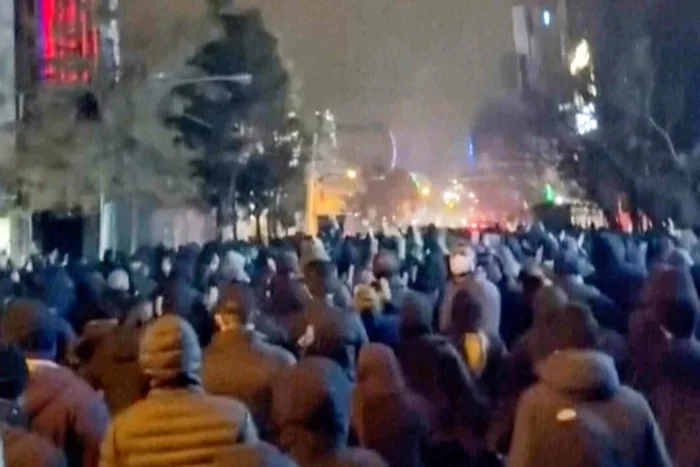
The Iranian regime threatened on Jan. 11 to strike Israeli and U.S. military bases if Washington attacks the Islamic nation, where thousands of protesters are taking to the streets as the economy crumbles and inflation soars.
The protests have reached a critical threshold in recent days, challenging Tehran’s clerical establishment with the largest wave of anti-government protests since 2022.
U.S. President Donald Trump has said if Iran shoots and “violently kills peaceful protesters, which is their custom, the United States of America will come to their rescue,” Trump wrote on Truth Social on Jan. 2.
“We are locked and loaded and ready to go.”
Trump reiterated on Jan. 10 that the United States is “ready to help,” spurring strong condemnations from Iran’s political elite.
This would be “a miscalculation,” Iranian Parliament Speaker Mohammad Baqer Qalibaf said while speaking in parliament on Jan. 11.
“Let us be clear: in the case of an attack on Iran, the occupied territories [Israel] as well as all U.S. bases and ships will be our legitimate target,” said Qalibaf, who previously served as a commander in Iran’s elite Revolutionary Guards.
Protests Challenge Regime
Since protesters took to the streets on Dec. 28, 2025, Iranian authorities have increased efforts to stem the tide of unrest and signaled on Jan. 9 that the suppression of demonstrations was coming soon.
“Last night in Tehran & some other cities, a bunch of people bent on destruction came and destroyed buildings that belong to their own country in order to please the President of the United States and make him happy,” the Iranian leader Ayatollah Ali Khamenei wrote on social media on Jan. 9.
Iran’s judiciary chief, Gholamhossein Mohseni-Ejei, promised that punishment for protesters would be “decisive, maximum and without any legal leniency.”
Human Rights Activists News Agency, a U.S.-based rights group, reported that the death toll stands at 203 since protests broke out in Iran last month, and includes the deaths of 41 members of Iran’s security forces and 162 protesters.
The agency is also receiving reports of larger numbers of deaths that it is still assessing. More than 3,280 people have been arrested by Iranian authorities so far.
First demonstrating against Iran’s skyrocketing inflation, protesters have now turned against Tehran’s clerical establishment that has retained an iron grip on the country since the 1979 Islamic Revolution.
Tehran has repeatedly pinned the blame for domestic political demonstrations on Israel and the United States, accusing the two nations of igniting unrest within its own borders.
Iranian authorities instituted an internet blackout on Jan. 8, cutting off the nation’s citizens from the outside world. Netblocks, an internet monitoring watchdog, reported that connectivity levels in Iran are at roughly one percent of the norm.
Iran has shut down internet access domestically twice before, once in 2019 when protesters challenged an increase in regime-subsidized gasoline prices, resulting in more than 300 people being killed.
The regime pulled the plug again in 2022 when citizens took to the streets to protest the death of Mahsa Amini after the nation’s morality police arrested her for allegedly not wearing a hijab. After a months-long crackdown, authorities had killed more than 500 people.
Reza Pahlavi, the exiled crown prince of the former ruler of Iran, who was ousted during the 1979 revolution, has called for increased protests throughout the Islamic Republic over the past four days, telling demonstrators to wave Iran’s old lion-and-sun flag and other national symbols from his father’s rule to “claim public spaces as your own.”
Iran’s internet blackout has many worried that a crackdown on protests could turn bloody, as it has in the past.
Recounting when security forces killed hundreds during demonstrations in 2019, Ali Rahmani, the son of Nobel Peace Prize laureate Narges Mohammadi, who is imprisoned in Iran, said, “We can only fear the worst.”
“They are fighting, and losing their lives, against a dictatorial regime,” Rahmani said.
Guy Birchall, The Associated Press, and Reuters contributed to this post.

More Stories
US Arranging Charter, Military Flights for Americans in the Middle East
By Savannah Hulsey Pointer The U.S. State Department is looking to help Americans in the Middle East find a way...
New Target CEO Forecasts Turnaround to Retailer’s Lackluster Sales in 2025
By Rob Sabo Target Corp. reported on March 3 slumping sales in the fourth quarter of fiscal 2025, but its...
France Sending Nuclear-Powered Aircraft Carrier to Mediterranean: Macron
By T.J. Muscaro France’s nuclear-powered aircraft carrier Charles de Gaulle has set sail for the Eastern Mediterranean under the orders...
Trump Says US Has ‘Virtually Unlimited’ Weapons Stockpiles
By Guy Birchall President Donald Trump said on March 3 that the United States has a “virtually unlimited supply” of...
Trump Criticizes Starmer, Says Special Relationship in Peril
By Owen Evans President Donald Trump has criticised British Prime Minister Keir Starmer and warned that the historic U.S.–UK Special...
Alone Season 11 is Live on Netflix: Know About Release Date, Participants, and Winner
Why is Alone season 11 getting a sudden hype after its original release date on 13 June 2024? There are...