
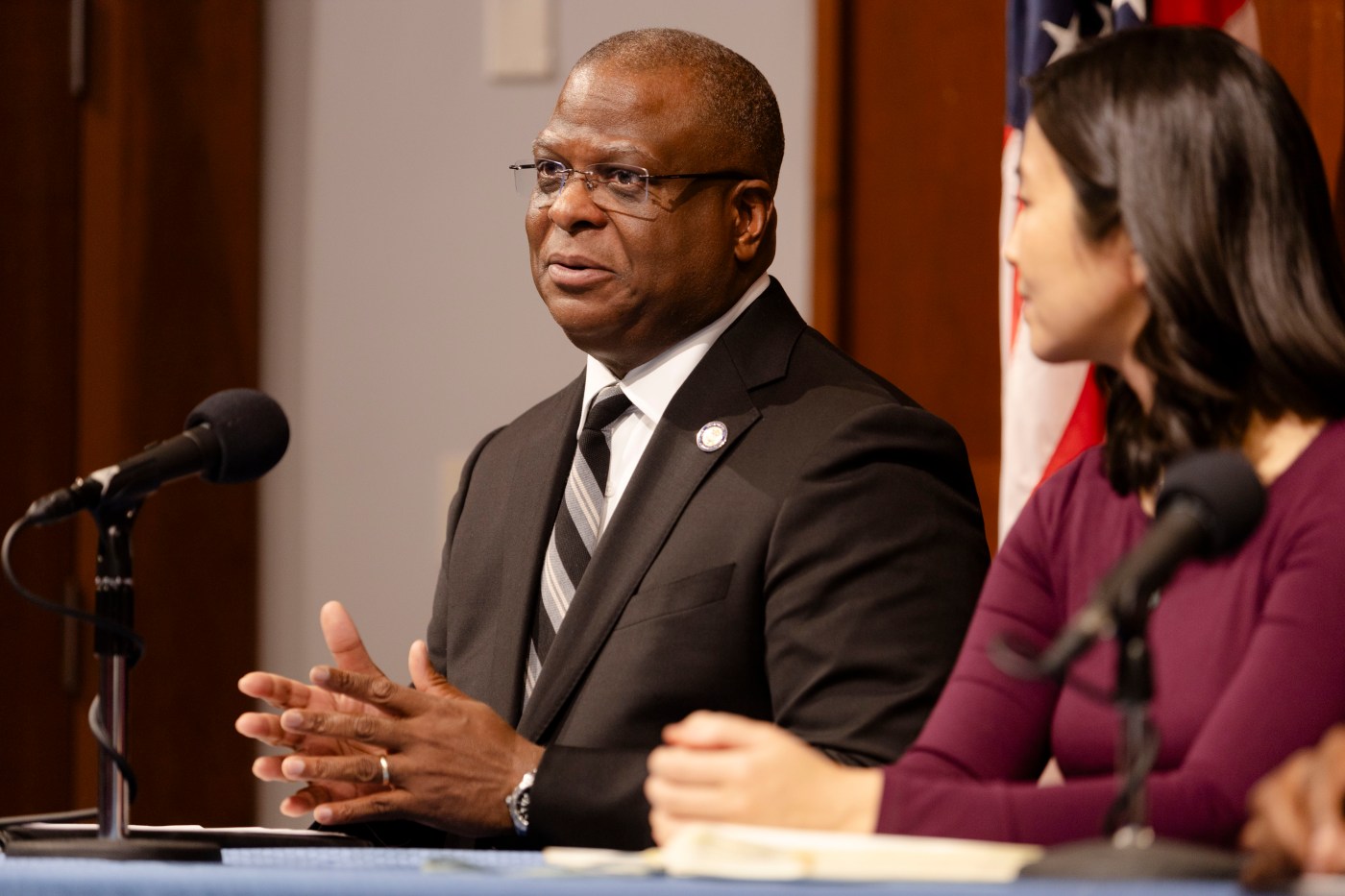
Former Boston cop seeks POST decertification of Cox, five other BPD heads

A former Boston police officer fired for posts on social media about the January 6, 2021 U.S. Capitol riot, asking the state’s Peace Officers and Training (POST) Commission to decertify Boston Police Commissioner Michael Cox and five other high-ranking department officials.
Filed on Thursday by former officer Joe Abasciano, the six POST Commission complaints target Commissioner Cox, Chief of Department Phillip Owens, Deputy Superintendent Sharon Dottin, Deputy Superintendent Richard Dahill, Staff Attorney David Fredette, and Officer Joseph Coppinger. It alleges the group participated in patterns of retaliation, untruthfulness, and abuse of authority. A pending federal lawsuit seeks damages and addresses additional claims, including religious discrimination.
“Restitution without accountability is not justice,” Abasciano told the Herald. “If the taxpayers of Boston just settle another multi-million dollar lawsuit, but the persons that are responsible for those bad actions aren’t held accountable, then what’s to stop the next commissioner from doing the same thing?”
Joe Abasciano was fired by Boston Police in 2023 after Commissioner Cox ordered a review of an internal investigation that found Abasciano had not violated BPD policy regarding social media use and that he was within his First Amendment rights.
He had been in Washington, D.C. the day the January 6 Capitol riot broke out, but did not participate and did not go near the Capitol Building. He did, however, anonymously post to X about the unfolding situation, calling those participating “patriots” in the politically charged post. His attorney says a “personal rival” of Abasciano’s turned the posts into BPD brass, sparking an internal investigation into whether he violated department policy and acted in a way unbecoming of a police officer.
“I really didn’t get close enough to participate or even see anything. We left town and on the way home I sent out a couple tweets anonymously and somebody began flagging my tweets and sending them off the Boston Police Department,” Abasciano said. “We were cleared of any wrongdoing or participating in any wrongdoing. We were also well-within our First Amendment-protected rights and even within the rights of the Boston Police Department as far as political speech and activism goes.”
Boston Police found Abasciano had not violated any department protocol with his tweets, with the investigator even noting in his report that his speech in the tweets were protected by the First Amendment. But Abasciano’s attorney, Mark Gagliardi, tells the Herald the case was reopened a year later when Cox was appointed Commissioner.
“This is a violation of the First Amendment where Joe is expressing opinions of matters of political nature on his own time and this was protected speech,” said Gagliardi. “They did a second investigation, which was basically a paper investigation. No new evidence was surfaced, no witnesses were interviewed, nothing was done except a review of the paper [report] and everybody flip-flopped and they fired Joe.”
Abasciano won an appeal to the Massachusetts Civil Service Commission in December 2024, which resulted in his termination vacated as the City argued he was fired with just cause due to “conduct unbecoming of a police officer.” U.S. District Court Judge Allison Burroughs also ruled in Abasciano’s favor in a federal lawsuit in November, granting a partial summary judgment on First Amendment retaliation claims against BPD. Galgiardi says Abasciano plans on filing claims for damages, disability discrimination and religious discrimination against the department.
In addition to his tweets about the Capitol riot, Abasciano also says he feels that Cox and the Wu Administration retaliated against him because of his public criticism of the City’s Covid vaccination policies during the pandemic.
“I was one of hundreds of first responders who challenged Mayor Wu’s vaccine mandate and the vaccine passport, but for whatever reason I think myself and one or two others were given more blame or more credit for challenging that policy,” he said.
Gagliardi says decertification would “reinforce the goals of the 2020 police reform law” by enforcing consequences for misconduct.
The Herald has requested comment from Boston Police and the Wu Administration.

More Stories
Trail Blazers vencen a Rockets 111-105 y extienden racha de triunfos a 5
PORTLAND, Oregon, EE.UU. (AP) — Toumani Camara anotó 25 puntos y los Trail Blazers de Portland ampliaron a cinco su...
Giannis frena a LeBron 2 veces en el minuto final y Bucks vencen a Lakers 105-101
LOS ÁNGELES (AP) — Giannis Antetokounmpo bloqueó un tiro de LeBron James y le robó el balón en posesiones consecutivas...
Rescatistas filipinos detectan “señales de vida” tras avalancha con desaparecidos en vertedero
Por JIM GOMEZ MANILA, Filipinas (AP) — Los rescatistas detectaron señales de vida en una avalancha de basura que mató...
Protestas contra ICE en EEUU tras tiroteos en Minneapolis y Portland, Oregón
Associated Press MINNEAPOLIS, Minnesota, EE.UU. (AP) — Ciudades y pueblos de todo Estados Unidos convocaron protestas en contra de la...
Stephen Curry suma 27 puntos y 10 asistencias; Warriors arrollan 137-103 a Kings
SAN FRANCISCO (AP) — Stephen Curry anotó 27 puntos y logró su mejor estadística de la campaña al atrapar 10...
Corea del Norte promete responder tras acusar al Sur de enviar drones a través de la frontera
Por HYUNG-JIN KIM SEÚL, Corea del Sur (AP) — El ejército de Corea del Norte acusó a Corea del Sur...