
Opinion: Landmarks Should Grant West-Park Presbyterian Church’s Plea for Hardship

“Preservation should absolutely preserve the buildings that enrich our communities, but not at the expense of the very institutions that made our communities what they are. Much as we would like to save both, this is not the case for West-Park.”
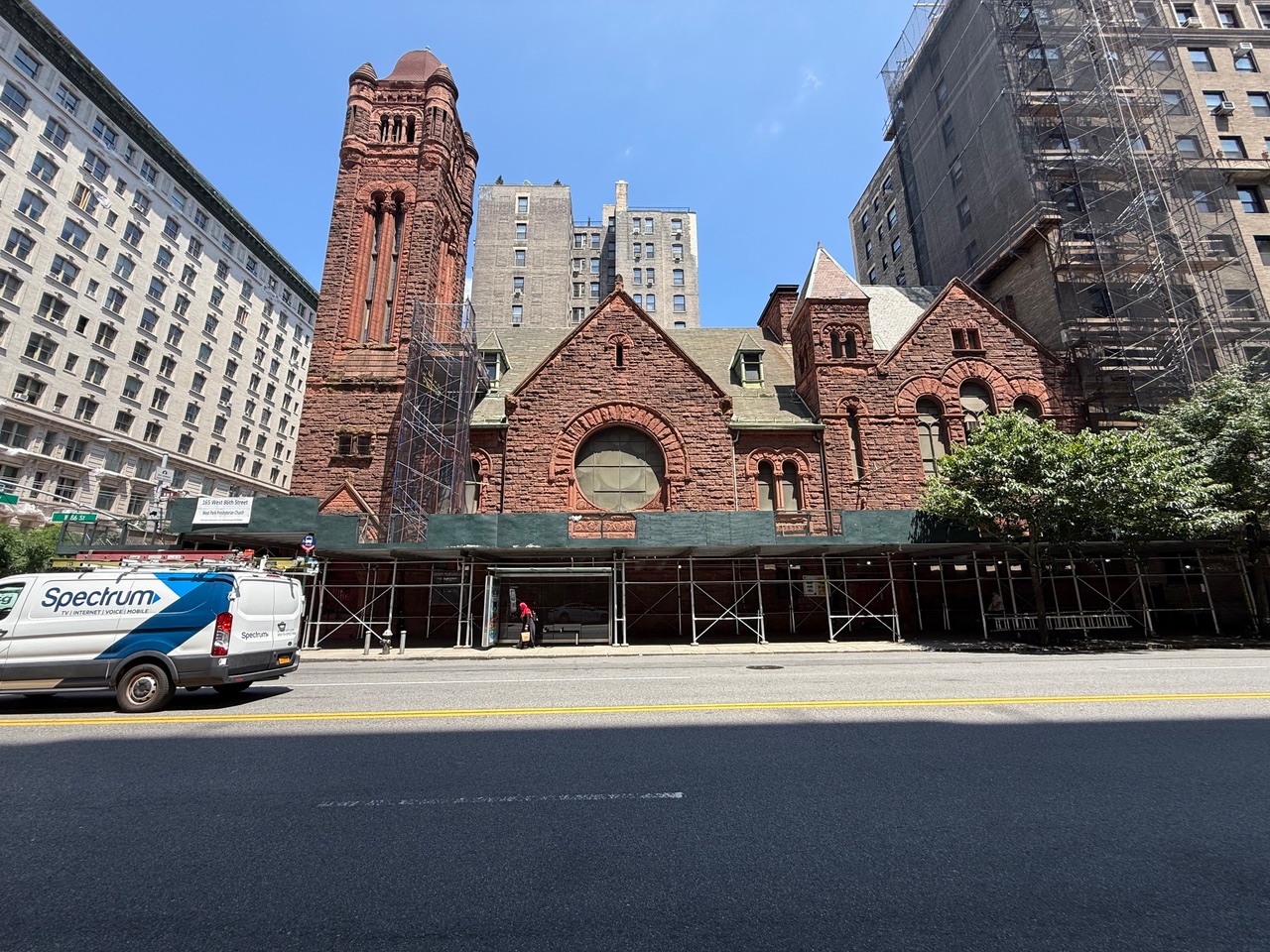
West Park Presbyterian Church at 86th Street and Amsterdam Avenue. (Courtesy of Roger Leaf)
Presenting the case for a hardship at the Dec. 9 historic Landmarks Preservation Commission hearing on behalf of the West-Park Presbyterian Church felt like I had stepped into the twilight zone. What unfolded was not a sober evaluation of facts, law or safety, but a stunning display of selective memory, and offensive misstatements about a building that should never have been landmarked.
A decade ago, LPC landmarked the West-Park Presbyterian Church at 86th Street and Amsterdam Avenue over the congregation’s clear and urgent objections. At the time, the structure was empty, without heat or running water, and had been surrounded by a sidewalk shed for over 10 years. The church had almost no resources to maintain the building, and it warned that landmarking would only accelerate both the building’s and the congregation’s decline.
The Commission landmarked the building due largely to Councilmember Gale Brewer’s emotional promises, much like those she made on Dec. 9, about the funding she could raise to pay for restoration. She and others again insisted that money would be raised, that grants would be secured, and that the congregation would not be left alone to shoulder the immense financial weight of restoration. Ten years ago, the Commission believed them. They shouldn’t make the same mistake twice.
As soon as the building was landmarked in 2010, Gale Brewer’s support vanished, and the congregation was forced to dedicate all its resources to repairs instead of the ministry and social outreach for which it has been so widely praised. Not surprisingly, as the pressures of building maintenance grew, the membership rapidly declined. Its loss of pastoral leadership in 2017 was the final nail in the coffin.
We heard repeatedly at the LPC hearing that the condition of the building was a calculated strategy of “demolition by neglect” by a greedy congregation, and the loudest voices came from the Center at West Park. This is the height of chutzpah, given that the Center at West Park was tasked with maintaining the building for the past eight years in return for a pittance in rent but never spent a dime on restoration.
If a hardship is granted by LPC, it allows the church to sell the building to a new owner, who would demolish it and build a new property with space for worship and community activities. It would also fund social justice initiatives through the five boroughs through a decided fund created by The Presbytery of NYC.
Granting this hardship is the only path forward for the survival of one the oldest faith communities on the Upper West Side. It would provide safe, accessible space for worship, funding for a pastor, and an unprecedented $30 million to endow a social justice fund to carry on its mission in struggling communities across the City. If the hardship is not granted, West-Park will almost certainly close its doors forever.
The not-for-profit provisions of the landmarks law are meant to prevent a taking when the burden of landmark designation has deprived the owner of the value of the property for the continuance of its mission. Such a condition could not be clearer in the case of West-Park. In 2021, an independent appraisal valued the building at $49 million if it were not landmarked. Today, there is no question that the value of the building as a landmark is a tiny fraction of that amount.
The landmarks law is clear—a hardship shall be granted to a non-profit if the building is no longer suitable or appropriate to which the owner is devoted. The church—the owner—is facing millions of dollars in repairs to the building that it can’t possibly afford. Without relief from the weight of the building, West-Park will be driven into bankruptcy.
The Center at West-Park is not a party to this hardship application. It is neither the owner nor a tenant, and has no connection to the church despite its wildly inappropriate name. But it was given an unprecedented opportunity last month to make a case for forcing the church to simply hand them the keys to the building—all to preserve the views from the apartments of six of its board members.
Preservation should absolutely preserve the buildings that enrich our communities, but not at the expense of the very institutions that made our communities what they are. Much as we would like to save both, this is not the case for West-Park. This application should be granted.
Roger Leaf is chair of the West-Park Administrative Commission. He has served as trustee for First Presbyterian Church in the City of New York for the past 20 years. He previously served as a board member, chair of audit, budget and finance committees for the Presbytery of NYC.
The post Opinion: Landmarks Should Grant West-Park Presbyterian Church’s Plea for Hardship appeared first on City Limits.


More Stories
Quick Fix: Chicken mac and cheese with lettuce and tomato salad
By Linda Gassenheimer, Tribune News Service I was looking for a quick and comforting meal for this busy time of...
How rodeo clowns have evolved, from funnymen to bullfighters — with lives on the line
DENVER — From the time he was in fifth grade, Richie Harris aspired to be a rodeo clown. For Harris,...
How rodeo clowns have evolved, from funnymen to bullfighters — with lives on the line
DENVER — From the time he was in fifth grade, Richie Harris aspired to be a rodeo clown. For Harris,...
A los 58 años, el futbolista profesional más viejo del mundo dice que mejora con la edad
TOKIO (AP) — Kazuyoshi Miura, el futbolista japonés al que llaman “King Kazu”, dice que solo mejora con la edad....
México quiere hablar con Rubio o Trump tras comentarios de EEUU de atacar a los cárteles por tierra
Associated Press CIUDAD DE MÉXICO (AP) — La presidenta de México, Claudia Sheinbaum, dijo el viernes que ha solicitado al...
This cafe takes orders in sign language. It’s cherished by the Deaf community
PORTLAND, Ore. (AP) — An Oregon cafe that takes orders in sign language has become a cherished space for the...