
How tariffs will continue reshaping the global economy in 2026

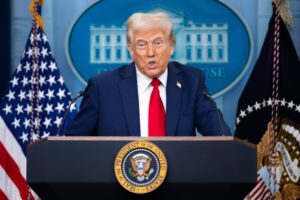
Donald Trump has never been shy about his favourite economic weapon. In his pre-Christmas address to the nation, the US president once again made clear that tariffs remain central to his vision for American prosperity.
While supporters argue that tariffs are reviving domestic industry, lifting wages and restoring economic sovereignty, critics remain unconvinced. What is no longer in dispute, however, is that Trump’s tariff regime has already reshaped the global economy, and will continue to do so well into 2026.
According to the International Monetary Fund (IMF), the cumulative impact of tariff measures is one of the key reasons global growth is now forecast to slow to 3.1 per cent in 2026, down from a pre-Covid average of 3.7 per cent. A year ago, the IMF had expected global growth of 3.3 per cent.
Kristalina Georgieva, the IMF’s managing director, has described the situation as “better than we feared, worse than it needs to be”. While a full-scale trade war has been avoided, growth remains too weak to meet rising expectations around living standards, employment and economic security.
Maurice Obstfeld, a former IMF chief economist and now at the Peterson Institute for International Economics, argues that the damage from tariffs has been contained largely because most countries avoided aggressive retaliation.
China was the notable exception, and even there, the US rapidly softened its stance following forceful counter-measures from Beijing. “We avoided a trade disaster,” Obstfeld says. “But we still ended up with more trade restrictions than when Trump returned to office.”
Five rounds of talks later, tariffs and trade barriers between the world’s two largest economies remain higher than at any point in recent history, creating lasting friction across global supply chains.
Rather than triggering an immediate downturn, tariffs have gradually increased costs and uncertainty for businesses. Planning long-term investment has become harder, while companies face constant risk that exemptions or rules may change overnight.
Ironically, the many loopholes built into US tariffs have softened their economic impact, but at the cost of predictability. “Exemptions lower the effective tariff rate,” Obstfeld notes, “but they also introduce huge uncertainty over who qualifies and for how long.”
This helps explain why the United Nations Conference on Trade and Development (UNCTAD) estimates global trade still grew by 7 per cent last year, reaching more than $35 trillion. Lower interest rates, a weaker dollar, creative supply-chain workarounds and selective tariff carve-outs have all played a role.
The US economy has so far shrugged off much of the disruption. Growth reached 4.3 per cent between July and September, the strongest pace in two years, underpinned by consumer spending and massive investment in artificial intelligence.
Aditya Bhave, senior economist at Bank of America, believes the US remains “very resilient”, though he warns tariffs have likely added up to half a percentage point to inflation. With consumption accounting for more than a quarter of global GDP, any slowdown in US spending would have global consequences.
Elsewhere, inflation trends are mixed. The eurozone has stabilised near target at 2.1 per cent, while the UK and US remain above central bank comfort levels, keeping pressure on household finances and interest-rate policy.
Several flashpoints loom large over the year ahead. The renegotiation of the USMCA trade deal, EU ratification of a long-delayed South American agreement, and a US Supreme Court ruling on the legality of Trump’s tariffs could all reshape trade flows.
Energy prices will also be pivotal. Goldman Sachs expects Brent crude prices to fall around 8 per cent this year, easing inflationary pressure. A gradual reopening of Red Sea shipping routes could further reduce global transport costs, though risks remain elevated.
China continues to cast a long shadow. Trade between Beijing and Washington fell for a third consecutive year in 2025, and tensions over rare earths, semiconductors and industrial overcapacity remain unresolved.
James Zimmerman, chair of the American Chamber of Commerce in China, says expectations for progress at a planned Trump-Xi summit in April are “low”, but ongoing dialogue is essential. “Beijing wants a fair chance to compete,” he says, “but the over-emphasis on security concerns is creating deep mistrust on both sides.”
Despite bold rhetoric about re-industrialisation, US manufacturing employment has barely moved, slipping slightly below 12.7 million workers. Yet tariffs remain politically entrenched.
Obstfeld argues the US economy has grown despite tariffs, not because of them, thanks to consumer resilience and the AI investment boom. Still, he sees no sign of a policy reversal.
“Tariffs aren’t going away,” he says. “They will remain a central part of economic policy and political debate.”
As 2026 unfolds, the global economy is unlikely to collapse under the weight of tariffs, but it will continue to bend, fragment and adapt around them, with uncertainty now the defining feature of global trade.
Read more:
How tariffs will continue reshaping the global economy in 2026


More Stories
Government’s £100m pledge for innovators dismissed as a drop in the ocean after £25bn National Insurance raid
The government has announced a £100million package of measures aimed at unlocking private investment for Britain’s entrepreneurs, start-ups and scale-ups,...
Don’t fear AI job losses – invest in training, urges Google’s UK boss
Kate Alessi, Google’s managing director for the UK and Ireland, has pushed back firmly against warnings that artificial intelligence will...
Higher defence spending could unlock £30bn annual boost for UK economy
Increased defence investment stands to deliver a significant windfall for the British economy, with new analysis suggesting that the government’s...
Oil price surges past $111 as Strait of Hormuz deadline looms
The price of oil climbed above $111 a barrel on Tuesday as mounting anxiety over stalled diplomatic efforts in the...
Manufacturers bracing for £1 billion business rates bombshell as April cost crisis deepens
Britain’s manufacturing sector is staring down the barrel of a near-£1 billion increase in annual business rates, piling further pressure...
Bristol’s new arena sets sights on hosting the Brit Awards
Bristol is about to join the big league of British live entertainment, with the city’s forthcoming Aviva Arena setting its...