
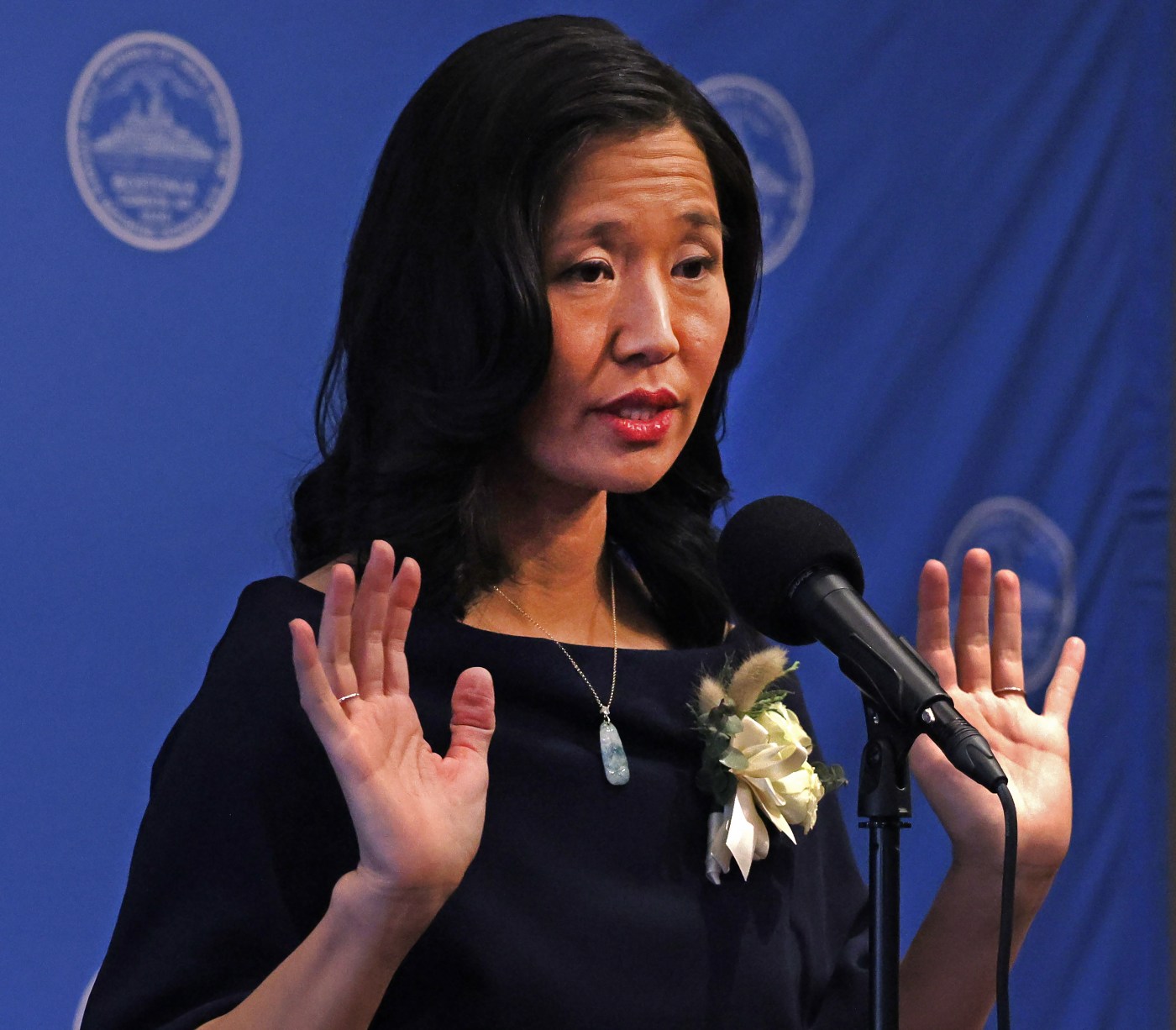
Mayor Wu ignores Boston’s ‘fiscal crisis’ driven by falling office values in inaugural address

Boston Mayor Michelle Wu’s inaugural address completely ignored the city’s financial crisis that has been created by falling office values, which one watchdog group has projected may lead to a more than $2 billion budget deficit in five years.
Wu spoke at length about her first-term administration’s achievements around housing, school improvements and reduced gun violence, but neglected to mention the city’s economy, which has been hit hard by a post-pandemic shift to remote work that has left commercial values plummeting and residential taxes skyrocketing.
The omission did not escape the notice of Gregory Maynard, executive director of the Boston Policy Institute, which initially sounded the alarm on the impacts vacant office space and declining values are having on the city’s $4.8 billion budget two years ago.
“Mayor Wu’s inaugural speech … did not include the words office, downtown, tax, or budget,” Maynard said in a statement. “That means there was no discussion of the $4.2 billion in assessed value lost by commercial properties in Boston over the last two years, the huge increases in homeowners’ property taxes that collapse in office values has brought on, or how the 2% cut to city departments that Mayor Wu said was coming in the FY27 budget will impact city employees and city services.
“Since those issues were ignored, this speech shed no light on the fiscal crisis that Boston is in the midst of, or Mayor Wu’s plan to tackle it,” he added.
Since BPI’s initial report in February 2024, its projected budget gap for the city has increased from $1.2-$1.5 billion to $2.1 billion over the next five years.
Maynard has said BPI updated its projections to the $2 billion “worst-case scenario” after the mayor’s office released data in December that showed commercial values are projected to drop by 6% this fiscal year, a decline that he said is happening faster than initially anticipated.
Wu’s office released data that showed the 6% drop in commercial property values are happening alongside a projected 2% increase in residential values. Given that the city’s budget derives roughly three-quarters of its annual revenue from property taxes, that dynamic is shifting more of the city’s tax burden onto homeowners.
The mayor renewed her push last month for the state Senate to approve her signature tax shift legislation, which was killed by the Senate at the end of 2024 and remained stalled for all of last year.
Wu’s legislation seeks to shift more the city’s tax burden from the residential to commercial sector to stave off what her administration has projected will be a 13% tax increase this year for the average single-family homeowner.
Her efforts have thus far not swayed the Senate, which has chosen instead to advance two alternative tax relief bills introduced by state Sens. Nick Collins and William Brownsberger, who led the effort to kill Wu’s legislation in late 2024.
On Monday, when Wu was asked by reporters about her decision to omit declining office values from the inaugural speech she had just delivered at the Symphony Hall, the mayor said she planned to continue to press state lawmakers to pass her tax shift legislation in the new year.
“I’ve gotten lots of messages this month as people have received their tax bills,” Wu said at a press conference after her speech. “We’re in a moment in our economy that residents, the lifeblood of our city, cannot be the ones bearing all of the burden of shifts that are beyond Boston alone.
“There’s solutions that need state sign-off and state legislative action,” the mayor said. “We will continue pushing for those, and we’ll continue using every other lever that’s under city control as well.”
Wu first introduced her tax shift bill in March 2024, and a spokesperson for her office told the Herald Monday that there’s been no progress from the state Senate since she renewed her push for its approval last month. It’s passed the Boston City Council and state House of Representatives three times.
Related Articles
Boston Mayor Wu takes aim at President Trump, outlines priorities in inauguration speech
In a shocker, Liz Breadon elected Boston City Council president, to defeat Brian Worrell
In a twist, Brian Worrell poised to become Boston City Council president: City Hall source
Mayor Wu inauguration to kick off celebration events Monday
Pols & Politics: Boston City Councilor Ed Flynn says Mayor Wu’s pride hurt the city’s finances
The bill is framed as being temporary, and would allow the city to tax commercial properties beyond the 175% state limit for a period of three years.
Asked about what the city’s long-term solution is to the fiscal crisis being created by the revenue loss from falling commercial values, Wu said her administration is focused on filling office vacancies.
“The long-term solution is to revitalize our business sector and downtown and ensure that we are getting rid of vacancies,” Wu said. “It’s really about business recruitment and the efforts that we have been building over the last term.”
Wu said the city’s focus has not only been on filling empty storefronts with businesses, but rethinking ways to convert vacant office space to an active use. She mentioned that more than 1,000 homes have been created through the city’s downtown office to residential conversion program.
The decision of “so many” large companies to “either move to Boston or double down their presence here” — including LEGO, Hasbro, and Eli Lilly — has been seen by Wu as a “huge sign of confidence in Boston’s growth and the direction and prosperity” of the Hub, the mayor said.
“Companies have been choosing Boston because this is where they find the best talent,” Wu said. “This is where their workforce wants to live. … Boston is going to be the best place for families, and therefore the place that everybody wants to come live and contribute their talents.”

More Stories
Cómo Estados Unidos podría hacerse con el control de Groenlandia y los posibles desafíos
Por EMMA BURROWS y BEN FINLEY El presidente de Estados Unidos, Donald Trump, quiere hacerse con Groenlandia. Ha dicho repetidamente...
Today in History: January 10, Staten Island workers killed in natural gas explosion
Today is Saturday, Jan. 10, the 10th day of 2026. There are 355 days left in the year. Today in...
Schoen: Dems’ national divide playing out in California
The growing divide within the Democratic Party is now coming to a head in California. Ostensibly, the conflict stems from...
Lucas: Walz dancing toward political disaster
There are three ways to get to Washington. One way is to get elected. The second is to be invited....
Editorial: Ford shows why government shouldn’t steer the economy
Federal mandates drove automakers into a financial ditch. Ford Motor Co. has announced a dramatic shift away from producing electric...
Make this the year you savor the arts
Art. Big, daunting word. Also the simple and hearty balm that soothes our savage hearts and feeds our souls. But...