
Lowell to purchase two restroom trailers for public use

LOWELL — Street-accessible bathrooms could be available for use in Lowell by this summer, in time for visitors to the Lowell Folk Festival or perhaps even to support the city’s homeless population.
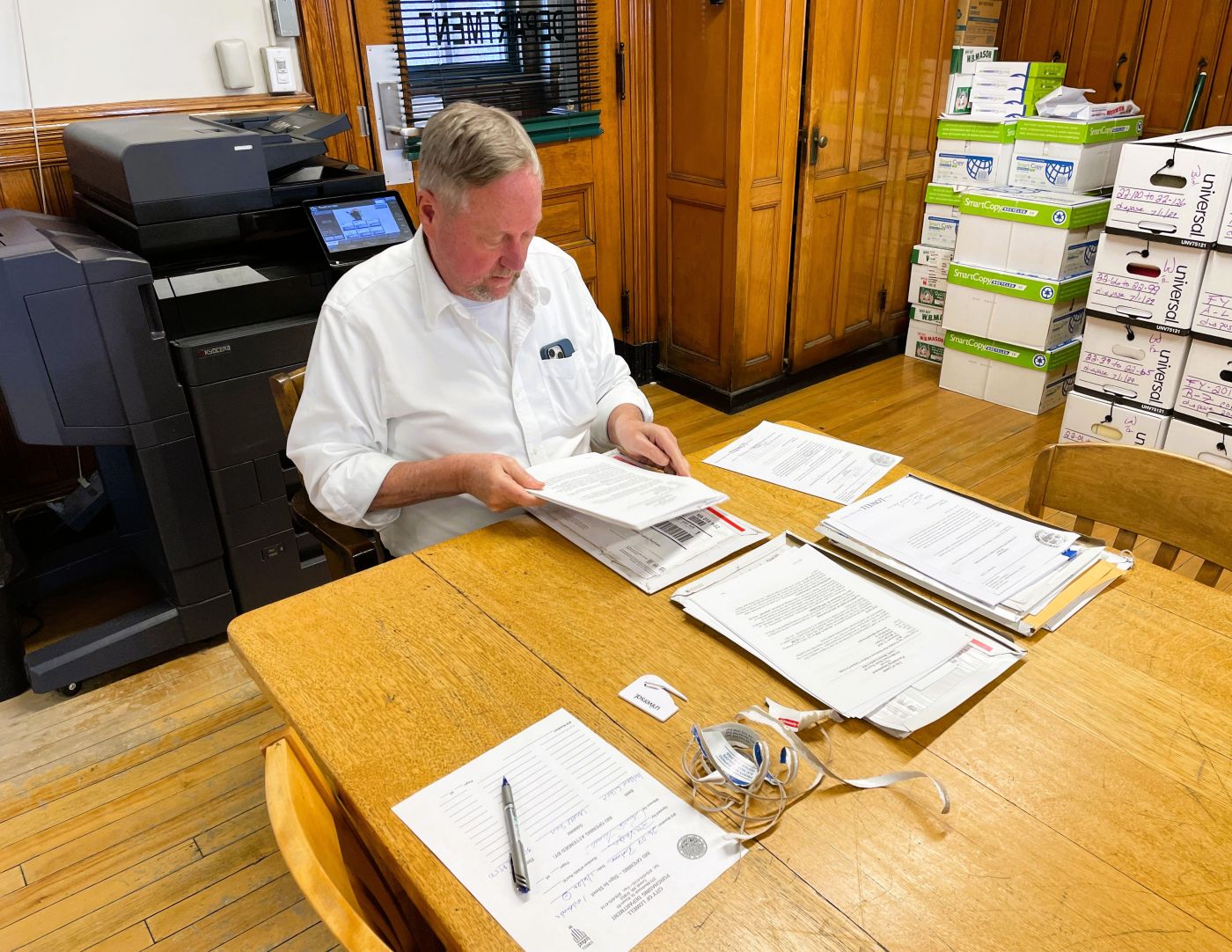
Tuesday morning, Chief Procurement Officer Michael Vaughn opened seven vendor bids for two Americans with Disabilities Act-compliant restroom trailers.
“The City of Lowell is seeking bids to purchase two new Portable 4 season ADA Restroom Trailer + 4 Station,” the contract bid said.
The 20- to 24-foot trailers will be equipped with an approximately 400-gallon waste tank and an approximately 135-gallon freshwater tank. Each private unisex suite has a flushable toilet, sink vanity, mirror and ample LED lighting. The exterior of each suite features lighting and handrails for safe entry. The four-season package ensures that the trailer can withstand extreme winters with temperatures as low as minus 20 degrees, as well as air conditioning for summer use.
Neither Department of Public Works Commissioner Paul St. Cyr nor Maura Fitzpatrick, the director of Homelessness Initiatives, responded to The Sun’s request for comment, but Vaughn said the units will be under the control of the DPW.
“DPW will determine both where to store and where to deploy,” he said. “No maintenance will be provided by the companies selling the units.”
Arizona-based Elk Creek Trailers, a professional restroom trailer manufacturer, was the lowest bid at $137,576, from submissions that ranged up to more than $200,000.
The company website says its goal is to create a restroom trailer that is “durable, easy to maintain and easy to clean.”
If the city rolls these units out for use by the homeless community, it will make a significant difference in the quality of life of all residents both housed and unhoused.
Numerous residents and business owners have appeared before the City Council to complain about urination and defecation in public places, such as sidewalks and downtown business doorways. Councilors have called the city’s Back Central neighborhood a “mini Mass and Cass,” referring to the area of Boston plagued by the same homeless, drug and crime crisis that has been growing for several years in Lowell’s poorest neighborhood.
Currently, there are limited publicly accessible restrooms for use by the homeless population. During the day, various locations such as City Hall and the Pollard Memorial Library on Merrimack Street and the Gallagher Terminal by South Common Park off Thorndike Street all offer public restrooms.
Most private businesses restrict bathroom use to paying customers.
The Day Center at Eliot Church, on Summer Street in Lowell’s Back Central neighborhood, addresses the needs of the city’s homeless population, including food, medical support and an accessible bathroom. The church runs the Day Center Monday through Friday, from 10 a.m. to 2 p.m., and St. Paul’s Soup Kitchen takes over the space from 3 to 6 p.m. for dinner service. Those services are not available nights or weekends.
During its operating hours, the Day Center’s single ADA-compliant restroom in the building’s Fellowship Hall serves a daily population of almost 200 people, said Charly Ott, the director of operations for the Eliot Church Day Center.
Access to the newly renovated bathroom is monitored by a Day Center employee. A sign on the door notes that only one person at a time is allowed, there is a five-minute time limit, and no coats, backpacks or bags are allowed in the room.
“Every little bit helps,” Ott said, referencing the potential for an additional city-provided sanitation system for the homeless population.
A Cambodian-American man, who declined to give his name, said Tuesday he had been on the streets since the New Hampshire company he worked for closed. He called a bathroom trailer for use by homeless people a “good idea.”
“I’m stuck out here,” he said. “I usually use the bathroom at the Eliot Church. The bathroom inside is [busy].”
Green plastic netting surrounded the small front lawn to the church entrance facing Summer Street to prevent tenting and toileting on the property. The green space became a de facto encampment following the city’s clearing of South Common Park last fall.
Down on Appleton Street, the newly opened Project Kompass said their bathroom facilities are only available to clients registered with their program services.
A small driveway adjacent to the building had been used as an outdoor toilet prior to the nonprofit purchasing the building, founder and Board Chair Dave Aldrich said Tuesday. The organization has since fenced off access to that area and will convert it into a garden for use by its staff and clients.
The number of homeless people sleeping rough in Lowell was 25 in 2016. Nine years later, the Point-in-Time count, an annual exercise mandated by the U.S. Department of Housing and Urban Development, recorded 250 homeless people in the city — 50 were unsheltered and living outdoors.
During the winter, homeless people are less visible on the streets thanks to winter protocol, which began on Nov. 17. The annual four-mouth program expands the number of hotel and emergency shelter beds, and allows for clients to stay indoors at the Lowell Transitional Living Center during the day.
Vaughn said the city reviews the lowest proposal first to determine whether they are a qualified bidder.
“Once that’s done, we’ll issue a request to the Law Department to make a contract with the low bidder and they’ll have to fill out the contract,” Vaughn said. “Once the contract is fully executed, a purchase order will issued and then they’ll be able to manufacture the units.”
Delivery is required no later than June 30.


More Stories
Millones de venezolanos dispersos por Latinoamérica observan con cautela qué vendrá ahora
Por FRANKLIN BRICEÑO, MARÍA VERZA y NAYARA BATSCHKE LIMA (AP) — Casi inmediatamente después del ataque estadounidense a Venezuela y...
Williams lidera remontada de Bears para vencer 31-27 a Packers tras desventaja de 18 puntos
Por ANDREW SELIGMAN CHICAGO (AP) — Caleb Williams brilló en su debut en los playoffs, lanzando un pase de touchdown...
Bob Weir, miembro fundador de los Grateful Dead, muere a los 78 años
Por ANDREW DALTON LOS ÁNGELES (AP) — Bob Weir, el guitarrista y cantante que, como miembro esencial de los Grateful...
Bulls vencen a Mavericks por 125-107 tras expulsión de Kidd en el 1er cuarto
CHICAGO (AP) — Coby White anotó 22 puntos, Ayo Dosunmu sumó 20 y los Bulls de Chicago vencieron el sábado...
Antesalista estelar Alex Bregman pacta por 5 años y 175 millones con Cachorros, según fuentes de AP
Por JAY COHEN CHICAGO (AP) — El antesalista estelar Alex Bregman llegó a un acuerdo contractual de cinco años y...
Wembanyama y Fox anotan 21 puntos cada uno en victoria de Spurs 100-95 sobre Celtics
Associated Press BOSTON (AP) — Victor Wembanyama anotó 16 de sus 21 puntos en la segunda mitad, incluyendo un tiro...