
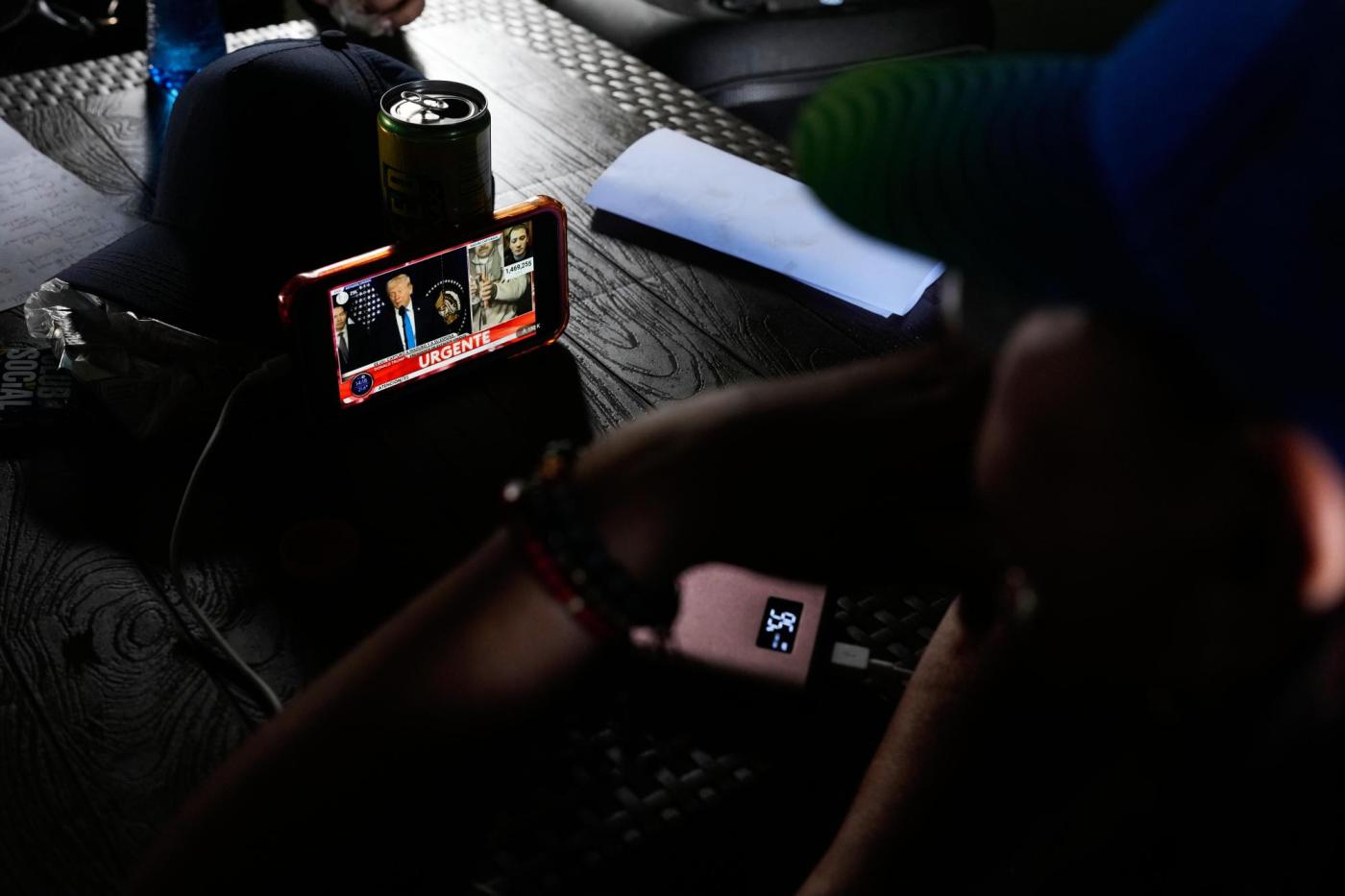
Trump administration thanks the media for keeping quiet before the strike that captured Maduro

By DAVID BAUDER
In the wake of last weekend’s U.S. military action in Venezuela, the news media got something it has seldom heard from the Trump administration: a “thank you.”
Related Articles
Abortion stays legal in Wyoming as its top court strikes down laws, including first US pill ban
Trump’s vague claims of the US running Venezuela raise questions about planning for what comes next
Indiana US Rep. Jim Baird expected to make a full recovery following car crash, his office says
Rep. Doug LaMalfa of California dies, reducing GOP’s narrow control of the House to 218-213
Trump administration’s capture of Maduro raises unease about the international legal framework
Secretary of State Marco Rubio credited news organizations that had learned in advance about Saturday’s strike that led to the capture of Venezuelan President Nicolás Maduro with not putting the mission in jeopardy by publicly reporting on it before it happened.
Rubio’s acknowledgment was particularly noteworthy because Defense Secretary Pete Hegseth has cited a mistrust of journalists’ ability to responsibly handle sensitive information as one of the chief reasons for imposing restrictive new press rules on Pentagon reporters. Most mainstream news organizations have left posts in the Pentagon rather than agree to Hegseth’s policy.
Speaking on ABC’s “This Week” on Sunday, Rubio said the Republican administration withheld information about the mission from Congress ahead of time because “it will leak. It’s as simple as that.” But the primary reason was operational security, he said.
“Frankly, a number of media outlets had gotten leaks that this was coming and held it for that very reason,” Rubio said. “And we thank them for doing that or lives could have been lost. American lives.”
Advance word got out
Semafor, citing “people familiar with communications between the administration and news organizations,” reported that The New York Times and The Washington Post had both learned of the raid in advance but held off reporting on it to avoid endangering U.S. military personnel. Representatives for both outlets declined to comment to The Associated Press on Monday.
Withholding information on a planned mission for that reason is routine for news organizations, said Dana Priest, a longtime national security reporter at the Post who now teaches at the University of Maryland. Even after the fact, the Post has asked government authorities about whether revealing certain details could endanger people, she said.
When The Atlantic magazine editor Jeffrey Goldberg was inadvertently included in a text chain last spring where Hegseth revealed information about a military attack in Yemen, the journalist did not report on the events until well after U.S. personnel was out of danger and the information had been thoroughly checked out.
Most Americans learned of the Venezuela attack in the predawn hours of Saturday when President Donald Trump announced it on his Truth Social platform upon completion.
President Donald Trump, followed by Defense Secretary Pete Hegseth, arrives to speak at Mar-a-Lago, Saturday, Jan. 3, 2026, in Palm Beach, Fla. (AP Photo/Alex Brandon)
While The Associated Press did not have advance word that the operation would happen, its journalists in Venezuela heard and observed explosions taking place there, and that was reported on the news wire more than two hours before Trump’s announcement. The U.S. involvement was not made clear until Trump’s post, however.
Decisions on publication have many dimensions
Hegseth, in defending rules that restrict reporters’ movements and reporting in the Pentagon, told Fox News last year that “we have expectations that you’re not soliciting classified or sensitive information.” The Times last month filed a lawsuit seeking to overturn the rules.
“What the so-called legacy Pentagon press corps has demonstrated is it can act responsibly, as it always has, to protect troops’ lives,” said Barbara Starr, a former CNN defense correspondent. “But even more important perhaps is it demonstrates the media makes every effort to continue to cover the news outside of Pete Hegseth’s control and endless message points.”
In this photo released by the White House, President Donald Trump monitors U.S. military operations in Venezuela, with CIA Director John Ratcliffe, left, Secretary of State Marco Rubio and White House deputy chief of staff Stephen Miller, right, at Mar-a-Lago in Palm Beach, Fla., Saturday, Jan. 3, 2026. (Molly Riley/The White House via AP)
Decisions on whether to report information that could put lives or a mission in danger often involve high-level discussions between editors and government officials. But Priest stressed that in a country with freedom of the press, the ultimate decision on whether to report the information lies with the news organization.
Generations ago, President John F. Kennedy persuaded editors at the Times not to report when it learned in advance of a U.S.-backed attack by Cuban exiles on Fidel Castro’s forces at the Bay of Pigs in Cuba. The mission proved a monumental failure, and a Times editor, Bill Keller, later said that Kennedy expressed regret that the newspaper had not reported on what it had known because it could have prevented a fiasco.
Many mainstream journalists covering the military and national security have extensive experience dealing with sensitive issues, Priest said. But there’s a difference, she said, between reporting information that could put someone in danger and that which could prove embarrassing to an administration.
“The reporters are not going to be deterred by a ridiculously broad censorship edict by the Trump administration,” Priest said. “They’re going to dig in and work even harder. Their mission is not to curry favor with the Trump administration. It’s to report information to the public.”
David Bauder writes about the intersection of media and entertainment for the AP. Follow him at http://x.com/dbauder and https://bsky.app/profile/dbauder.bsky.social.
More Stories
From Scotland Yard Commander to Global Security Entrepreneur: Dr Ali Dizaei’s Leadership Story
There are career journeys that follow a straight line, predictable, uniform, and comfortable. And then there are journeys shaped by...
The Naughty AI President: A New Age of Governance
In the race to build better systems of governance, humanity has always chased an impossible ideal: the perfect ruler. Rational,...
Sends shares Q1 2026 business update and product progress
Sends reported Q1 2026 updates sharing news on digital cards, app redesign, ClearBank integration, and fintech industry recognition. Sends, a...
Government doubles down on gaming with £30m funding package as sector eyes global growth
The government has fired the starting gun on a £30 million funding offensive aimed at Britain’s video games sector, urging...
Rising energy costs from Middle East conflict set to leave UK households £480 worse off this year
Rising energy costs triggered by the escalating Middle East conflict are on course to strip nearly £500 from the finances...
UK firms risk being left behind as AI adoption gap widens, warns PwC
British businesses are in danger of being left stranded in the middle of the pack on artificial intelligence, with a...