
Ford Reports Best Annual US Vehicle Sales in 8 Years as Hybrids, Trucks Offset EV Slowdown

By Tom Ozimek
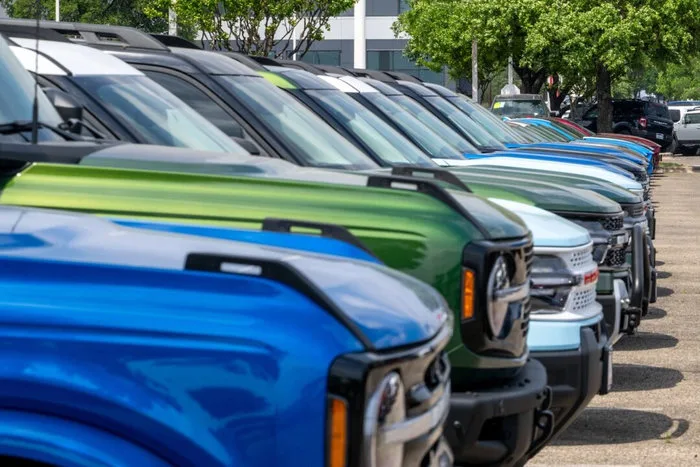
Ford Motor Company on Jan. 6 reported its strongest annual U.S. vehicle sales since 2019, buoyed by surging demand for hybrid models and affordable pickup trucks that helped counter a sharp slowdown in electric-vehicle sales.
The Detroit automaker said U.S. sales rose 6 percent in 2025 to 2,204,124 vehicles, up from 2,078,832 a year earlier, marking its best annual performance in eight years.
Fourth-quarter sales increased 2.7 percent, to 545,216 vehicles—Ford’s best fourth-quarter performance since 2019—as the automaker gained market share in a year defined by pricing pressures, policy shifts, and weakening demand for battery-only vehicles.
Ford finished 2025 as the third-largest automaker in the United States, behind Toyota and domestic market leader General Motors.
“This past year proved that Ford has the right product and powertrain offering for the lives of our customers,” Andrew Frick, president of Ford Blue and Model e, said in a statement. “We’re growing share and beating the trend because we offer a great range of products, from accessible entry-level models to high-performance off-roaders.”
Ford’s results came as the broader U.S. auto market defied repeated disruptions in 2025, with industrywide sales rising 2.4 percent, to roughly 16.2 million vehicles, according to research firm Omdia.
Industry Posts Gains Despite Challenges
Several automakers have reported solid December 2025 results to close out the year. Toyota recently posted an 8 percent increase in U.S. vehicle sales in 2025, supported by demand for its lower-priced models, a segment largely vacated by Detroit automakers. Hyundai Motor also reported an 8 percent gain, driven by strong hybrid sales, which in December soared 71 percent to set a new all-time monthly record.
General Motors said its U.S. sales rose 6 percent for the year, despite a weaker fourth quarter marked by a 43 percent plunge in sales of electric vehicles. Stellantis reported a 3 percent decline in U.S. sales from 2024, though the company gained momentum in the second half of the year, including 4 percent higher sales in December 2025 from the same month a year prior.
Automakers navigated supply-chain bottlenecks, unpredictable tariffs, and the removal of a $7,500 federal EV tax credit, factors that drove some consumers to dealer lots ahead of potential price increases.
“Despite challenges, 2025 has been a good year for new-vehicle sales,” Charlie Chesbrough, senior economist at Cox Automotive, said in a Dec. 18 statement. “The fourth quarter is showing the expected slowdown, as headwinds from tariffs, inflation, and reduced EV incentives weigh on the market after nine surprisingly strong months. Still, consumer demand has kept the new-vehicle market healthy throughout 2025.”
As was the case for many automakers, Ford’s electric-vehicle sales declined sharply in 2025, falling 14.1 percent for the year, including a roughly 52 percent drop in the fourth quarter. A nearly 22 percent increase in hybrid sales helped offset some of those losses, a segment the company expects to continue expanding. Ford said earlier it expects nearly every vehicle it produces to feature a hybrid or multi-energy powertrain option by 2030.
“Our growth across record hybrid sales shows that our ‘power of choice’ approach—offering gas, hybrid, and electric—is exactly what consumers are looking for right now,” Frick said.
Demand also remained strong for Ford’s Maverick compact pickup, one of the most affordable trucks on the U.S. market. Maverick sales climbed about 18 percent to 155,051 vehicles in 2025, a record number that reflects buyers’ growing focus on lower-cost options. Sales of Ford’s F-series pickups—America’s best-selling truck—rose 8.3 percent for the year, with 828,832 units sold.
Looking ahead, analysts are divided on the outlook for 2026. Cox Automotive has forecast a 2.4 percent decline in U.S. auto sales, citing slower economic growth and reduced EV incentives, while Edmunds expects sales to hold steady or dip slightly. Lower interest rates and the return of maturing leases could provide some support as the year progresses.
“These dynamics set the stage for a more balanced and potentially stronger performance as 2026 progresses,” said Thomas King, president of OEM solutions at J.D. Power.
Reuters contributed to this report.


More Stories
US Property Taxes Grow 3 Percent on Average in 2025, Outpacing Inflation
By Rob Sabo Property taxes are rising across the United States and, on average, have outpaced inflation. Homeowners in 2025...
Shane Lowry Makes Golf History With His 2nd Masters Hole-in-One
By Ross Kelly There are millions of casual golfers around the world who dream some day of recording an ace...
Treasury, IRS Propose Rules for 1 Percent Remittance Tax on Some Money Sent to Foreign Countries
By Naveen Athrappully The Internal Revenue Service and the Department of the Treasury proposed regulations on Friday regarding the new...
Hezbollah Leader Says Group Would Continue to Fight Israel After Strikes
By Jack Phillips The leader of Lebanese terrorist organization Hezbollah has said that his group would continue to fight Israel,...
IBM to Pay $17 Million to Settle Allegations of Discrimination
By Jacki Thrapp IBM will pay millions of dollars to resolve allegations that it failed to comply with anti-discrimination requirements...
Trump Says US ‘Loading up the Ships’ Ahead of Iran Talks, Signals Military Option If Diplomacy Fails
By Tom Ozimek President Donald Trump said the United States is preparing military options if negotiations with Iran fail to...