
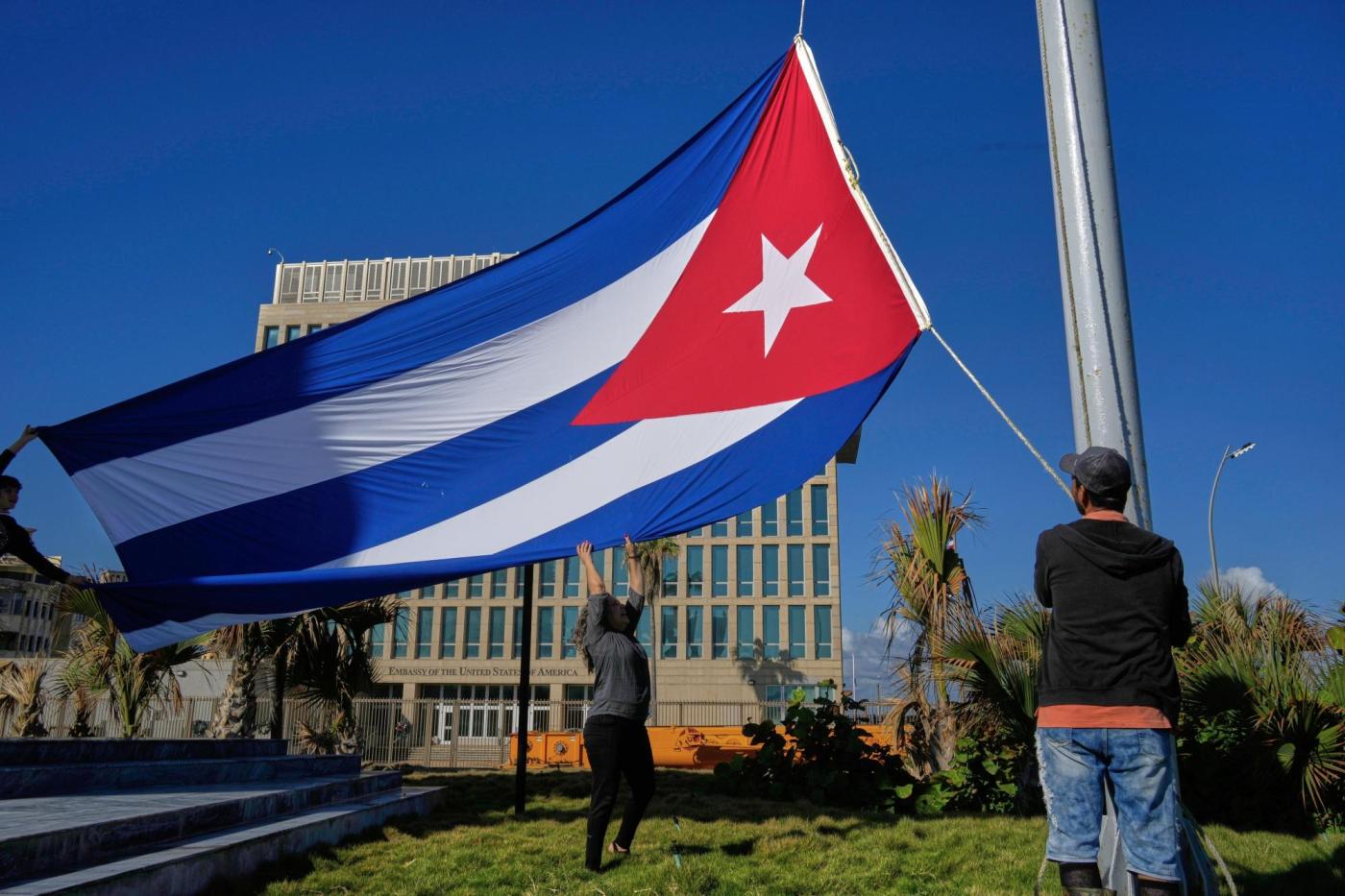
Cuba releases details of 32 officers killed in US strike on Venezuela as US defends attack

By DÁNICA COTO and ANDREA RODRÍGUEZ
HAVANA (AP) — The names, ranks and ages of the 32 Cuban military personnel killed during the capture of Venezuelan President Nicolás Maduro by U.S. forces were published Tuesday by the Cuban government, which announced two days of mourning.
Related Articles
At least 24 Venezuelan security officers killed in US operation to capture Maduro, officials say
Israel clears final hurdle to start settlement construction that would cut the West Bank in two
Musk’s AI chatbot faces global backlash over sexualized images of women and children
Security forces clash with protesters in Iran’s main market as at least 36 killed in demonstrations
France’s Macron says a security statement endorsed by Ukraine’s allies is a ‘significant step’
Among the deceased are colonels, lieutenants, majors and captains, as well as some reserve soldiers, ranging in age from 26 to 60.
The uniformed personnel belonged to the Revolutionary Armed Forces and the Ministry of the Interior, Cuba’s two main security agencies. The publication did not specify their missions or exactly how they died.
Cuban state media published their details and headshots, which show them clad in olive-green military uniforms.
In a statement Sunday, Cuban authorities acknowledged the deaths of the personnel who were in the South American nation as part of agreements between the two countries.
“Our compatriots fulfilled their duty with dignity and heroism, falling after fierce resistance in direct combat against the attackers, or as a result of the bombing of the facilities,” the official statement said.
Limited details of Cubans killed in strike
Information about the Cuban officers killed began trickling out on Monday night, with Cubans publicly saying they had died for a just cause.
“You have to say that to say the same thing as the government,” said Luis Domínguez, who runs the website, Represores Cubanos, or Cuban Repressors, which doxes officials allegedly involved in human rights abuses and violations of democratic norms.
“Inside, Cubans have to be saying something else,” he added.
Domínguez said he believes that one of those killed, 67-year-old Col. Humberto Alfonso Roca Sánchez, used to be the garrison commander of Punto Cero, where Fidel Castro once lived.
Another officer who was killed, 62-year-old Col. Lázaro Evangelio Rodríguez Rodríguez, is believed to have overseen Cuba’s coast and border guards, Domínguez said.
As top-tier economic and political allies, Cuba and Venezuela have agreements in areas ranging from security to energy, with the sale of subsidized oil to the island since 2000. However, the extent of military or advisory exchanges has rarely been reported.
A post published Monday on the independent website La Joven Cuba, a blog that provides a platform for many opposition voices on the island, featured a profile of 1st Lt. Yunio Estévez. It was written by a journalist who was a close friend. The post included details of the 32-year-old’s life and featured pictures with his three children, whom he had raised together in Guantánamo province in eastern Cuba.
La Joven Cuba report stated that Estévez, a communications expert in charge of a personal security department, was shot during the attack. The post was removed later that evening at the family’s request, the website reported.
A protest and a moment of silence
The U.S. strike on Venezuela prompted the Organization of American States to hold a special meeting on Tuesday, where a protester interrupted the speech of U.S. Ambassador Leandro Rizzuto.
“The majority of people are against this!” cried out Medea Benjamin, co-founder of Code Pink, a U.S.-based anti-war nonprofit. “Hands off Venezuela!”
She called for sanctions to be lifted as OAS officials called for security guards who eventually led her out of the room.
Rizzuto resumed his speech after Benjamin was removed: “I understand there are many raw emotions.”
He called the strike a “targeted law enforcement action” against an “indicted criminal.”
“Let me be clear, the U.S. did not invade Venezuela,” Rizzuto said. “President Trump offered Maduro multiple offramps. This was not an interference in democracy…it actually removed the obstacle to it.”
He said the U.S. wants a better and democratic future for Venezuela.
“You cannot continue to have the largest oil reserves in the world under the control of adversaries of the Western Hemisphere while the people of Venezuela have no electricity, substandard quality of life, and its profits don’t benefit the people in Venezuela,” Rizzuto said. “The profits are stolen by a handful of oligarchs around the world, including those inside of Venezuela.”
He also called on the release of an estimated 1,000 political prisoners, saying the U.S. supports the request of the Inter-American Commission on Human Rights to visit the detention center in person.
After Rizzuto spoke, Peruvian Ambassador Rodolfo Coronado called for a minute of silence for the victims of Maduro’s regime.
During the OAS meeting, representatives of several countries strongly condemned the U.S. strike.
Mauricio Jaramillo, Colombia’s vice minister of foreign relations, denounced what he said was an attack against Venezuela’s sovereignty. He said the unilateral military action was a “clear violation of international law” that set “an extremely worrying” precedent.
Before the special OAS meeting began, about a dozen protesters gathered outside holding signs that read, “No war on Venezuela” and “Arepas Not Bombs.”
Coto reported from San Juan, Puerto Rico.
More Stories
From Scotland Yard Commander to Global Security Entrepreneur: Dr Ali Dizaei’s Leadership Story
There are career journeys that follow a straight line, predictable, uniform, and comfortable. And then there are journeys shaped by...
The Naughty AI President: A New Age of Governance
In the race to build better systems of governance, humanity has always chased an impossible ideal: the perfect ruler. Rational,...
Sends shares Q1 2026 business update and product progress
Sends reported Q1 2026 updates sharing news on digital cards, app redesign, ClearBank integration, and fintech industry recognition. Sends, a...
Government doubles down on gaming with £30m funding package as sector eyes global growth
The government has fired the starting gun on a £30 million funding offensive aimed at Britain’s video games sector, urging...
Rising energy costs from Middle East conflict set to leave UK households £480 worse off this year
Rising energy costs triggered by the escalating Middle East conflict are on course to strip nearly £500 from the finances...
UK firms risk being left behind as AI adoption gap widens, warns PwC
British businesses are in danger of being left stranded in the middle of the pack on artificial intelligence, with a...