
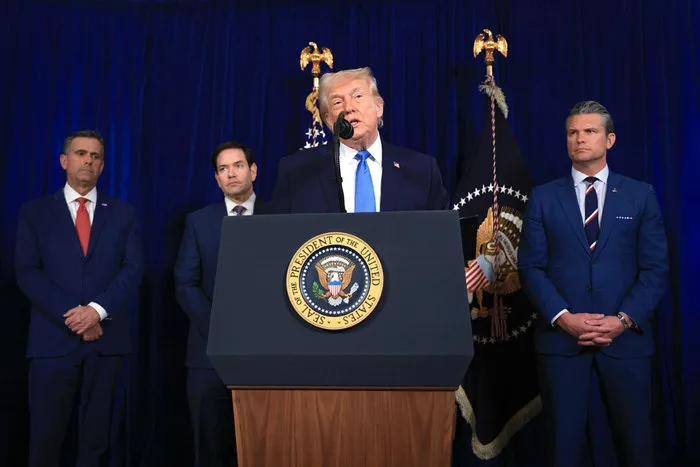
Trump Praised for Bold, Unprecedented Venezuela Operation

By Emel Akan
WASHINGTON—On Saturday morning, Jan. 3, many Americans woke up to news that U.S. special forces had captured Venezuelan leader Nicolás Maduro.
A military buildup in the Caribbean had been underway for months, and many had anticipated some form of U.S. military action, but few expected an operation so ambitious and complex.
The operation was carried out with a high level of secrecy.
Late in the evening on Jan. 2, Trump ordered U.S. special operations forces to launch a helicopter-borne raid on the Venezuelan capital city of Caracas to capture Maduro. The operation was the culmination of months of preparation and weeks of waiting for the perfect window of opportunity, including the weather.
U.S. forces located Maduro and his wife, detained them, and brought them to the United States without any reported American casualties or damage to U.S. assets.
The U.S. forces had been trained extensively on a model of Maduro’s compound.
“They actually built a house which was identical to the one they went into,” Trump told Fox News on Saturday.
In the early morning hours of Jan. 3, dozens of manned and unmanned U.S. military aircraft began targeting Venezuela’s air defense arrays, paving the way for the helicopter-borne assault team to land at a fortified compound where Maduro was staying. Within minutes of landing, those special operations troops managed to rush through the complex and locate the Venezuelan leader and his wife, Cilia Adela Flores de Maduro, before the pair could barricade themselves in a steel vault safe room and potentially wait for the Venezuelan military to come to their rescue.
“He didn’t get that space closed. He was trying to get into it, but he got bum-rushed so fast that he didn’t get into that,” Trump said.
Secretary of State Marco Rubio described the operation in Venezuela as “unbelievable and a tremendous success.”
“It is not easy to land helicopters in the middle of the largest military base in the country,” Rubio told CBS’s “Face the Nation” on Sunday. “The guy lived on a military base. Land within three minutes, kick down his door, grab him, put him in handcuffs, read him his rights, put him in a helicopter, and leave the country without losing any American or any American assets–that’s not an easy mission.”
Some commentators view this as a potential legacy-defining foreign policy achievement for the Trump administration, likely to be discussed and debated for years to come.
People react to the news of the capture of Venezuelan President Nicolas Maduro, following U.S. military actions in Venezuela over the weekend, in Doral, Florida, near Miami, on Jan. 3, 2026. Giorgio Viera/AFP via Getty Images
Evan Ellis, a military strategist and former Latin America policy adviser to the U.S. State Department, believes the capture of Maduro will be considered a success of Trump’s foreign policy, particularly if a democratic transition occurs in Venezuela in the coming months.
“I think suddenly there will be a lot of stories being printed about the dramatic successes of President Trump’s foreign policy and his role in restoring democracy throughout the world,” Ellis told The Epoch Times.
However, Ellis acknowledged the current uncertainty in Venezuela. He said that the United States had the military capability and intelligence to remove most senior leaders, but chose to target only Maduro. In the coming days and weeks, he noted, the socialist regime and its military leaders will need to decide whether to cooperate with the United States to protect themselves.
Soon after the operation’s success was confirmed, many Republicans praised the Trump administration, while Democrats questioned the president’s authority to order the operation and requested congressional briefings.
“Today’s military action in Venezuela was a decisive and justified operation that will protect American lives,” House Speaker Mike Johnson (R-La.) posted on X.
Senate Majority Leader John Thune (R-S.D.) also supported the president’s decision, writing on X, “I am grateful for the brave men and women of our armed forces who carried out this necessary action.”
Sen. John Fetterman (D-Pa.) was among the few Democrats who praised the U.S. military operation in Venezuela, departing from his party’s position.
U.S. military fighter jets sit on the tarmac at José Aponte de la Torre Airport, formerly Roosevelt Roads Naval Station, in Ceiba, Puerto Rico, on Jan. 3, 2026. Miguel J. Rodriguez Carrillo/AFP via Getty Images
“Grateful for our U.S. military personnel that handled these orders in Venezuela with precision,” Fetterman wrote on X. “I maintain that we have the STRONGEST and MOST LETHAL military in the world—today proves that even more.”
Many Democrats, however, voiced concerns that no congressional authorization was sought before the strike.
“Our Constitution places the gravest decisions about the use of military force in the hands of Congress for a reason,” Sen. Mark Warner (D-Va.) posted on X. “Using military force to enact regime change demands the closest scrutiny, precisely because the consequences do not end with the initial strike.”
Senate Minority Leader Chuck Schumer (D-N.Y.) also criticized Trump’s plan for the United States to control Venezuela until elections become possible.
“The idea that Trump plans to now run Venezuela should strike fear in the hearts of all Americans,” Schumer said in a statement posted to X. “The American people have seen this before and paid the devastating price.”
Trump said during a press conference at Mar-a-Lago on Saturday that military plans were kept secret because “Congress has a tendency to leak.”
Speaking Sunday on NBC’s “Meet the Press,” Rubio rejected the idea that congressional approval was required.
“This was not an action that required congressional approval. In fact, it couldn’t require congressional approval because this was not an invasion. This is not an extended military operation,” Rubio said.
A Venezuelan motorcycle rider holds a flag along a highway, on the Colombia-Venezuela border after the confirmation of Nicolas Maduro’s capture this early morning in Caracas, in Cucuta, Colombia, on Jan. 3, 2026. Jair F. Coll/Getty Images
During the “Face the Nation” interview, Rubio also said: “The whole foreign policy apparatus thinks everything is Libya, everything is Iraq, everything is Afghanistan. This is not the Middle East, and our mission here is very different. This is the Western Hemisphere.”
New National Security Strategy
Trump’s foreign policy marks a significant departure from previous administrations. The new National Security Strategy, released in November, reflects this change by redefining U.S. geographic priorities.
Trump’s America First approach, unlike traditional neoconservatism, puts the Western Hemisphere at the center of U.S. foreign policy. This has led to greater focus on the homeland and nearby regions, including Venezuela and Greenland.
“The Trump administration is not saying the Western Hemisphere is all they’re focused on. They’re not saying they’re not focused on Russia and China,” Michael Walsh, a nonresident senior fellow at the Foreign Policy Research Institute, told The Epoch Times. “It’s just that they’re prioritizing the Western Hemisphere and the U.S. homeland, in a way that they haven’t been prioritized in recent memory.”
Rubio echoed this point during his interview with NBC on Sunday. He defended the U.S. operation in Venezuela, pointing to the administration’s new national security strategy as his justification.
“This is the Western Hemisphere. This is where we live,” Rubio said. “And we’re not going to allow the Western Hemisphere to be a base of operation for adversaries, competitors, and rivals of the United States.”
Travis Gillmore and Ryan Morgan contributed to this report.
More Stories
Oil Falls, Stocks Jump on Renewed Hopes of Iran War Ending
By Tom Ozimek Oil prices dropped and stocks around the world rallied on April 1 on renewed hopes of a...
US Appeals Court Blocks Judge’s Rulings Against Trump Immigration Detention Policy
By Jack Phillips A U.S. appeals court on Tuesday halted a federal judge’s nationwide rulings that blocked the Trump administration...
Trump Says He’s Strongly Considering Pulling US Out of NATO
By Guy Birchall U.S. President Donald Trump said he is strongly considering withdrawing the United States from NATO, in comments...
Iran’s Top Leader Issues Statement Saying Regime Will Keep Backing Anti-Israel Forces
By Jack Phillips Iran’s top leader released a new statement on April 1 saying the Iranian regime will continue to...
Who is Jessi Draper? Know about her kissing drama with Chase McWhorter
Who is Jessi Draper? A star member of Hulu’s popular reality series, Secret Lives of Mormon Wives, has again stepped...
City Hunter 2: Release Date, Cast, Plot, and Review
Netflix has officially announced City Hunter Season 2, following the first film’s notable success. The streaming platform plans to release...