
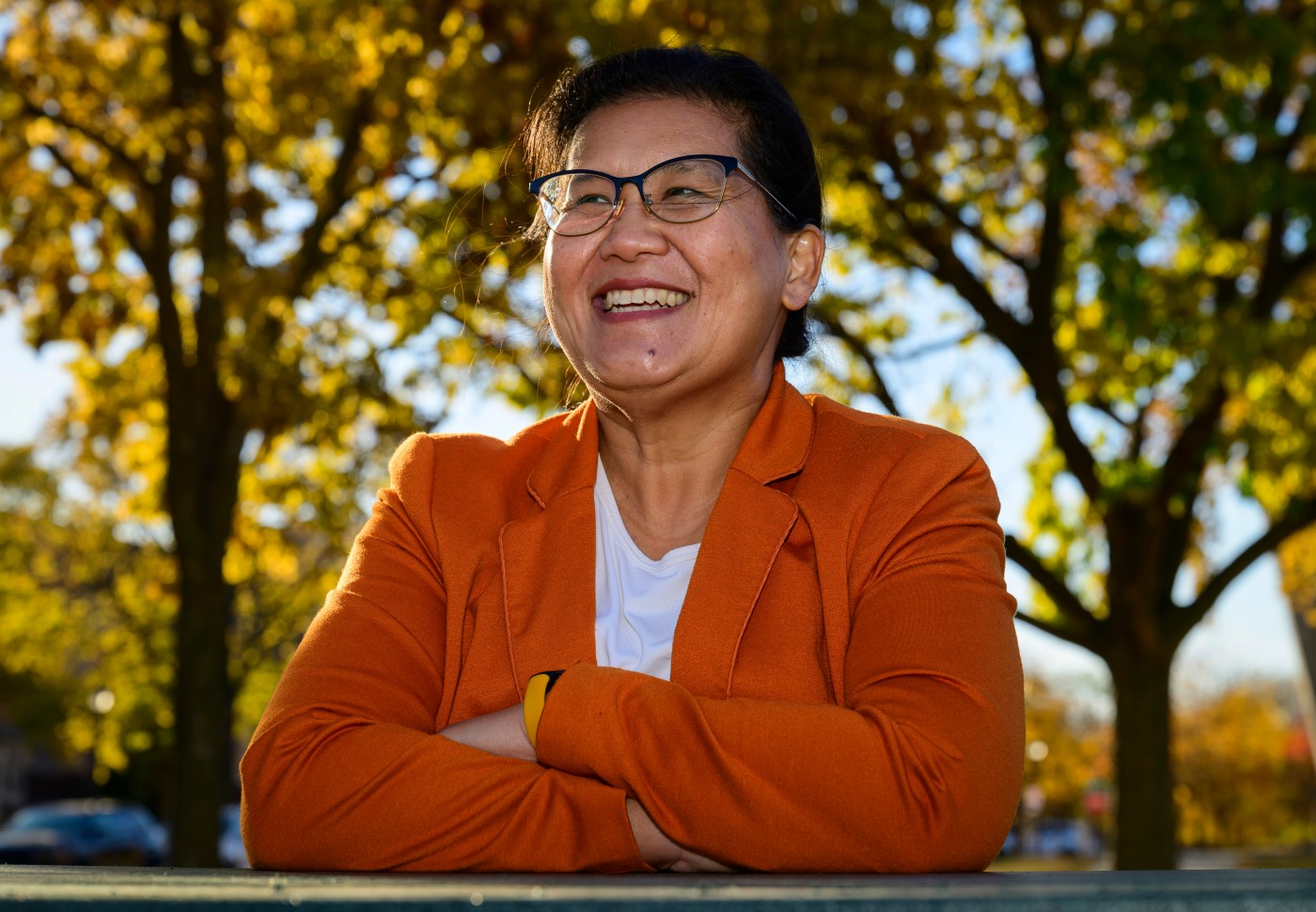
Kaohly Her to be sworn in as St. Paul mayor on Friday

In the lead-up to St. Paul’s Nov. 4 mayoral election, then-state Rep. Kaohly Her issued a campaign mailer that promised “to make our neighborhoods safer” through “strong partnerships” with first responders and law enforcement.
“Development has stalled,” she wrote, promising an environment that welcomes business. “We’ve lost critical retailers, and our tax base is stretched thin.”
The city’s housing stock, she noted, was too expensive and needed an infusion of public, affordable and market-rate units. Finally, under the title “Defending Our Neighbors,” she wrote: “I am a refugee and know the stakes are high for our immigrant neighbors. I will actively rise to meet the moment and not just passively respond.”
Voters in the five-way mayor’s race welcomed her message and propelled her to the corner office of City Hall as St. Paul’s 47th mayor. She is scheduled to be sworn into on Friday in a pair of back-to-back ceremonies at the International Institute of Minnesota on Como Avenue and St. Catherine University’s O’Shaughnessy Auditorium on Randolph Avenue.
Her first swearing-in — by invitation only — was to take place before a relatively intimate crowd of family, peers and Hmong leaders. Her becomes the first woman and first Hmong person to be elected mayor of St. Paul, where she had previously served as state representative since 2019.
Born in a bamboo hut
Her holds a bachelor of science degree in investment and finance from the University of Wisconsin-Madison, and a master’s of business administration from Northeastern University in Boston. She is currently a doctoral candidate in Education Leadership at the University of St. Thomas, studies she put on hold to run for mayor.
In her campaign materials, she described her journey from the mountains of Laos, where she was born in a bamboo hut, to the United States with her family when she was three years old. Her family lived in Illinois and Wisconsin before coming to St. Paul, where they gained prominence in the fast-growing Hmong community, pooling money with other Hmong refugees to launch one of the region’s first Southeast Asian-themed food distributors, as well as a restaurant off Rice Street and University Avenue.
Her grandfather had served as a colonel under Gen. Vang Pao during the CIA’s “Secret War” in Laos, and he became instrumental in founding the Lao Family Community of Minnesota, a non-profit that assisted early waves of Hmong refugees in the U.S.
As an adult, she spent 15 years in the financial services industry, focusing on budget analytics for Securian, then known as Minnesota Life, and American Express. She then became a stay-at-home mom for the two children, now grown, that she has with her husband, Kong, before returning to the workforce as a grants director for the St. Paul and Minnesota Foundation, a board administrator with the St. Paul Public Schools and then a policy director for St. Paul Mayor Melvin Carter, a role she held for the early part of his first term.
As Carter’s policy director, she helped lead two of his signature initiatives: the effort to establish a citywide $15 minimum wage and launch CollegeBound St. Paul, which connects each of the city’s newborns to college savings accounts. She soon found herself spending more time away from City Hall after winning election to the role of state representative for House District 64A. Her, a DFLer who served as deputy speaker pro tempore, resigned from the House on Nov. 17, two weeks after winning the mayoral election.
Transition
Her has said she will maintain the city’s existing department directors for the time being as she evaluates the fit of Carter’s top staff and other programming initiatives.
Her’s mayoral campaign did not focus heavily on the future of Grand Casino Arena in downtown St. Paul, though she was critical of how the mayor’s unfulfilled ask for $400 million in state bond funds for an arena remodel rolled out before state lawmakers last session.
In a recent interview with Kare 11, Her said she was open to drawing the Timberwolves and the Lynx basketball teams to St. Paul, and that there had been some “some great introductory conversations” and “I look forward to future conversations” with team co-owner Alex Rodriguez.
Carter, the city’s first Black mayor and its youngest when he was first elected in 2017, led across years of pandemic and political upheaval with a progressive agenda that launched new city offices and cabinet-level positions. They included the Office of Financial Empowerment, to oversee CollegeBound St. Paul and other anti-poverty efforts, and the Office of Neighborhood Safety, which coordinates grants to community agencies that provide pre-emptive outreach to crime-prone areas as an early alternative to police response.
Carter was advised by a chief resilience officer who coordinated the city’s energy-saving and environmental initiatives, including the city’s involvement with the Evie electric carsharing network, a partnership with HourCar and the city of Minneapolis. The mayor forgave library fines and worked to establish new micro-neighborhoods at Highland Bridge in Highland Park and The Heights off Larpenteur Avenue and McKnight Road, where development has moved forward in stops and starts.
Carter also oversaw the roll-out of a voter-approved rent stabilization ordinance, or rent control, which many critics have since blamed for adding to the hodgepodge of issues stalling residential real estate development citywide. The mayor and city council later amended the ordinance, crafting key exceptions to it, before eliminating rent control entirely this past May for housing constructed after 2004.
Her has said she did not vote for rent control when it went to ballot in 2021, though she did not actively campaign against it.
As one of his final acts in office, Carter this week appointed Greg Duren as interim fire chief.
The outgoing mayor joined U.S. Sen. Amy Klobuchar in a countdown to ring in the New Year with a giant disco-themed puck drop in Rice Park shortly after 8 p.m. Wednesday, which was followed by a lengthy fireworks display. The event was coordinated with the World Juniors Ice Hockey Championships, an international tournament that concludes Jan. 5.
More Stories
Twins acquire Eric Wagaman in swap with Marlins
The Twins completed a small trade on Friday, acquiring first baseman Eric Wagaman from the Miami Marlins for minor league...
BTS announces March comeback date, putting an end to a nearly four-year hiatus
By MARIA SHERMAN, Associated Press NEW YORK (AP) — They’re going to light up 2026 like dynamite: K-pop group BTS’...
BTS announces March comeback date, putting an end to a nearly four-year hiatus
By MARIA SHERMAN, Associated Press NEW YORK (AP) — They’re going to light up 2026 like dynamite: K-pop group BTS’...
Some adult immigrants in Minnesota lose access to state-funded health care
About 15,000 adult immigrants in Minnesota lost access to their state-funded health care on Jan. 1. In 2023, the Minnesota...
Huge challenge for short-handed Gophers men’s basketball: 18 straight Big Ten games
First-year Gophers men’s basketball coach Niko Medved and his team are embarking on a grueling stretch of 18 consecutive Big...
Judge refuses to order release of man charged with planting pipe bombs on eve of Capitol riot
By MICHAEL KUNZELMAN WASHINGTON (AP) — A federal magistrate judge on Friday refused to order the pretrial release of a man charged...