
Boston strikes deal with Kraft Group to move Everett soccer stadium plan forward

Boston Mayor Michelle Wu said the city and Kraft Group have reached a $48 million community impact agreement for the Everett stadium development, far exceeding the Krafts’ prior $750,000 offer dismissed by Wu and allowing the plan to move forward.
The 15-year agreement includes $13 million in direct payments and a new, permanent per-ticket revenue source for the city that is expected to total $34 million in the first 15 years, Wu’s office said Wednesday when announcing a deal had been struck just in time for the New Year’s Eve deadline to avoid arbitration.
By comparison, the Kraft Group had initially offered a $750,000 one-time mitigation payment to offset the traffic and parking impacts its private soccer stadium development in Everett is expected to have on the nearby Charlestown neighborhood in Boston, per Wu’s office.
“The city fought for a fair deal for Boston and our residents, and that is what we have achieved through this agreement,” Wu said in a statement. “After months of negotiations, we have secured commitments addressing the needs of Charlestown residents and feedback from community partners.
“This stadium will enhance Boston’s position as the sports and entertainment capital of New England while transforming a blighted site on our doorstep,” the mayor added. “I’m grateful to all our neighborhood leaders and community advocates who helped us reach this important step, and the legislative leaders who ensured Boston would be at the table. We will continue to engage with the project as it advances to the next stage of review.”
The community benefits package includes additional commitments around project design review, local hiring and regional transportation coordination. In addition to annual payments, the Kraft Group will make substantial infrastructure improvements in Sullivan Square in Charlestown prior to the stadium’s opening and fund all public safety and transportation management costs for stadium events, per Wu’s office.
The deal was reached after months of tense negotiations that included a war of words between Boston’s mayor and the Kraft Group, particularly during this past year’s mayoral race between Wu and Josh Kraft, a son of the billionaire New England Patriots owner Robert Kraft who owns the Kraft Group.
Wu had dismissed the Kraft Group’s offer of $750,000 as “unserious,” while pointing to a prior mitigation package for Boston tied to the Everett casino that totaled $68 million. In response, representatives for the Kraft Group and New England Revolution, which is set to play at the planned stadium, called the mayor’s demands around the mitigation process “politically motivated.”
The deal came just in time for the Dec. 31 deadline built into mediation, which was triggered after consensus was not reached by a prior May 1 deadline and was led by Thomas Glynn, former CEO of Massport and general manager of the MBTA. Had a mitigation agreement not been reached by Wednesday, the matter would have gone to arbitration.
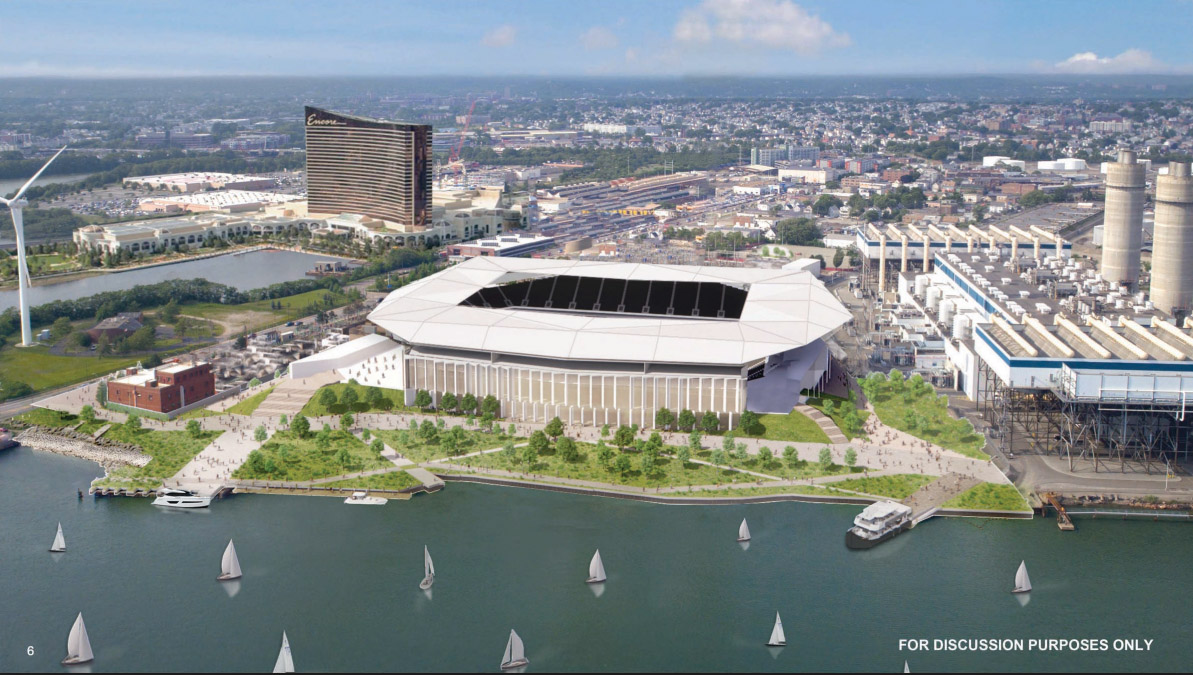
Instead, the agreement allows the Kraft Group to move forward with their plan to redevelop an old industrial site into a professional soccer stadium and a new park in Everett. The two sides were required to reach a community migration agreement as part of 2024 state legislation that freed up 43 acres of land along the Mystic River for the Krafts’ privately-funded project.
“The Kraft Group has reached agreements with the cities of Everett and Boston, marking an important milestone in our effort to transform a long‑neglected industrial site along the Mystic River into a vibrant, publicly accessible waterfront destination and the future home of the New England Revolution,” a Kraft Group spokesperson said in a statement.
“These agreements reflect years of collaboration with city leaders and community stakeholders to ensure the project delivers meaningful, lasting benefits for residents while addressing transportation, environmental, and municipal impacts.”
The Kraft Group added, “We are especially grateful for Mayor Carlo DeMaria’s leadership and vision. At its core, this is an investment in Everett and its future. In addition, it provides improved access and an enhanced neighborhood experience by removing a physical and visual barrier for the residents of Charlestown and we appreciate Mayor Michelle Wu and her team’s partnership.”
“Under the agreements, we will undertake significant environmental remediation and demolition of the long‑vacant power plant, invest in extensive traffic and transportation improvements, and deliver substantial community benefits, including millions of dollars towards infrastructure improvements,” the Kraft Group said.
“These agreements demonstrate the power of public‑private partnership to deliver transformational outcomes. We look forward to continued collaboration with Everett, Boston, and the community as the project advances through local and state review and as we take the many next steps necessary to bring this vision to life,” the Kraft Group added.
To support the Charlestown neighborhood, which will be most impacted by the stadium, the Kraft Group will make an initial payment of $3 million over six years which will be directed to the Charlestown Community Impact Fund. The Fund was created in 2016 to distribute annual community mitigation funds from the Encore casino and annually supports a range of Charlestown organizations,” Wu’s office said
The City of Boston also announced that of future annual ticket revenues, anticipated to be $2 million per year, at least half will be directed to Charlestown-specific municipal projects.
Related Articles
Boston firefighters to receive 8.5% pay hike after striking 4-year deal with city
Boston City Council to elect new president, but feature little turnover in new year
Mayor Wu announces staff changes ahead of start of second term
State’s highest court to take up lawsuit against Boston’s White Stadium soccer plan
Boston sued by commercial property owner who alleges retaliatory overtaxation
The Kraft Group also committed to establishing an annual traffic and parking management plan to be approved by the City of Boston; a construction management plan executed with the City of Boston to reduce impacts on Charlestown during stadium construction; annual monitoring of traffic impacts; and the creation of a ferry service dock at the stadium for water transportation.
The deal also calls for the construction of the stadium at 2070 flood resilience standards; prioritization of stadium design features in compliance with zero net carbon operational goals; noise and light pollution mitigation requirements; prioritized hiring for Boston residents for stadium jobs; a commitment to solicit 25% of both construction and ongoing contracts from local minority, woman owned, and/or veteran owned companies; and an agreement for the Kraft Group to participate in regional working groups to address regional transportation concerns.
More Stories
JLR battery plant lands £380m as government unveils £700m EV package
Jaguar Land Rover’s under-construction gigafactory in Somerset has been handed a £380 million taxpayer grant as part of a £700...
OpenAI pulls plug on Stargate UK, leaving Starmer’s AI superpower pitch in tatters
Sir Keir Starmer’s pledge to forge Britain into an artificial intelligence “superpower” has suffered its most embarrassing setback to date,...
Former Liverpool CEO eviscerates FIFA for World Cup ticket pricing
Peter Moore has called on the governing body to “sort out” their structures ahead of the summer spectacular Former Liverpool...
Mortgage defaults hit two-year high as Iran crisis drives borrowing costs sharply higher
Britain’s homeowners and small businesses are facing a fresh squeeze on credit as the fallout from the Iran crisis works...
Mexico threatens to ditch US gas
The country has signaled a shift toward domestic fracking as global energy prices soar due to the war in the...
US energy giants report fallout from Middle East war
Exxon and Chevron have both disclosed production declines which resulted from the Iran conflict US energy giants ExxonMobil and Chevron...