
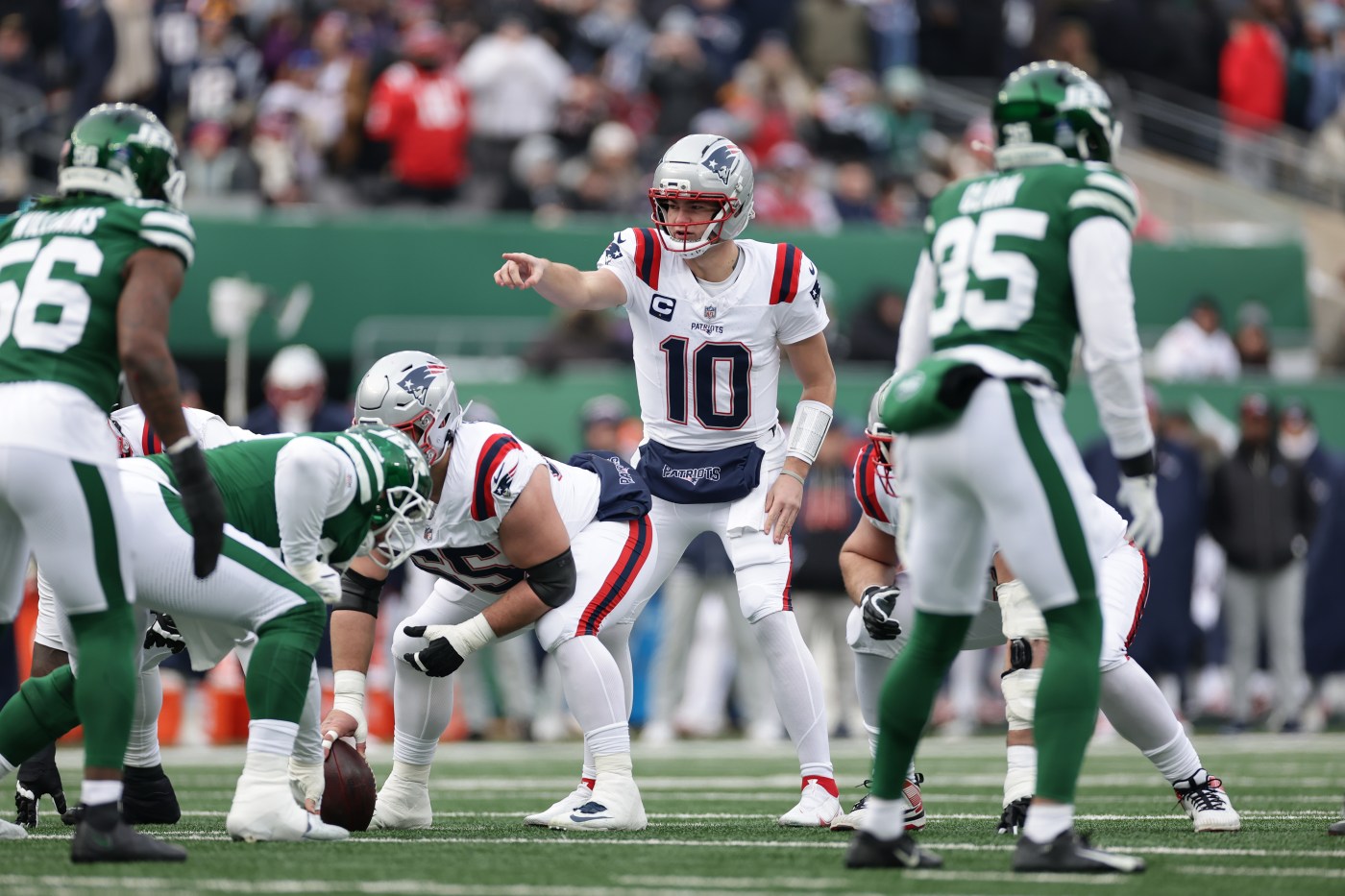
Patriots film review: Inside Drake Maye’s near perfect game that demolished the Jets

Over his 23-year career, Tom Brady had one game with 20 or more passes and fewer than three incompletions.
Drake Maye now has two.
That’s how close Maye was to perfection against the Jets, the 28th start of his booming, beautiful career.
By the Brady standard, the eye test and QBR — an evolved version of passer rating that, since its inception in 2006, had never measured a game as good as this one — Sunday was one to remember. The only person capable of stopping Maye was Mike Vrabel, who pulled him after six straight touchdown drives.
Of course, we know who their opponent was. The Jets are the Jets, hapless as they are helpless. But as we continue to learn about Maye, the driver and engine behind the Patriots’ renaissance, it’s important to mark moments like these.
Games like Sunday’s always seem to foreshadow greatness that follows. Before Brady stormed the biggest stages in the sport, he took smaller steps; authoring regular-season comebacks and new chapters in the league’s record books. So if we ask in January how Maye possibly did this or became a playoff hero at such a young age, the answer will be: well, he showed us he was capable all along.
Here’s what else the film revealed about the Patriots’ latest win, with all personnel, play-calling and team stats tallied before they pulled Maye with a 42-3 and 5:31 left in the third quarter:
Drake Maye
19-of-21 for 256 yards, 5 TDs, 22 rushing yards
Accurate throw percentage: 95.2%
Under pressure: 7-of-8 for 134 yards, TD
Against the blitz: 6-of-6 for 90 yards, 3 TDs
Behind the line: 1-of-1 for 10 yards
0-9 yards downfield: 11-of-11 for 121 yards, 2 TDs
10-19 yards downfield: 6-of-7 for 94 yards, 3 TDs
20+ yards downfield: 1-of-1 for 31 yards
Notes: Maye’s tape wasn’t entirely spotless, so let’s clean up what he missed.
His 13-yard completion to Hunter Henry was thrown slightly behind the tight end. Maye missed an open Austin Hooper up the seam on his end-zone incompletion for Kyle Williams that drew a pass interference penalty. He didn’t pull the trigger on an opening throwing lane to Stefon Diggs over the deep middle before scrambling for nine yards, then forced a pass to Diggs on the play where he absorbed a roughing the passer penalty and lobbed an inaccurate, low-odds pass down the middle for DeMario Douglas.
Other than that, though, he was perfect. Which, when understanding that missed reads and off-target throws, are a part of life as a quarterback, Sunday was as good as it looked.
Maye was not fooled by the Jets’ handful of disguises, including a well-dressed snap of Cover 2 that presented as man-to-man coverage late in the second quarter when Maye zipped a sideline throw to Williams, who dropped the ball. He spread the ball around, picked his best matchups and generally threw with precision. He maneuvered well inside the pocket, dealing with more pressure than was apparent on first viewing.
Maye was, well, Maye. Enough said.
Critical areas
Turnovers: Patriots 0, Jets 1
Explosive play rate: Patriots 18.5%, Jets 9.4%
Success rate: Patriots 60%, Jets 32.5%
Red-zone efficiency: Patriots 5-5, Jets 0-2
Defensive pressure rate: Patriots 34.2%, Jets 32.1%
Offense
Game plan
New England Patriots running back Rhamondre Stevenson (38) stiff-arms New York Jets cornerback Brandon Stephens during the first half of an NFL game Sunday in East Rutherford, N.J. (AP Photo/Frank Franklin)
Personnel breakdown: 38% of snaps in 11 personnel, 13% of snaps in 12 personnel, 8% of snaps in 13 personnel, 13% of snaps in 21F personnel, 11% of snaps in 21H personnel, 11% of snaps in 22 personnel, 6% of snaps in jumbo personnel.***
Personnel production: 83% success rate in 11 personnel, 83% success rate in 12 personnel, 75% success rate in 13 personnel, 16% success rate in 21 personnel, 60% success rate in 21H personnel, 40% success rate in 22 personnel, 33% success rate in 23 personnel.
First-down down play-calls: 60% run (44% success rate), 40% pass (77% success rate)
Play-action rate: 25%
Facing the league’s worst pass defense by DVOA, the Patriots did the obvious thing: pack it in by using an extra offensive lineman on more snaps than they had in any game to date.
Josh McDaniels, in fact, used six offensive linemen for most of the Patriots’ opening drive, when he deployed seven different personnel groupings on as many plays. McDaniels seemed intent on rotating personnel so he could keep what’s left of his roster healthy. The greatest challenge, oddly enough, was replacing veteran receiver Mack Hollins, who had taken the most offensive snaps among wideouts entering Week 17.
Hollins’ role is unique in that he sometimes serves as a traditional perimeter blocker, an insert blocker and de facto tight end in the run game. On Sunday, replacing Hollins meant utilizing less 11 personnel, more two-back plays and an extra offensive lineman on 16 snaps with Maye on the field. McDaniels used players from every non-quarterback position to fill Hollins’ duties in the run game.
Overall, he stuck to a fairly basic set of plays he disguised with the constant shuffling of personnel and formations. That plan included exploiting the Jets’ man-to-man coverage with pick-route combinations and mismatches manufactured by formation (see: Efton Chism’s 30-yard catch and Rhamondre Stevenson’s 22-yard touchdown with an edge defender in coverage). McDaniels also set up Stevenson’s rushing touchdown that capped the Pats’ second drive by using the same personnel, formation and pre-snap motion he had on the Patriots’ opening touchdown, a 1-yard, play-action throw to Austin Hooper.
Player stats
Broken tackles: RB Rhamondre Stevenson 2, RB TreVeyon Henderson 2, WR Stefon Diggs
Pressure allowed: LG Ben Brown 3 (3 hurries), LT Vederian Lowe 2 (QB hit, hurry), Team 3 (QB hit, 2 hurries), QB Drake Maye (hurry)
Run stuffs allowed: Team 5, FB Jack Westover
Drops: WR Kyle Williams
Notes
Just a masterful performance built on a clever mix of personnel and play-calling with brilliant quarterbacking. The Pats lived off explosive plays, starting with Rhamondre Stevenson’s 24-yarder on the opening drive, three long runs from TreVeyon Henderson and a few long Maye completions.
Those plays allowed them to overcome six run stuffs through two and a half quarters, which reflected a mostly underwhelming run-blocking effort from an offense that used so much heavy personnel.
The Pats posted a 41% rushing success rate overall and 42% when running behind an extra offensive linemen. Short-yardage running remains a problem, too; an issue they solved Sunday with a shield screen pass to Stefon Diggs for a 3-yard touchdown.
Stevenson continued to round into form coming off a turf toe injury. His vision furnished most of his best runs, while Henderson ran decisively, but occasionally into tacklers.
Hunter Henry was a major bright spot as a run-blocker, holding off Jets edge defenders long enough to allow for explosive gains. That is how the Patriots must make their money on the ground: creating enough runs of 10, 12, 15 and 20 yards to offset their overall inefficiency.
On the flip side, this marked one of the Patriots’ best, most consistent games in pass protection. Center Garrett Bradbury, right guard Mike Onwenu and right tackle Morgan Moses posted clean sheets, though Bradbury and Moses were beat on a few plays that did not result in pressure.
Diggs and Efton Chism were the Patriots’ chief answers versus man-to-man coverage. Both finished with two catches against man, including Chism’s touchdown.
Chism is a hand-in-glove fit for the slot receiver role in this offense. If he can continue to make tight-window catches as he did on his 10-yard touchdown, he is heading for a bigger role in the future.
Diggs didn’t draw any hard double-teams until it was too late for the Jets. His chemistry with Maye set up an initial 12-yard gain, off a staple Patriots pass concept then the spectacular 31-yarder along the right sideline during a scramble-drill play. Limiting Diggs’ playing time for most of the season has paid off in December.
The Patriots should have a new fullback in 2026. Jack Westover plays with great effort, but out of position. His lack of force showed up at the goal line, where the Patriots got stuffed, plus another run stuff early in the game.
New England Patriots running back Treveyon Henderson runs against the New York Jets during the first half of an NFL game Sunday in East Rutherford, N.J. (AP Photo/Adam Hunger)
Defense
Game plan
Personnel breakdown: 62% three-corner nickel package, 27% base defense, 11% dime.****
Coverage breakdown: 70% zone, 30% man
Blitz rate: 43%
Blitz efficacy: 20% offensive success rate and 2.9 yards per play allowed
Another straightforward plan from defensive play-caller Zak Kuhr.
The Pats blitzed at one of their highest rates of the season, trusting the Jets’ receivers wouldn’t get the best of Christian Gonzalez, Carlton Davis and Co. They were right.
The Patriots also played out of a single-high structure on most snaps, including Jaylinn Hawkins’ interception where Hawkins roamed over as the deep safety in Cover 1 for an easy pick. There was no need to spin the dial against third-stringer Brady Cook, who led the league in turnover-worthy play percentage entering the game. The Pats kept it simple, and let Cook unravel.
Best of all, with the help of an early lead, they stopped the run. The Patriots didn’t even need to bulk up often with base personnel, fielding a combined seven defensive linemen and linebackers. The Pats run-blitzed with their preferred nickel groupings, and thrived thanks to key contributions from a slew of backups across the front seven.
Player stats
Interception: S Jaylinn Hawkins
Pressure: DL Christian Barmore 2 (QB hit, hurry), OLB Anfernee Jennings 2 (QB hit, hurry), OLB Elijah Ponder 2 (QB hit, hurry), DT Leonard Taylor III 2 (2 hurries), S Dell Pettus (sack), OLB K’Lavon Chaisson (hurry), LB Marte Mapu (hurry), DL Cory Durden (hurry)
Run stuffs: Chaisson, Team 4
Pass deflections: Chaisson, Mapu
Missed tackles: CB Christian Gonzalez, S Craig Woodson, LB Christian Elliss, DL Eric Gregory, Hawkins, Pettus,
Notes
If the Patriots were healthy, this would have played out like one team rolling out its regular-season starters versus another’s preseason roster. But even as injured as they were, this was a straight-up butt-whooping.
Hats off to the bottom of the roster. Defensive tackle Leonard Taylor III and new linebacker Chad Muma fortified a leaky middle against a Jets offense that knew it had to run the ball and couldn’t.
Muma was involved in a late run stuff, as was Jahlani Tavai who often found himself in the backfield as part of a swarming run defense.
On the edge, Anfernee Jennings turned in a vintage performance as an edge-setter. He was also disruptive as a pass rusher, tallying two pressures.
Opposite Jennings, fellow outside linebacker K’Lavon Chaisson got victimized on one of the Jets’ longest runs of the game, but otherwise was a positive force throughout with a pass deflection, run stuff and a hurry.
Rookie edge defenders Elijah Ponder and Bradyn Swinson served as rotational pass rushers. Both players took turns rushing from the inside. Neither flashed, though Ponder has had his moments this season.
In the back end, the Jets strangely tried Christian Gonzalez deep on their first drive and failed. Overall, the Pats dominated in man-to-man coverage, allowing Cook a 33% completion percentage on those plays.
That battleground was one of New York’s only paths to an upset, specifically through talented receiver Adonai Mitchell. Thanks to Gonzalez and Carlton Davis, he finished with three harmless catches for 22 yards.
Gonzalez and Davis mostly enjoyed strong Decembers, the best reason for hope for the Patriots’ banged-up pass defense. The pass rush will get help soon when Milton Williams and Harold Landry return, but it’s unclear whether either of them will be in peak form for the playoffs.
Christian Barmore had two pressures, though his quarterback hit was arguably late enough to warrant a flag in today’s league. His run defense in Milton Williams’ absence has at times been underwhelming.
Backup cornerback Charles Woods had a near interception, and fellow reserve Miles Battle had a few plays he would want back. No surprise, the team released him Monday, presumably to make room for Williams’ activation off injured reserve.
*Explosive plays are defined as runs of 12-plus yards and passes of 20-plus yards.
**Success rate is an efficiency metric measuring how often an offense stays on schedule. A play is successful when it produces positive EPA (Expected Points Added).
***11 personnel = one running back, one tight end; 12 personnel = one running back, two tight ends; 13 personnel = one back, three tight ends; 21 personnel = two backs, one tight end; 21H = two halfbacks, one tight end; jumbo personnel = two backs, two tight ends, six offensive linemen.
****Base defense = four defensive backs; nickel = five; dime = six, dollar = seven.


More Stories
Middle East war triggering global energy ‘shock’ – IMF
Disruptions to oil and gas supplies will leave lasting “scars” on the world economy, managing director Kristalina Georgieva has said...
What is fueling unrest across the EU?
The bloc is facing an energy crisis due to the Strait of Hormuz disruption, with soaring diesel prices triggering protests...
OECD urges reeves to overhaul ‘inefficient’ UK tax system
Rachel Reeves has been told by one of the world’s most influential economic bodies that Britain’s tax system is holding...
Easter lifts footfall but retailers brace for April cost squeeze
Britain’s high streets enjoyed a welcome lift last month as an early Easter drew shoppers back through the doors, but...
Google takes on Opentable with AI that books your dinner in seconds
Google has fired the opening shot in a battle for Britain’s restaurant booking market, rolling out an artificial intelligence tool...
Retail backers of SEIT face wiping out half their money as green trust raises the white flag
Thousands of small investors who piled into one of London’s best-known green investment vehicles are staring down the barrel of...