
Could Modular Homes be Part of the Solution to NYC’s Housing Crisis?

Developers and New York City are building homes in factories and propping them up on vacant lots in the outer boroughs. Proponents say it can significantly cut down on construction time—and create more affordable housing in the process.
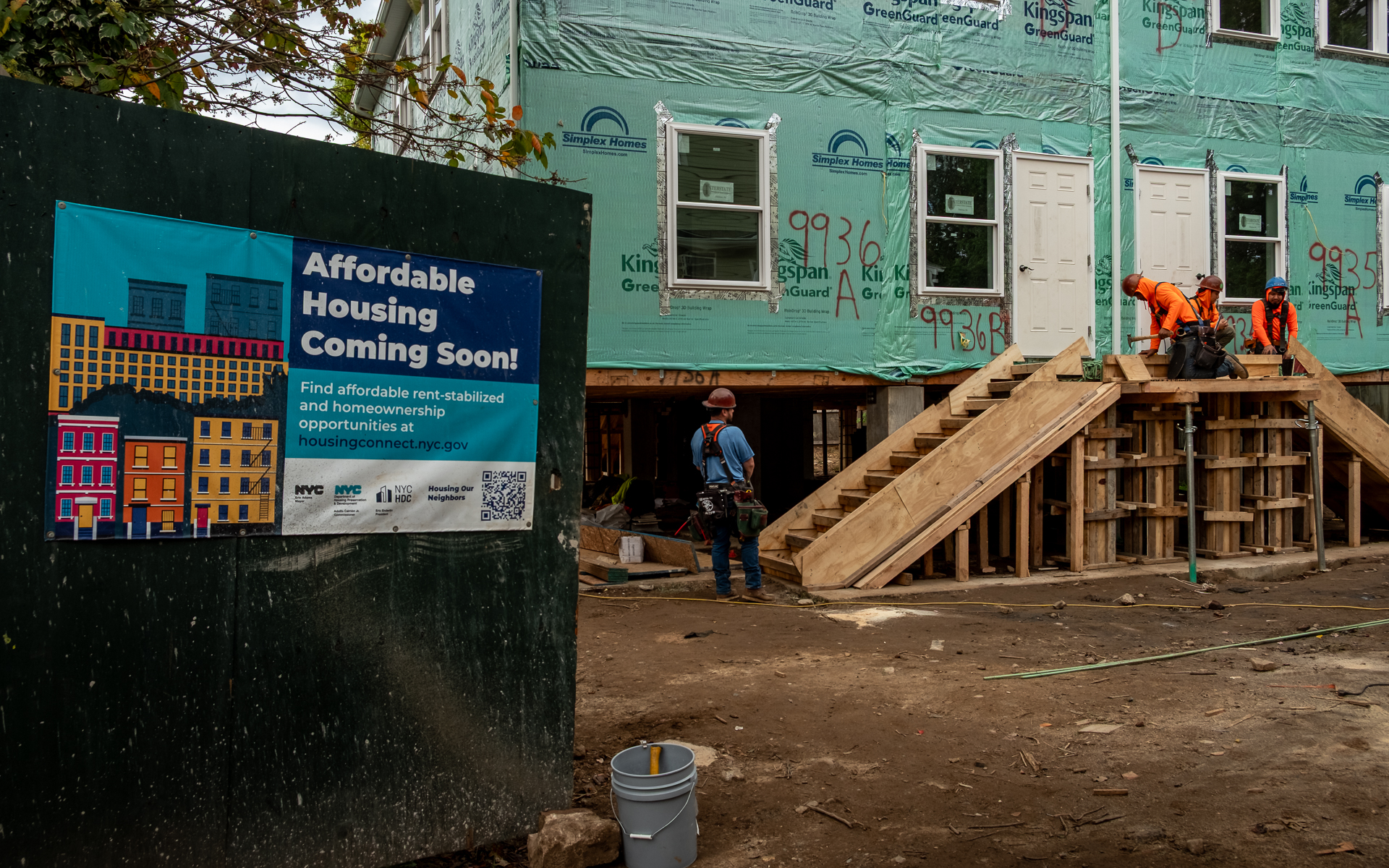
A modular home under construction on Greeley Avenue in Staten Island. (Adi Talwar/City Limits)
Building housing in New York is notoriously expensive. Part of the reason: it takes a long time to build.
The city is testing an innovative building method in the outer boroughs that significantly cuts down on construction time—and could create more affordable housing in the process.
On the south shore of Staten Island, developers are shipping pieces of homes from Scranton, Pennsylvania, and plopping them on vacant lots. The pieces are assembled in a factory, and then joined together on a foundation.
It can shorten construction timelines between 30 and 50 percent, according to Everett Perry of Urban Ecospaces, the developer behind a project to build 23 modular homes on Staten Island.
“You show up at four or five o’clock in the morning, there’s nothing here except the foundation. By 12 o’clock, you’re looking at a sort of a house. By two o’clock, you’re looking at a house. By four o’clock the roof is on,” said Perry.
After the pieces are assembled on site, it takes another two months to complete the home with finishes and hardwood floors, Perry said.
(Adi Talwar/City Limits)
(Adi Talwar/City Limits)
The one and two-family homes will hit the market in mid-2026 and be homeownership properties, available to New Yorkers with moderate and middle incomes through the Department of Housing Preservation and Development’s Open Doors program.
New Yorkers can apply for the homes, which will have list prices between $300,000 and $500,000, through the city’s affordable housing lottery system, Housing Connect. The typical home value in New York City is nearly $800,000, according to Zillow.
The Open Doors program, which provides construction financing to qualifying affordable homeownership projects, allowed the developers to list the homes at affordable prices. Under the program, the more affordable a property is, the more money HPD gives to offset costs.
“At the end of the day, it pencils about the same [as non-modular construction], quite frankly, but the time value is just—it’s hard to quantify,” said Perry.
Details of a roof construction with prefabricated parts at a modular home construction site on the corner of Father Capodanno Boulevard and Linda Avenue on Staten Island. (Adi Talwar/City Limits)
Less construction time on site means lower labor costs and fewer overruns, he added.
Factory work elsewhere may also save builders money on prevailing wage requirements in public projects—New York has some of the highest in the country—because builders only pay those rates for work done on site, said Alex Carmack, director of government affairs for the Modular Building Institute.
Another perk: the more work done offsite, the less disruption to the neighborhood during construction.
A modular home under construction at 527 Greeley Ave., Staten Island. (Adi Talwar/City Limits)
Everett Perry and his partner Tamia Perry began building modular after Hurricane Sandy, when storm surges destroyed many homes in coastal areas like Staten Island’s South Shore.
The modular houses are built on raised foundations, making them resistant to future storms. One site City Limits visited this fall was once a home that was badly damaged by Sandy, and sat vacant. The lot eventually came into the city’s hands.
Usually, crews build a foundation, put up a frame, then add electrical and plumbing before closing up the walls and finishing construction. When modular homes are placed on their foundations they already have electrical, plumbing, cabinets, and some finishes in place.
Prefabricated door units at a modular home construction site. (Adi Talwar/City Limits)
Insulation and walls are up, but the pitched roof is folded in on itself. After raising the roof, 70 to 80 percent of the work is already done, according to Urban Ecospaces.
“This is still a traditional stick built house, built in a controlled environment, and they build inside out instead of outside in,” said Stephen Kenner, the company’s director of construction.
Despite all the work done off-site, “you cannot tell it is a modular home,” said Perry.
Right now, the developers are targeting single and two-family projects on Staten Island and in the Rockaways, but are hopeful that the method could catch on in other parts of the city.
“If you can fit a truck down the street like and get a delivery, you can build a modular home,” said Perry.
A modular home under construction at 527 Greeley Ave. on Staten Island. (Adi Talwar/City Limits)
The method is taking off around the United States, where it grew to be a $20 billion industry in 2024, according to the Modular Building Institute. A third of that business was for multifamily apartments, not just single and two-family homes.
HPD previously tested modular building in 2022, and this year Gov. Kathy Hochul launched a $50 million program to build more manufactured homes in the state, following a pilot in Syracuse, Schenectady, and Newcomb.
Carmack said the industry took it as a positive sign for the future of modular housing in the state. He also pointed to City of Yes zoning reforms and the housing ballot measures that passed earlier this year as potentially opening up new opportunities in the city.
“New York City has taken a position of ‘we know there are issues that we have that make it tough for these modular builders or any builder to do business in our city, we want to start addressing those,’” said Carmack. “That’s extraordinarily encouraging to us as an industry.”
To reach the reporter behind this story, contact Patrick@citylimits.org. To reach the editor, contact Jeanmarie@citylimits.org
Want to republish this story? Find City Limits’ reprint policy here.
The post Could Modular Homes be Part of the Solution to NYC’s Housing Crisis? appeared first on City Limits.


More Stories
F1 set to cancel Bahrain and Saudi Arabian Grands Prix amid Middle East conflict
Formula 1 is expected to cancel the Bahrain and Saudi Arabian Grands Prix as the escalating conflict in the Middle...
UK and Ireland strengthen economic partnership as £937m investment set to create 850 jobs
The UK and Ireland have strengthened their economic partnership as leaders gathered in Cork for the second UK-Ireland Summit, where...
UK economy stalls in January as hospitality slowdown drags growth to zero
The UK economy stalled at the start of the year as households cut back on discretionary spending, with restaurants and...
US-Israeli war on Iran wipes billions off Gulf energy revenues – FT
The Middle East escalation has cut off a number of American allies from the vital Strait of Hormuz Oil producers...
Maersk halts operations at Oman port after drone strike widens Iran conflict disruption
Global shipping giant Maersk has suspended operations at the Port of Salalah in Oman after a drone attack struck oil...
Savills agrees $1bn deal to buy Eastdil Secured in major US expansion push
Savills has agreed a deal worth close to $1 billion to acquire US property investment bank Eastdil Secured, marking a...